

Since the spring, state officials have made clear that they expect Vermont’s K-12 students to be physically back in the classroom five days a week this fall. The days of hybrid and online learning, they said, were over.
But as Vermont finds itself stuck in yet another Covid-19 wave as the school year approaches, more families are growing anxious about sending their kids back to crowded classrooms. School leaders, meanwhile, say they cannot pull off a full return to in-person education and offer quality all-virtual instruction.
In Burlington, Kele Bourdeau said her 12-year-old autistic son thrived last year during remote learning. He had long struggled with school, but attending virtually allowed him to truly participate and engage in ways he had never been able to before. He briefly tried physically attending school over the summer, but school officials twice lost track of him when he ran away and hid after being bullied.
Still, when Bourdeau asked school officials if she could re-enroll her son in a virtual option this year, she was flatly told no. The pandemic made possible a once-unimaginable array of accommodations for people with disabilities, but Bourdeau now worries these were only temporary.
“It wasn’t all wonderful. But there were things that came out of it that were good, and I hate seeing those good things being packed away because the majority doesn’t need them anymore,” Bourdeau said.
In-person learning is “far superior” to remote learning for the “vast majority of students,” Burlington School District superintendent Tom Flanagan said in a written statement.
“We have prioritized our resources to support full in-person learning, like other schools in Vermont who have also moved back into in-person learning five days a week. Having adequate staff in our buildings to support this means that we cannot offer additional remote learning classrooms this year,” he wrote.
While the state has generally discouraged virtual learning this year, it has not prohibited it. Schools will not be required to offer online education, but they are allowed to offer it to students with qualifying medical needs or who might otherwise benefit. But many superintendents say they simply do not have the capacity to deliver full-time in person and virtual school systems.
“I can’t staff two options,” said Zach McLaughlin, the superintendent in the Springfield school district.
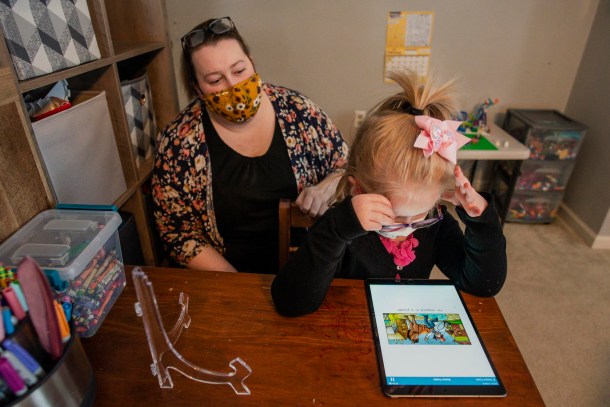
Depending on the month, anywhere between 11% and 18% of Vermont’s K-12 students attended school online full time last year. Many did so via virtual academies built and staffed in-house by their school districts, but thousands also used the Vermont Virtual Learning Cooperative.
The Vermont Virtual Learning Cooperative works, as its name suggests, on a cooperative model. School districts contribute their own teachers to its labor pool, and, in exchange, receive free slots for their students to attend. Just over 2,000 kids attended school full time through the Vermont Virtual Learning Cooperative last year, according to Jeff Renard, the cooperative’s director.
With schools under pressure to reopen completely in person, they’ve had few educators to spare toward the effort, and Renard said Friday that the cooperative’s capacity for students attending fully online was currently about 300.
Renard acknowledges he’s concerned he will get inundated with requests from school leaders and families as the school year inches ever closer and cases remain high. He’s already noticed an uptick. But he also expressed confidence the Vermont Virtual Learning Cooperative will be able to scale up if that happens.
“This time last year, we probably had that same capacity. It was in the last two to three weeks before school started that we brought on 112 full-time teachers and enrolled all of those students,” he said.
In the North Country Supervisory Union, for example, Superintendent John Castle was initially planning to only offer remote learning to a small number of children with a certified medical need. But the Delta variant appears to be making many families re-evaluate their needs.
“We are now starting to get more inquiries about virtual options,” Castle said. “We have started to explore that a little bit more — which we understand may be somewhat problematic because of limited capacity for folks like [the Learning Cooperative].”
Experts, meanwhile, are split on whether remote learning should be a priority.
“Unequivocally yes,” schools should offer virtual instruction this year, said Annie Hoen, an associate professor of epidemiology at Dartmouth College’s Geisel School of Medicine. “We learned that remote learning is a reasonable accommodation and now it is being taken away, despite a significant minority of families who need or want it to remain as an option.”
Remote learning would de-densify classrooms and make all kids safer, said Liz Winterbauer, a consulting epidemiologist and part-time public health instructor at St. Michael’s College and the University of Vermont. It would give families too uncertain about the Delta variant, who cannot homeschool, access to equitable services.
“We should give all families (not just those with high-risk kids) a remote learning option,” Winterbauer wrote in an email to VTDigger.
But others argue in-person learning must be the topline goal. They say it’s unrealistic to expect schools to successfully pull off in-person learning and a robust virtual option.
“I do think that it would be in many ways a disservice for districts to be spending time and energy on anything other than figuring out how to make the in-person environment safe for everybody. That should be the overarching priority,” said Benjamin Lee, a pediatric infectious disease specialist at the University of Vermont Children’s Hospital.
“I believe that in Vermont we can keep students, even high-risk students, safe in schools,” said Rebecca Bell, a pediatric critical care physician, also at UVM’s Children’s Hospital. “I support prioritizing in-person learning and believe that schools should focus on creating a safe in-person environment.”
Karen Price, the executive director of the Vermont Family Network, which supports people with disabilities and their caregivers, said most families with immunocompromised children have been able to negotiate remote options from their districts. But families who do not have a strict medical need to keep their kids at home — who simply found that virtual education worked better for their kids than in-person school — are having a tougher time making their case.
And many more families want in-person school for their kids, she said, but worry that too little has been done to keep it safe. The state has put out a two-page guidance document on pandemic mitigation in schools, but the memo is nonbinding, and most experts believe it falls short anyway.
“My sense is that families are pretty overwhelmed,” Price said.
Like everyone else, parents have been taken aback by the sudden surge of Delta cases in Vermont. But they are also meeting the fall with a mix of deja vu and anger.
“It seems as if we should have had maybe more control over it. But then, you know, we didn’t. So to be in a precarious position — again — at the beginning of the school year, definitely does not feel good,” Price said.
Correction: An earlier version of this story incorrectly attributed quotations to a Burlington School District spokesperson, rather than superintendent Tom Flanagan.
