


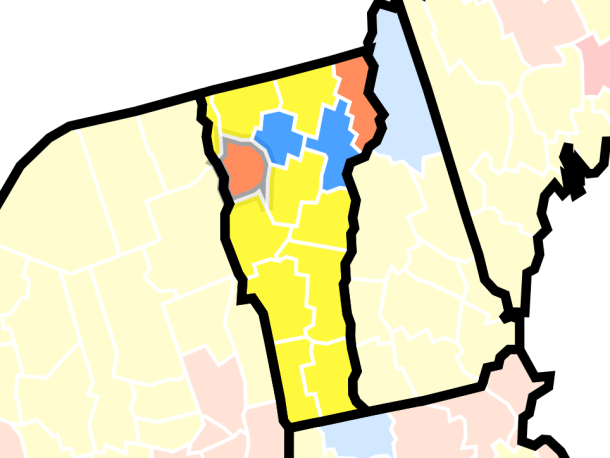
Chittenden and Essex counties are now reporting “substantial” Covid spread, according to the U.S. Centers for Disease Control and Prevention, placing both regions under new recommendations for universal indoor masking.
The CDC announced last Tuesday that both vaccinated and unvaccinated individuals should wear masks in indoor public settings in any counties reporting “substantial” or “high” levels of transmission. “Substantial” refers to at least 50 new cases per 100,000 people in the past seven days, and “high” refers to 100 or more.
But for now, state officials say no new restrictions are being contemplated. Hospitalizations and deaths remain in the low single digits, according to Jason Maulucci, a spokesperson for Gov. Phil Scott. And case growth is still driven by unvaccinated adults, he said.
“This confirms that vaccines work,” Maulucci wrote in an email. “The data is not telling us that new broad restrictions are necessary, or justifiable, at this time.”
According to a CDC tracker, Chittenden County has reported 99 cases in the past seven days: a rate of 60.45 per 100,000 people, a 102% increase from the previous period. Roughly one-quarter of Vermont’s population lives in the county.
Burlington City Council President Max Tracy said on Monday afternoon that the state’s most populous city is evaluating its next steps and is expected to reach a decision by Tuesday. Representatives from Mayor Miro Weinberger’s office were not immediately available for comment.
Essex, Vermont’s least populous county, has reported too few cases to display on the CDC dashboard. According to data from the Vermont Department of Health, three cases have been reported in Essex County in the past week.
The two counties diverge in vaccination rates. Chittenden has one of the highest vaccination rates in the state, with 85.5% of eligible residents having received at least one dose. Essex has the state’s lowest vaccination rate: 58.6%.
The CDC’s recommendations last week arrived as the nation began to grasp the severity of a new wave of Covid cases driven by the more contagious Delta variant. Health officials have stressed that existing Covid-19 vaccines remain effective against the rising strain, but unvaccinated people remain highly vulnerable.
Though infection rates are rising, Vermont’s highly vaccinated population is still protected from a surge in hospitalizations and deaths, according to Dr. Tim Lahey, an infectious disease expert at the University of Vermont Medical Center.
“I think we’re gonna see this [situation] where one county is going to flare up as some cases bubble up,” he said. “The speed at which [counties] go back to normal is going to depend on how well vaccinated they are.”
These on-again off-again outbreaks will likely crop up elsewhere in the state, too, Lahey said, and residents will likely have to wear masks if their community becomes a hotspot. Residents of neighboring counties can proceed as they normally would, provided they are not traveling to affected counties, he said.
Other experts, meanwhile, called on the state to center the most vulnerable in its response and reimpose certain mitigation measures.
“Yes, vaccines work. And we still have a large segment of our population that can’t get vaccinated. All of our children under 12 are completely vulnerable,” said Liz Winterbauer, a consulting epidemiologist and health services researcher.
“I want to see indoor masking back in all settings,” said Winterbauer, who also teaches health courses at UVM and St. Michael’s College. Schools are of particular concern, she said, and should also once again offer virtual options. School employee vaccinations should be mandatory, she added, and the state should plan for some sort of student testing regimen.
Anne Sosin, a policy fellow at the Nelson A. Rockefeller Center for Public Policy, said she’d like to see mask mandates reintroduced indoors in places like schools and grocery stores, to keep them safe for children and those with compromised immune systems.
“I would like to see masking in essential settings not as a tool for controlling transmission but rather a way of making them accessible and safe,” she said. “Cancer patients should be able to go to the grocery store.”
Sosin, who has studied the Covid-19 response in Vermont, doesn’t think that restrictions on voluntary activities — such as restaurants, bars, and gatherings — are warranted right now. But she does think the state will have to redouble its efforts to close any vaccination gaps in high-risk settings, like prisons and long-term care facilities.
In Vermont, officials have projected that cases will continue to rise in the weeks ahead. Health department data shows the state’s seven-day average has been increasing since July 7.
The state reported 70 new cases on Saturday, 36 new cases on Sunday and 42 new cases on Monday. Saturday’s total was the highest one-day count since May 12. As of Monday, Vermont’s seven-day average case positivity rate was 2.1%.
Hospitalizations and deaths have remained low. As of Monday, four people were hospitalized, with one person in intensive care. The state has reported two deaths from Covid-19 in July.
Health department data also suggests that the dominance of the Delta variant in Vermont is recent. Data published last Wednesday, based on samples collected from June 30 to July 20, showed 48 instances of the Delta variant spread across eight of Vermont’s 14 counties. The previous week, there were seven Delta samples in only two counties.


