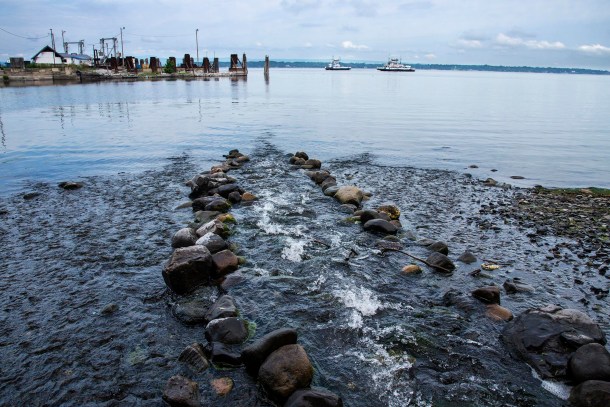
Lake Champlain Transportation Co., which operates ferries between Vermont and New York State, is facing opposition from Grand Isle residents over plans to build a maintenance, storage and office building near the Gordons Landing ferry terminal.
The company wants to move its maintenance operations from King Street in Burlington to a new, 30,000-square-foot facility on Lake Champlain’s largest island — saying that with staff and parts next door, repair work will be easier.
But in the quiet, tree-lined neighborhood where the project is planned, locals have questioned whether the facility is an appropriate fit.
Laura Heaberlin, who lives next to the site, has raised concerns the proposal is inconsistent with local zoning laws, could cause noise pollution and could contaminate the island’s drinking-water supply.
Another Grand Isle resident, Josie Leavitt, has also questioned the proposal.
“It’s a very well-run ferry, it’s a vital ferry and I’m really glad that it’s there,” said Leavitt, who has been to every public hearing for the project. “I’m just not sure this project, of this scale, needs to be right where they want to put it.”
Each year, the Grand Isle ferry makes 22,000 landings and departures, transporting more than 1 million passengers between Vermont and Plattsburgh, New York, according to the U.S. Army Corps of Engineers.
Lake Champlain Transportation runs two other ferry routes: one between Burlington and Port Kent, New York, and another between Charlotte and Essex, New York.
The Burlington ferry has been closed for the 2021 season because of the pandemic, officials have said. They plan to reevaluate service next spring.
Lake Champlain Transportation did not respond to VTDigger requests for comment for this story, including a reporter’s in-person request at company headquarters.
A question of use
The Grand Isle Development Review Board has held three meetings on the company’s proposal so far. At a hearing last month, Heaberlin — who is among the project’s most ardent critics — gave a 90-plus-slide presentation examining, in detail, many aspects of the project.
Lake Champlain Transportation applied to build a “storage and repair” facility, Heaberlin said, but she thinks the project should be considered an “industrial” facility, which would not be allowed on the site under the town’s zoning laws.
Buermann Engineering, owned by Jay Buermann, is the firm working on the project. In an exchange with a state regulator, Buermann stated the facility “will be where the company does automotive maintenance/repair of their vehicle fleet,” and would include “welding, electrical shop, mechanical shop, wood shop, sandblasting, and a painting booth” to maintain ferry components, docks and ticket booths.
Grand Isle zoning laws define industrial use as “manufacturing and/or warehousing, and major vehicle or equipment repair establishments” — including, for example, “body shops, electrical, mechanical and chassis repair shops, but not gas stations.”

In an interview with VTDigger, Heaberlin said the way ferry officials have described the project to state permit analysts “has a lot of word-for-word resonance with our bylaws’ definition of ‘industrial.’”
The site is zoned as a commercial recreation shoreline district, which allows such uses as storage and repair, marinas, boathouses and offices, among others.
Heaberlin said the bylaws consider different intensities of repair as different uses. The term “storage and repair” may be appropriate for a golf course, she said in the presentation, but not for the heavier use the ferry company has planned.
In response to Hearberlin’s presentation, Buermann Engineering said in a document posted to the town’s website that Lake Champlain Transportation “fervently disagrees” that its vehicle and equipment repair facilities cannot be built in a non-industrial area of Grand Isle.
Some residents have suggested the company should build its facility in the town’s industrial park instead, which is several miles inland from the ferry terminal.
The engineering firm stated Lake Champlain Transportation considers “industrial” use to mean “operations related to manufacturing,” or repeatedly making goods for sale.
“They are maintaining and repairing materials and equipment for their own use,” the engineering firm stated in its response, “using their own internal shops solely in support of their ferry operations: Storage and Repair.”
Jay Buermann declined to comment for this story when reached on the phone by VTDigger.
Heaberlin also has argued that Lake Champlain Transportation’s application was incomplete, noting the project description was just seven words long: “construct corporate offices, storage and maintenance facilities.”
This stands in contrast, she said, to much longer project descriptions the ferry company submitted to the city of Burlington for a 6,500-square-foot restaurant it wants to build on King Street in place of its maintenance facilities there.
In the response posted online, Buermann Engineering stated the ferry company tailors its applications to different communities and it provided additional information and documents to the Development Review Board in testimony.
‘Stone wall’
Heaberlin said she and other residents also worry that if hazardous waste is spilled at the facility, it could contaminate Grand Isle’s drinking water.
The site is in a source protection area for the Grand Isle Consolidated Water District, she said, meaning groundwater likely passes through the land before traveling into the lake, where an offshore intake for the public water source is located.
The state Department of Environmental Conservation has identified auto body and repair facilities, as well as industrial facilities, as potential sources of drinking water contamination, according to material in Heaberlin’s presentation.
Lake Champlain Transportation received a state no-exposure certification for the project this month, so if it gets built, “all industrial materials and activities” must be “protected by a storm-resistant shelter to prevent exposure to rain, snow, snowmelt, and/or runoff,” according to the certification form.
The company also has a stormwater treatment plan for the site, Hearberlin said. Buermann Engineering stated in its response that drinking water is not not an issue listed for Development Review Board consideration in the town’s bylaws.
Leavitt said she wants more clarity on several issues raised in Heaberlin’s presentation, such as which hazardous materials will be stored at the site and whether noise pollution could be an issue for neighbors.
She has been “frustrated by the lack of information” that Lake Champlain Transportation has given her and other residents at the public hearings, she said. As a cancer survivor, she cares deeply about protecting the town’s water supply.
“I feel like we’re being met with somewhat of a stone wall,” Leavitt said.
The town’s Development Review Board will hold a deliberative session about the project Aug. 4, which is not open to the public. The public hearing will continue on Aug. 18.
Asked where the body stood in its deliberations, board clerk Marie Prescott said members had no comment. She did not know when a final decision could be made.