

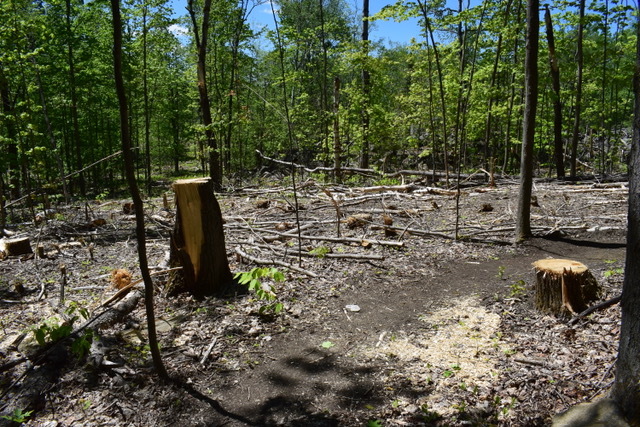
A winter logging job that created canopy openings in sections of the roughly 380-acre Barre Town Forest led many residents to voice concerns. Some are calling on the town to end logging in the forest before another timber harvest occurs next winter.
Limlaw Pulpwood, the logger, began work in the 72-acre harvesting area in December, and wrapped up work in April, according to Barre Town Manager Carl Rogers. The logging brought in more than $27,000, and the revenue goes to the town’s general fund, Rogers told VTDigger.
The logging shocked many of the people who frequent the network of trails that run through the forest.
“I was walking on a trail that I go on all the time called Capitol Loop,” said Barre Town resident Diane Solomon. “And I just all of a sudden was almost lost.”
Some residents criticized the logging, saying the town had put the beauty, history and recreational value of the forest below other considerations when they decided to log. The description for a petition to end logging in the forest created by Barre Town resident Tim Belcher said the forest is “worth more than the few dollars that were earned from the damage that was done last winter.” The petition, started a month ago, had garnered more than 360 signatures as of Friday afternoon.
Consulting forester Jeff Smith said the logging was conducted for economic reasons — to promote the growth of healthier trees that “would be more valuable in the future” — and for forest health reasons, such as concerns about the emerald ash borer, an invasive pest.
Logging was also called for in the forest management plan created by then-Washington County Forester Russ Barrett when Barre Town acquired the forest in 2013, according to Smith.
The Vermont Land Trust co-holds a conservation easement for the forest with the Vermont Housing and Conservation Board. A requirement of the easement is that municipalities write a forest management plan for harvesting timber, according to Caitlin Cusack, a Vermont Land Trust forester.
The plan
The forest management plan written by Barrett divides the forest into eight stands and recommends management for each, including specific cutting cycles.
“Planned activities” include a timber harvest in 2018 for stand seven, one of the stands logged this winter. That stand and stand six were slated to be logged and harvested this winter in an amendment to the plan written by Smith and signed by Cusack.
This winter’s harvest was the second logging contract for the Barre Town Forest since the town acquired the land in 2013. The first timber harvest took place in the winters of 2015-16 and 2016-17, according to a statement prepared by the town manager.

The amendment Smith wrote prescribed logging in stands six and seven for the 2020-21 winter. Rogers said logging in one of the stands was not completed during the timber harvest that occurred several years ago. The amendment cites “economies of scale by working in adjacent areas and the proximity of the emerald ash borer” as reasons for logging in stand six, which was not originally slated for a harvest within the 10-year scope of the management plan.
Lori Bernier, whose husband was a member of the forest Management Plan Committee in 2013, said the town did not solicit feedback about the amendment before approving it. Bernier said she has read through the 177-page community forest plan several times. She pointed to a line on page 58 that says grantors must secure feedback “before the final adoption of each Community Forest Plan, including updates, revisions and amendments.”
Rogers confirmed the town did not secure public input for the amendment.
“I question if the plan equates an amendment like [Smith] proposed last year to an update. The update to me would be the 10 year to 12 year update coming up,” he wrote in an email to VTDigger.
Concerns about the logging
Rogers said the town first began to hear concerns from residents in April, during a town selectboard meeting in which the chair read a statement with background information about the logging project.
But Bernier, whose property backs up to part of the town forest, said she and her husband raised concerns about the project in 2020, before cutting had begun. Some of the trees on her property were accidentally marked for harvest, Bernier said, which was corrected.
One of Bernier’s concerns was that more trees were logged than were originally marked for cutting when her husband walked around with Rogers and Smith in 2020. Smith said this is because the loggers had to maneuver large equipment in the forest that necessitated additional cutting.
“I’m out there well ahead of time marking trees, and I’m trying to visualize how they’re going to get the trees out with their equipment, but I don’t know the exact route that they’re going to have to take to get to every tree that I’ve marked,” he said.
Many residents raised concerns about the size of the openings created by the logging and the debris left behind after the job was completed.
Rogers said his understanding is that debris has since been removed from trails by volunteers at the Millstone Trails Association. That clean up was finished in April, according to Rogers, but then the loggers blocked two of the trails again while conducting cleanup of the log landing area. That debris has since been removed, Rogers said.
Though some referred to logged areas as clearcuts, current Washington County Forester Robert Nelson said the canopy openings created by the logging were too small to be designated as such according to the forestry definition.
Nearly all of the logging was “single tree selection harvest,” according to Nelson, which decreases the density of trees in the area by about 70%, he said. The remainder of the logging was “group selection harvest,” which produces openings of between one quarter and two acres, he said.
This second type of harvest, he said, was done to ensure a level of younger growth in the forest.
“Across the state of Vermont, the percentage of young forest is, I think, only at about 4%,” he said. “It’s quite low, and there’s a whole host of wildlife species, songbirds included, that depend on having that young forest type.”
Even so, town officials acknowledged the impact of the logging on the appearance of the forest.
“This spring when the snow melted, the forest looked its very worst,” said a statement read by the selectboard chair in an April meeting and which Rogers shared with VTDigger.

The town held a workshop while the logging was in progress and another June 19. The workshop last month allowed residents to walk through the forest with several panelists, including the current and former Washington County Foresters, Cusack, Rogers and a biologist from the Fish and Wildlife Department.
Belcher said the workshop did not change his views on the project.
“What I heard from them was that within the parameters of what they were trying to achieve that they made sane, sound decisions,” he said. “Where I’m coming from is that sometimes nature just should be left alone.”
Belcher said he wishes the town hadn’t logged the forest, and he hopes they won’t continue to in the future. But if they do, he hopes they will make decisions that are “less invasive, less destructive and more geared towards protecting the forest as a natural place.”
The town is planning to hold a public discussion about the logging on August 3. Rogers said the selectboard seems open to considering opinions and any new information.
“If somebody comes up with a suggestion that’s worthwhile or a concern that had not been previously considered, then when the town plan revision is worked on in the coming years, you could see the selectboard asking to have that taken into consideration,” he said.
The specific review date for the town forest management plan is unclear, but it will occur in the next few years, Rogers said.
As for whether the town would be able to stop future logging even though they are currently mid-contract, Rogers did not give a definitive answer.
“You can’t say that it’s not possible to do it, but it’s not like the selectboard can just say, ‘OK, we’re not going to do that logging,’ and that’s the end of it,” he said.
