

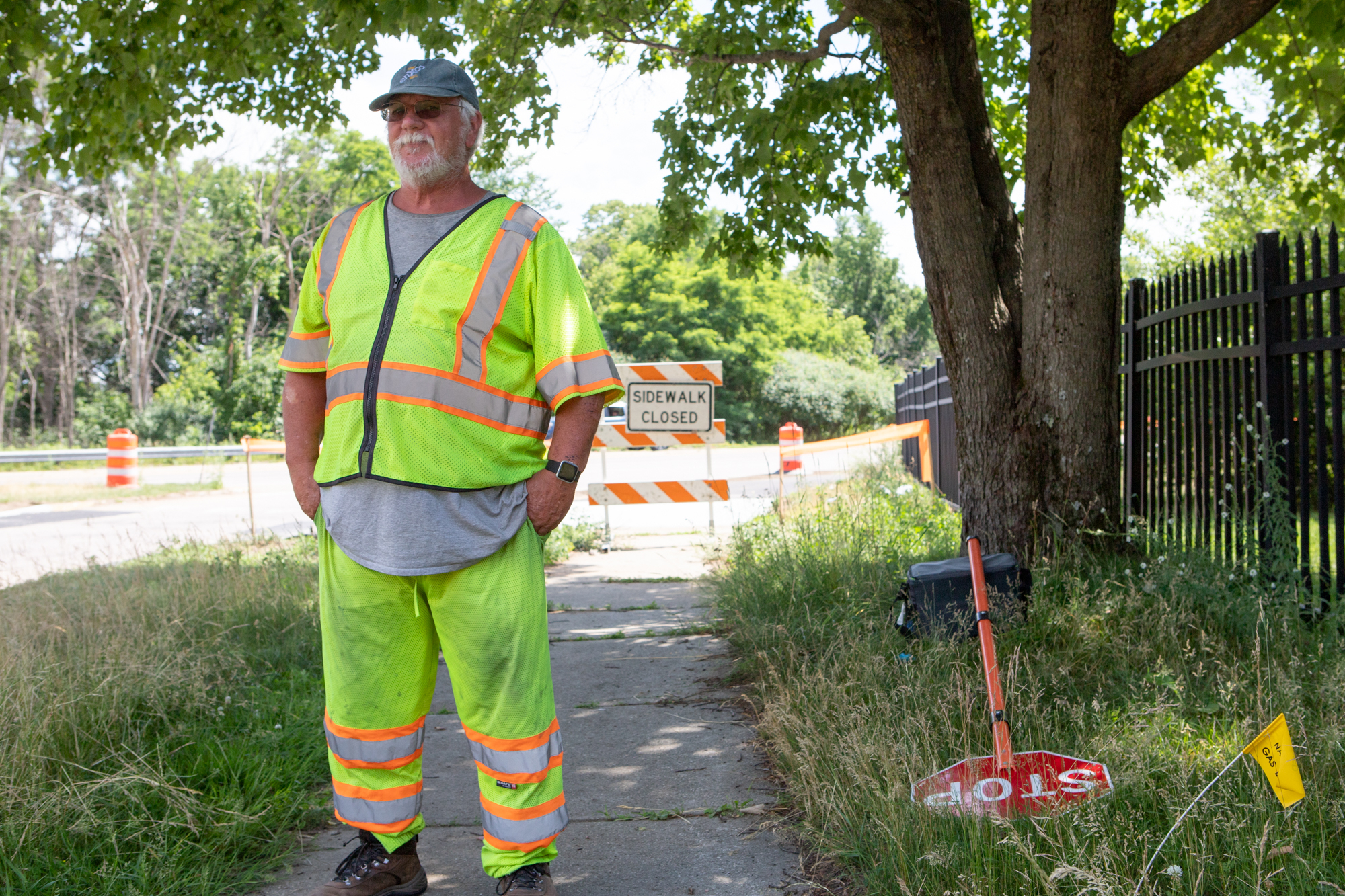
When Ronald Brace woke up on Thursday and saw Burlington was expected to reach 93 degrees, he immediately put six bottles of water in the freezer.
His day starts at 6 a.m., and by 3 p.m, Brace had drunk half his water supply while standing alongside Route 15 in Colchester. Brace is a flagger on a construction crew, so he’s responsible for directing traffic around the rest of his team. They were out placing topsoil to finish a multi-use path project.
His colleagues say Brace has one of the hardest jobs on a hot day — flaggers, pavers and roofers, by their estimate, face the most intense temperatures during days like these. And because he’s the only flagger managing traffic here, Brace can’t easily duck out and take respite in one of the blue pickup trucks lined up on the side of the road, which are left running solely for their A/C.
“Some people have been known to wear their pajamas underneath their uniform,” Brace said, pointing to his neon mesh vest and pants. He’s layered his uniform over a gray T-shirt and shorts. “It’s cool. Cooler than pants.”
This week’s heat wave not only made the crews job more strenuous, but also changed the equipment they can use. Once air temperatures reach about 90 degrees, the pavement’s surface can surge well past 130 degrees — so hot that this week-old pavement becomes too soft to bear the load of machinery without getting damaged.
The crew had to close down one of Route 15’s two westbound lanes to get the job done.
“Everything is harder when it’s hot out,” said Rob Barbour, who drives machinery at the site.
Scott Whittier, the warning coordination meteorologist at the National Weather Service in Burlington, said this week’s intense heat is due to a subtropical ridge: basically an area of very warm, high-pressure air.
It’s the same type of weather system that has caused record high temperatures in the Pacific Northwest, though the two aren’t related. Whitter said the East Coast’s “heat dome” was centered over New Jersey and the shore of southern New England.
Whittier said that, despite a string of hot days earlier this month, this is the year’s first official “heat wave” for most of the state, as that designation requires at least three consecutive days of heat 90 degrees or higher.
The humidity this week also drove the heat index — how hot it actually feels — to over 100 degrees in some areas of the state.
And while forecasters expect the heat will break on Thursday, with the National Weather Service predicting temperatures in the 70s, “it’s still early in the summer,” Whittier said.
“We still have July and August,” he said, “and July is our typically hottest month.”
Whittier said climate change isn’t necessarily a good explanation for any particular heat wave, but meteorologists are noting measurable changes year over year.

Burlington had eight days in June with temperatures 90 degrees or higher, he said. Generally, Burlington has about 10 days each summer that are at or above 90 degrees.
“I think that’s where we got to start thinking more in the future, is we’ve got to start building for heat resiliency in Vermont,” Whittier said.
