

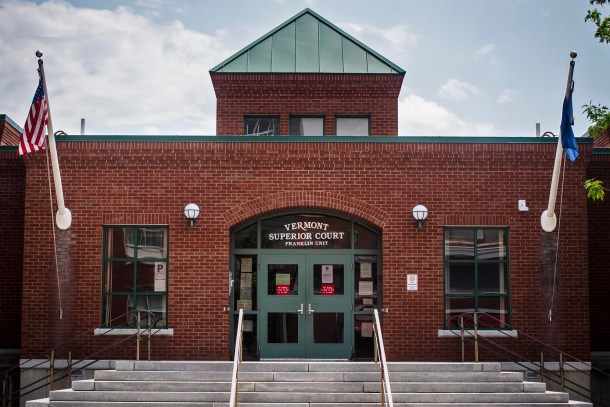
The Vermont court system is moving toward a full reopening of its courthouses after Gov. Phil Scott lifted restrictions based on his Covid-19 emergency order earlier this month.
State court buildings will be open “for in-person trials, hearings and filings in earnest,” said Pat Gabel, the court administrator.
However, she said, not all courts will be open and available for all court proceedings in the near-term. And some delays are expected in clearing out a backlog of cases that built up over the course of the pandemic.
An expert building team is conducting an assessment of ways to protect unvaccinated and medically vulnerable people inside the courthouses.
“We never completely closed the courts,” Gabel said, “because we’ve always been open for emergency proceedings. The real issue comes down to inviting people back into the buildings.”
The reopening is expected to begin around July 5, said Harold Eaton, an associate justice of the Vermont Supreme Court. “And of course, that means we have to send notice of hearings and things, and take some time to get those scheduled,” he said.
Gabel said that, based on Covid-19 trends in Vermont, she is optimistic that court clerks can open their offices in most buildings after the July 4 holiday.
The installation of “advanced HEPA air filtration systems,” CO2 monitoring, and limitations on building capacities will be pursued to ensure the safety of the public and staff.
“As we advance this important work, we will continue to make public health and safety our top priority,” Gabel said.
The state court will continue to hold virtual hearings and “emphasizes the need to increase access to the courts for more Vermonters.” Remote hearings have allowed for case processing, and a “modernized case management system” enables remote access to court documents and processes. As some courthouses move towards a full reopening, remote practices will still be continued.
The types of hearings to be held virtually are “not fully developed at this point,” Eaton said.
“We have asked the oversight committees of each of the dockets to identify for us, which cases should be continued to be held remotely, if possible. We’re in the process of sorting out what things will continue virtually and what things will be in-person,” he said.
Gabel hopes that remote proceedings will continue in the long run.
“We hope remote proceedings will become a part of the work that we do. … Thanks to funds appropriated to us by the legislature from last year, [Coronavirus Relief Fund] funds, and this year’s [American Rescue Plan Act] funds to have limited service positions, it has addressed the need to support remote proceedings,” she said.
Virtual proceedings can also address issues of inequity, Gabel said, as people can attend hearings remotely without worry of arranging transportation, extensive leave from work, or hassles in finding childcare.
“It’s become a cliché, maybe, to say that as awful as the pandemic has been, there have been silver linings because we were forced to do things that we might have considered over the long run with all kinds of due deliberation, but there was no time for due deliberation in order to protect public health,” she said.
Chittenden County State’s Attorney Sarah George agrees that remote proceedings have helped to address issues of inequity.
“For the attorneys, victims, witnesses, and in the end, the folks who have committed a crime, a lot less time can be taken off from work, for example, to join a status conference,” she said. “We have been forced in a really great way to go entirely paperless, which has also been something we’ve wanted to do for a long time … and I think the court has been amenable or is amenable to continuing to do some of this virtually in a way that makes sense for everybody.”
However, George raised concerns of what jury duty may look like paired with “clearing the backlog” of cases and “getting back on track to having a consistent approach and a consistent way of getting folks in and out of the courthouse.”
While the reopening of courts will expand in-person hearings, changes to the pace in which cases are processed from the backlog is unclear. A slight delay is expected.
Eaton said it’s difficult to quantify because there are some criminal cases ready for trial in terms of how long they’ve been pending, “but whether they are in fact ready for trial means something different.”
The fact that cases are going to trial “is an incentive for other cases to get resolved,” he said.
Gabel said that there will be “a short period where we continue to see delay.”
“Even though we were fortunate that the legislature did approve our funding for our pandemic response and recovery plan, which adds positions to the judiciary to help us get through the backlog and other impacts from the pandemic, that law doesn’t actually come into effect until July 1,” she said.
“It’s as if you have a big engine that has to shut down, and then you have to get the engine back up again,” Gabel said. “We’ll take a little bit of time to get up to speed, but I think then you will see the pace increase, particularly in courthouses where there are ventilation systems and such, and the layout of the courthouses are such that we can start bringing more people in.”
For Chittenden County, much work has been done to resolve cases in “creative ways,” George said, in order to “keep cases moving and to provide some sense of closure for the person charged and the victims.”
“It’s still a lot of cases. There are people that we’ve lost track of, and we really need to try to find some folks and get them back in court. That part is definitely going to take some time,” she said.
A large part of clearing the backlog is ensuring that people can access resources that they need, said John Campbell, executive director of the State’s Attorney & Sheriffs office.
“We need to get the system working again. For some of the criminal defendants, it will be the only way to get them into the treatment and programming they need,” he said.
If anyone has questions about a hearing or whether a particular courthouse is open to the public, they are asked to check with their attorney or call the Judiciary’s Information Center at 802-652-1900. Information is also available at vermontjudiciary.org/covid19.
Correction: An earlier version of this article incorrectly rendered one of Gabel’s quotes. Her references to American Rescue Plan Act and Coronavirus Relief Funds have been corrected.

