

Alburgh is seeking residents’ views on how best to word a local declaration of inclusion, which voters may then be invited to approve, or not approve.
The town selectboard did not decide Wednesday night whether to endorse a declaration of inclusion, instead opting for an unusual process members feel will involve more voices, said Board Chair Lee Kimball.
Residents can start a petition that includes a declaration of inclusion, which, if signed by enough registered voters, would go up for a townwide vote. That vote could take place at a special election later this year, Kimball said, or at the annual town meeting next March.
“This is something that’s important to the people and important to us, but I need guidance from the citizens of Alburgh to understand what they’re looking for,” he said.
The declaration brought forward Wednesday states that Alburgh condemns racism and discrimnation, will protect those who identify with protected classes “to the fullest extent of the law,” and will be a place where people “can live freely and express their opinions.”
Bob Harnish of Pittsford, who owns a vacation home in Alburgh, presented the declaration. Along with Mendon resident Al Wakefield, Harnish has led an effort across the state to encourage municipalities to adopt similar, or identical, declarations.
“The great majority” of communities Harnish and Wakefield approached have adopted a declaration, Wakefield said, including Franklin, Middlebury, Pittsford and Rutland.
Harnish said he was “impressed” the Alburgh selectboard spent the better part of an hour discussing the declaration of inclusion, and he hopes any future public discussion about the proposal will not become politicized.
“I can always be disappointed that they didn’t just go ahead and approve it, but on the other hand, they could just approve it and it’s words on a piece of paper — and it gets put on a dusty shelf,” he said. “I would rather see real community involvement.”
Some people who spoke at the meeting Wednesday night said they thought a local declaration of inclusion was unnecessary, because Gov. Phil Scott last month signed a proclamation that “formally condemns discrimination” and is effective statewide.
Others said the local declaration was too vague, and ought to identify specific problems or propose specific solutions to address implicit bias in the town.
Kimball, the selectboard chair, said if a declaration goes up for a vote, he would prefer it take place at town meeting, because special elections tend to have poor turnout.
For instance, in May’s special election that decided Alburgh should partner with a broadband provider to build out a network in the town, only about 115 of some 1,500 registered voters cast a ballot, Kimball said.
“I would like to have an amount of participation we can look at and say: ‘Yep, that’s a meaningful number of people,’” he said. “And I think that that carries a lot of weight.”
Bailee Goodell, who lives in Alburgh, said she will help draft a petition to endorse a declaration of inclusion. In small rural towns such as Alburgh, she said, the experiences of people who identify with a marginalized community are often overlooked.
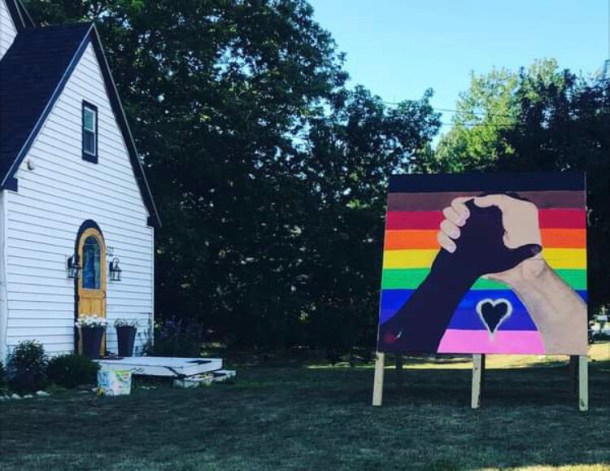
Goodell has a mural in her yard that shows a white person linking arms with a Black person, over a background of a racially inclusive pride flag. Several members of the community have shared support for the inclusive message it sends, she said.
“I’m pleased that more people came to the meeting than usual,” Goodell said. “But it is still clear that there’s a lot of work to be done in the town of Alburgh.”
