

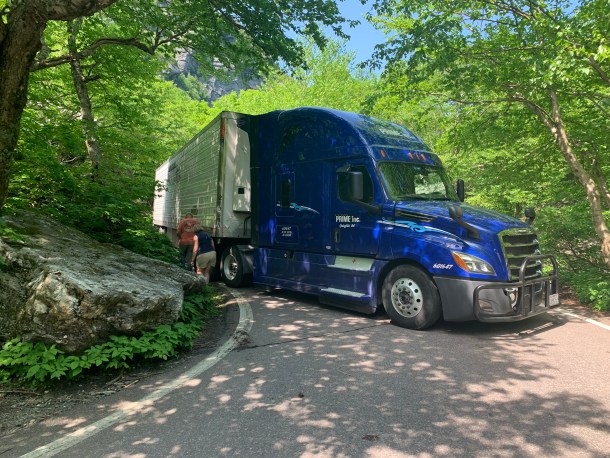
This article by Aaron Calvin was published June 17 in the Stowe Reporter.
STOWE — As the coronavirus pandemic wanes, the Vermont Agency of Transportation is launching a new campaign to curb another ongoing epidemic: the inability of truck drivers to stay out of Smugglers Notch.
“Tractor-trailer trucks getting stuck on VT 108 in Smugglers Notch is a serious public safety matter, and potentially a serious environmental safety matter,” Joe Flynn, secretary of transportation, wrote in a letter June 11 informing the Stowe Selectboard of initiatives to curb the problem.
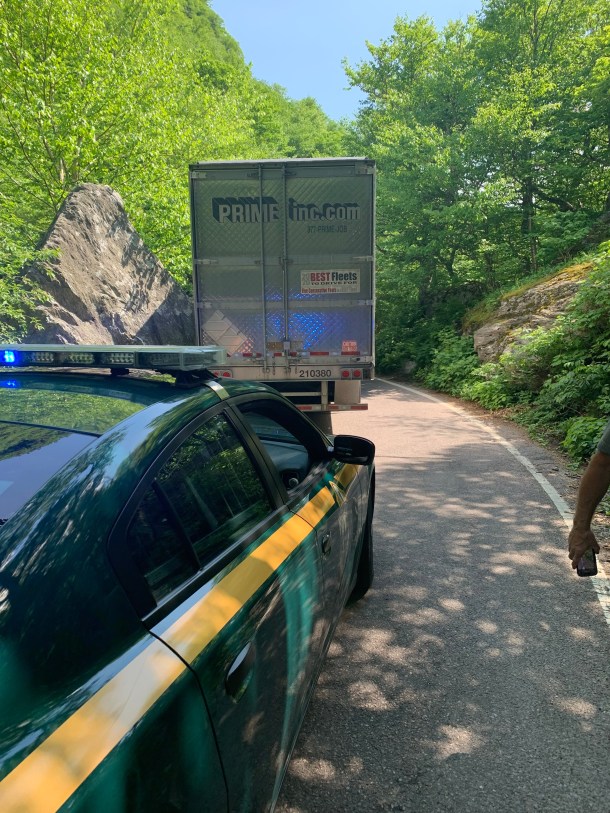
The narrow, twisting road through the Notch is impassable to tractor-trailers and most tour buses. Flashing signs warn truckers that their vehicles won’t fit, yet still they try — and then have to back down the mountain.
“Road closures for hours on end deny use for commuters, residents, local businesses and visitors here to enjoy Vermont’s natural beauty. The agency believes more must be done and additional measures taken at this time,” he wrote.
The tendency for truck drivers to willfully ignore, misunderstand or simply not see the warning signs trying to keep them off one of Vermont’s most scenic roads — where hairpin turns trimmed with large boulders at its peak ensure a tractor-trailer will be rendered immobile — has officially been ruled a public crisis.
In his letter, Flynn said 92 trucks have gotten stuck in the Notch since 2009, even though the road is closed once snow and ice arrive, because the road is impossible to plow. The average is 8.4 trucks getting stuck per year.
Additional data from VTrans shows that 12 trucks were stuck in the Notch each year in 2013, 2014 and 2017. The number has been increasing, generally, since 2011, with at least seven big rigs stuck in the Notch every year since 2013.
When it’s open, about 2,000 vehicles move through the Notch each day. The tight, treacherous road was originally forged through Mount Mansfield as a route for smuggling British goods into the United States through Canada in the early 19th century, according to folklore.
No data is currently available on the cumulative number of hours these stuck trucks have caused Route 108 to be closed, which can vary widely depending on how badly a truck gets wedged between the boulders lining the narrow mountain pass.
Frank Ewing, a truck driver from Duluth, Georgia, who got stuck in the Notch on June 3, caused the road to close for five hours.
Anecdotal data suggests that most of the truck drivers who don’t see or ignore the signs begging tractor-trailers to stay out of the Notch are mostly out-of-staters, according to Josh Schultz, operations and safety bureau manager at VTrans.
Two trucks have been stuck in the Notch so far this year, which apparently prompted VTrans to develop both short- and long-term solutions to this seasonal traffic issue caused by hubris and ignorance.
“I think truckers think they can make it. They go and they think, ‘Well, I think I can still negotiate this curve through these protruding rocks’ and the road obviously winds around them,” Schultz said. “I think they think they can make it, and then they find out they can’t when they get into it. They find out too late, unfortunately. At that point, they get stuck.”
Short-term solutions
In his letter to the Stowe Selectboard, Flynn outlined a set of short-term solutions he hopes will help prevent trucks from getting stuck in the Notch this season.
Variable message boards will be placed along different roadways that drivers might take on their way to Route 108, including Interstate 89, Route 100 and Route 15, warning truckers that they won’t fit and they will be fined.
Warning signs that say “be prepared to stop” will be placed at critically narrow locations along the Notch. Solar flashing beacons will be added to augment signs alerting truckers that they’re not allowed on Route 108.
VTrans has also partnered with Stowe police to patrol and monitor the area daily and specifically ask truckers if they have seen the signs as they approach the Notch. The focus of this effort, Flynn said, will be data collection and education, not to hand out fines.
One major issue is that drivers trust their GPS over the road signs and other indicators that driving through the narrow road might be a bad idea. Along with flashing signs that read “Your GPS is wrong,” VTrans is going right to the source.
“It seems like truck drivers are trusting their GPS units over the signs. So they’re either not seeing the signs or their GPS is saying, go this route. That’s certainly a problem for the out-of-staters,” Schultz said. “So one of the things we’re actively working on, and have been working on for years now with some traction, is to have GPS companies work more with us to somehow get that vital information out to the public.”
Schultz said it’s often not as simple as calling up a GPS provider and asking that an alert be placed on its maps or in its software, but trucker-specific GPS now often comes with this warning, and he hopes the program will continue to expand.
Long-term solutions

This summer, VTrans will conduct a formal road safety audit of Smugglers Notch and analyze future safety options to reduce the number of trucks getting stuck on the road. Law enforcement, engineers, GPS experts, local businesses and area municipalities will be consulted.
“It’s a scenic road, so we want to be sensitive to that,” Schultz said. “We want to make sure that, whatever we do, we obviously want to be effective. But we don’t want to take away from the road that we have. It’s beautiful, and we want to keep it that way.”
One option is soft bumpers that stand beside but not over the roadway, to drive home the fact that trucks of a certain size simply will not fit.
The study will likely take the entire summer, but Schultz hopes VTrans will be able to greatly reduce, if not entirely eliminate, tractor-trailers getting stuck in the Notch.
“It’s definitely a priority. It certainly is a route that drivers take, that local Vermonters take as a shortcut in the summertime. We definitely want to make sure that, whatever we do, we accommodate those drivers. It’s not just drivers from out of state or even in state that are just looking for the scenic views that the Notch offers. There’s also commuter traffic that uses that road, so we want to make sure we’re sensitive to those folks as well,” Schultz said.
