

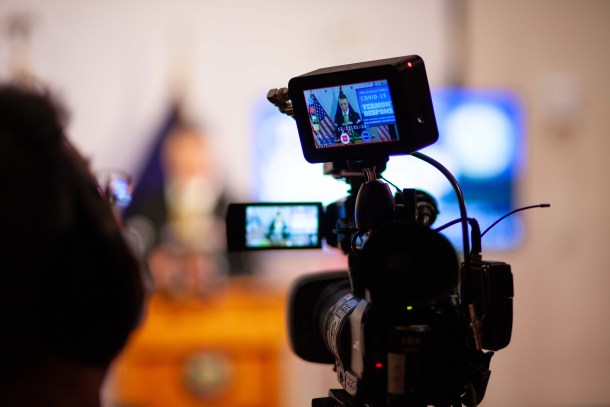
Gov. Phil Scott and top administration officials gathered once again Tuesday for a media briefing about the latest on Covid-19.
Fifteen months into the governor’s declared state of emergency, Tuesday’s press conference was a two-hour affair, with Scott and Health Commissioner Mark Levine fielding questions from news reporters across the state.
During the past year, many people have made tuning in to these press briefings — aired in their entirety by VPR and Vermont’s major television networks — a part of their weekly routine.
However, as the state approaches an 80% vaccination rate of people who have received at least one Covid-19 shot, the declared state of emergency, along with the marathon press briefings, will soon end.
The governor has already scaled back. Throughout 2020, Scott had held three press conferences a week, but as the crisis seemed to ease, he eased back to two a week, and is now holding just one briefing per week.
The hourslong media availability, a hallmark of Scott’s response to the coronavirus, will end “relatively soon,” said Jason Maulucci, the governor’s press secretary.
Then what? The Scott administration has already had conversations with news organizations about the future of the press conferences. The tentative plan is for the governor to return to his pre-pandemic routine, typically taking reporters’ questions once a week in his office — but without an entourage of cabinet members or live broadcasts.
One new feature, Maulucci said: Reporters from across Vermont who usually cannot get to the Montpelier event will continue to have access to the press conferences.
“We’re going to maintain that in some way,” Maulucci said. “I don’t know if it will be a call-in number or a TV screen at the end of the table and people can Zoom in.”
Scott himself has said the increased access to him and his cabinet by journalists all over the state has been one of the “silver linings” of the Covid-19 pandemic.
“We’ve been forced in some respects to hear from people from all over the state, by telephone, and hear their thoughts — hear what’s going on in their geographical areas,” Scott said during a press conference in May.
“It’s been more transparent,” he said.
That pleases Mike Donoghue, executive director of the Vermont Press Association.
“The press association and its members are excited to think that the press conferences that so many Vermonters have come to love will somehow continue on after Covid-19,” Donoghue said.
However, Scott’s platform for reaching Vermonters may shrink.
The state’s major broadcast news organizations are figuring out how to handle Scott’s pressers post-pandemic.
“We are currently discussing this but haven’t made any firm decision,” Sarah Ashworth, vice president of news at VPR, told VTDigger in an email.
VPR has carried Scott’s Covid-19 briefings uninterrupted throughout the pandemic, with Jane Lindholm, who hosted “Vermont Edition” until March, chronicling each one on Twitter.
Roger Garrity, news director at WCAX-TV, Channel 3, said his station will end its live broadcasts of the briefings when the state of emergency ends.
“We decided to televise the press conferences back at the start of the pandemic, seeing it as a public service during a public health emergency,” Garrity said.
Garrity said WCAX’s commitment to air the press conferences uninterrupted has cut into its ad revenue.
“When the state of emergency ends — that seems like a good point if we were doing it because it was a public health emergency,” he said.
Garrity also said that, if Scott extends the state of emergency, WCAX may well end live coverage when Vermont hits the 80% vaccination rate.
With Covid-19 taking a back seat to other potential subjects and issues, news organizations will have to weigh the newsworthiness of continuing to cover the governor’s press briefings.
“I think relatively soon that [coronavirus] won’t be the primary focus of them,” Maulucci said. “It might be a quick update and then other topics.”
Donoghue said that, as the governor and the state move out of crisis mode, each individual broadcast outlet will have to decide whether to give Scott the same amount of airtime he has enjoyed since March 2020.
“It might not be as interesting to hear about Act 250 or tax assessments,” he said.
