

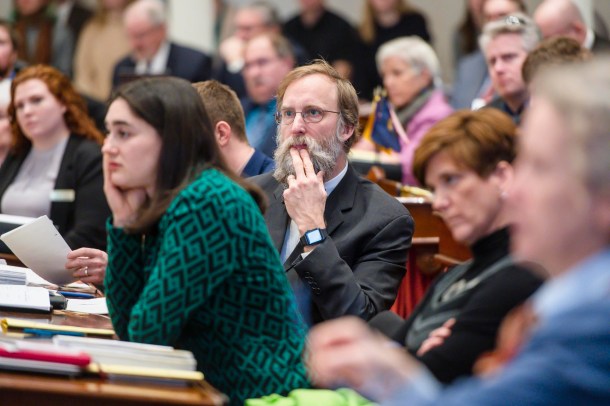
The House has passed a bill that ensures a crime victim would know if the person accused of the crime is set free because they were found incompetent to stand trial or not guilty by reason of insanity.
The legislation, S.3, is intended to make sure the crime victim knows when the accused person is released to the community. Under the bill, the state Department of Mental Health must provide at least 10 days’ notification of the accused person’s upcoming release to the prosecutor in the county where the crime took place. That prosecutor would be obligated to notify the crime victim.
The same notification process would take place if an offender escaped from custody.
Rep. Martin LaLonde, D-South Burlington, presented the bill on the House floor.
“If a court finds a person is a danger to self or others, and commits the person to the custody of the Department of Mental Health for treatment,” Lalonde said, “current law provides no way for the crime victim to be made aware when the person returns to the community.”
A key section of the bill, he said, “closes that gap by creating a system of victim notification in these cases.”
The legislation now goes to the Senate. The Senate has already approved the bill, but the House amended it by moving up dates that certain reports must be completed. The Senate is expected to take up that amended bill next week.
The bill would also allow the prosecution to have its own psychiatrist examine a person charged with a crime when a court-ordered examiner has found that person incompetent to stand trial.
In addition, the legislation calls for formation of a forensic care working group, whose job would be to identify gaps in the current mental health and criminal system that affect public safety, and gaps in the coordination of treatment for people incompetent to stand trial or found not guilty by reason of insanity.
The working group will also:
- Look at the need for a forensic treatment facility in Vermont.
- Determine what entity or entities are most appropriate to run such a facility.
- Calculate the number of beds needed in a forensic treatment facility.
The bill also sets aside $530,000 for the state Department of Mental Health — $500,000 to contract with Vermont Legal Aid to provide legal representation and independent psychiatric evaluations for commitment proceedings, and $30,000 to support the forensic care working group.
Kerry Carroll of Bennington testified on the bill earlier this session. Carroll’s 26-year-old daughter, Emily Hamann, was attacked and killed on a walking path in downtown Bennington in January, police said.
Darren Pronto, who is being charged with first-degree murder in her death, had reportedly been diagnosed with schizophrenia. Carroll testified she has since learned that Pronto had been in state mental health treatment before, including once for threatening his neighbors.
Carroll emailed a letter to lawmakers before Friday morning’s vote, urging them to pass the legislation and stressing the need for Vermont to establish a forensic treatment facility and to work toward eliminating “disconnects” in the system.
Any single case should not determine law, she wrote, but one case can highlight “significant disconnects in the system, and that is exactly what Emily’s murder does. Please pass S.3.”
Carroll’s letter included a photo of her daughter holding her young child.
“I want all of you to see Emily’s face,” the letter stated, “and if any of you are going to vote no on S.3, then I want you to remember her smile and think about all of the holidays and experiences my grandson is going to miss when you cast that no vote.”
The House approved the bill 143-0.
