

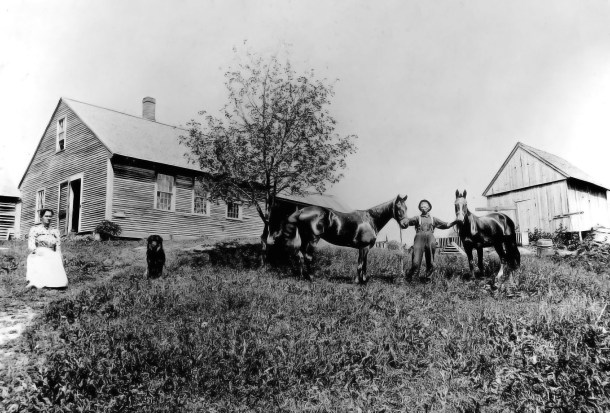
The marriage of George Gould and Laura Cutler lasted barely 14 hours.
It started at about 9 p.m. on Sept. 4, 1889, at the home of the minister who married them. It ended shortly after 11 a.m. the next day, at their home, when Gould was shot in the face and chest. The single shotgun blast that ended their marriage started one of the strangest murder cases in Vermont history.
Laura Cutler had grown up on a farm in East Montpelier, the only child of Willard and Fanny Cutler. From the time Laura was in her mid-teens, the household also included a hired hand, James Sherman Caswell, who started working there shortly after fighting for the Union Army during the Civil War. He was like part of the family.
Sherm, as he was known, was smitten with Laura, who was eight years his junior. Apparently the feeling was mutual. But when Caswell asked Willard Cutler for permission to marry his daughter, Cutler refused, saying his daughter was too young to marry. Perhaps he worried that Sherm drank too much or lacked ambition. Laura later said that her father never wanted her to marry anyone.
But her father wasn’t the only obstacle. After he died in 1884, Laura still wouldn’t agree to marry Sherm. When her mother died four years later, Laura decided that, for propriety’s sake, they couldn’t live alone under the same roof, so she invited an 84-year-old woman named Phoebe Perry to live with them.
Sherm needed help on the farm. He had been wounded at the Battle of Gettysburg, shot in the left leg while helping repel Pickett’s Charge. The injury was making farm work difficult, so in 1888 he hired George Gould to help out. George was 35 at the time, two years younger than Laura, 10 younger than Sherm. He stood about 5-foot-6, wore his short hair parted in the middle and sported a long mustache that he curled up slightly in thin wicks at the end.
George found reasons to visit the Cutler farm even when he wasn’t working. The attraction was Laura. By the end of the next summer, he had managed to do what Sherm could not: persuade Laura to marry him. The two set a date for September.
Sherm was incensed. He said Laura had no right to marry another man, since the two of them had lived together for more than 20 years. “Sherm, were we ever married?” Laura later remembered asking. “Have I got to get a divorce from you before I can marry anyone else?”
When he was sober, Sherm would try logic, arguing that his Army pension would cover the farm’s debts. If she married George, who had no money, they would lose the farm, he said. When Sherm was drunk, he would curse her and make threats. If she married George, he would kill the man. Laura took the threats as the ravings of a drunk.
On her wedding day, she sat down with Sherm for breakfast. “Well, Laura,” he said, “this is probably the last meal we shall eat together.”
“Yes,” she answered, “I presume it is, as I am going away today.”
The next day, Laura returned to the farm with her new husband at about 11 o’clock. The elderly Phoebe Perry and a teenage girl from the neighboring farm, who had stayed the night to look after her, told Laura that Sherm was upstairs and “pretty full”; he’d been drinking. George decided to stay around the farmhouse to make sure there was no trouble. He was prepared; he’d brought a revolver with him that day.
Laura changed out of her good clothes and prepared to cook dinner. George took off his coat and switched from his formal hat to his work one, then headed out to the woodshed to gather kindling for the stove. He never made it back.
Moments later, the women heard the tremendous blast of a gun followed by terrible screams. Laura looked up the stairs and saw Sherm standing there, empty-handed. “Why, you have shot George!” she said. Sherm didn’t reply. She stepped out the door and saw blood splattered on the step and kindling scattered on the ground, then ran to a neighbor’s for help. When Sherm came downstairs, Phoebe said, “I am so sorry you have shot George!” “So am I,” he replied.
George was still alive. He had been just about to reenter the house when Sherm had leaned out an upstairs window and fired a shotgun down at him. The gun had been loaded with birdshot, but the shot had not had time to disperse before it struck George — the end of the gun had been only about 8 feet away from him. The shot struck George in the left cheek, tearing away some teeth, part of his upper lip, nose and chin, and breaking his jaw. The shot also pierced the right side of his chest, smashing three ribs and tearing holes in his liver and one lung.
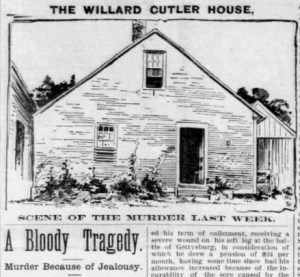
But George hadn’t fallen. He had dropped the load of kindling, grabbed his face and run for the road. He crossed it before falling in the grass beside a fence. Three men who had been working at a nearby quarry came running. They found George struggling to his feet. He refused their help, standing and falling twice. The men said George spoke, despite his mangled jaw, crying out in pain when the men tried to prop him up. The men ministered to George as best they could as he bled to death over the next half-hour.
While George lay dying, Sherm headed across the fields to a neighboring farm and asked for a ride into Montpelier, where he turned himself in. His guilt was never in doubt. The next edition of the Montpelier Argus and Patriot published an “Interview with the Murderer.” His lawyers said their best hope was to get a life sentence instead of the death penalty. To do that, they would have to show that the crime was an act of passion, not premeditated murder.
Though a trial wouldn’t be held for months, both Sherm and Laura agreed to interviews with the Argus and Patriot just days after the murder. Sherm said he had become distraught when Laura left on her wedding day. He had considered packing his things immediately and moving west. He had contemplated suicide. Many details were a blur, he said. He didn’t even remember lifting the shotgun to fire it.
But he was sure of a couple of things. He hadn’t loaded the gun to shoot Gould; he had loaded it about 10 days earlier, when his dog had treed a squirrel, but hadn’t fired it.
And he said had been engaged to Laura for years and had even bought her a dress. They just hadn’t gotten around to marrying. “(S)he was as much my wife as she can be of any man, and has been for 20 years,” he said.
Laura, who the reporter noted was remarkably composed, saw things differently. She explained that “the matter (of their marrying) was never brought to any more intimate relation than that he was her escort on nearly all occasions when she took part in the social pastimes of the neighborhood.” She said Sherm had given her $10 on her last birthday and she had shortly thereafter bought a dress, but it hadn’t been a wedding dress.
The trial began in late March 1890. Laura’s testimony shocked those in attendance. “From the latter part of the year 1867, is it not true that your relations with Sherman Caswell were as those of a wife toward her husband?” asked Caswell’s lawyer, Hiram Huse. Without hesitation, Laura replied “yes.”
“(I)t seemed as if everybody (in the courtroom) had simultaneously arose in their seats and then sat down again,” the Argus and Patriot reporter wrote.
Laura said those “relations” continued until about two months before she married George Gould. A man who worked occasionally on the Cutler farm testified that he “always supposed by the actions of Sherman and Laura that they were married.”
During his testimony, Sherm said he had loved Laura since he met her 23 years earlier and had panicked at the thought of Gould taking her away.
In his closing remarks, Huse compared Sherman Caswell to U.S. Gen. Daniel Sickles. Like Sherm, the general had also been wounded at Gettysburg. But more importantly, Sickles had famously killed his wife’s lover and gotten away with it. The jury at Sickles’ trial had accepted the argument that he had been driven temporarily insane by jealousy.
What effect that argument had on members of Caswell’s jury is unclear, but the next morning they announced they would spare Caswell’s life. He was convicted of second-degree murder and sentenced to life at the Vermont State Prison in Windsor.
Three weeks later, Vermonters were stunned by another wrinkle in the story. Sherm had finally gotten his wish: Laura had agreed to marry him. The couple held hands through Caswell’s cell door at the Washington County jail while a justice of the peace, Sherm’s lawyer Hiram Huse, married them.
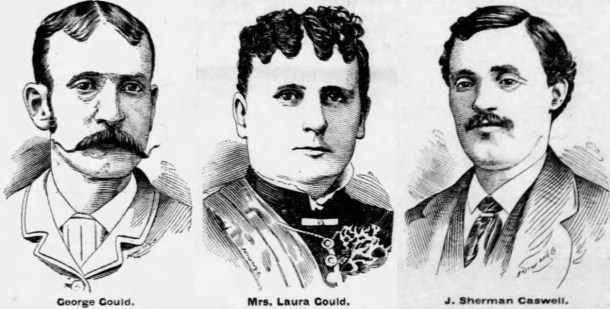
Newspapers vilified Laura. “(W)hile the mangled body of George J. Gould was still in the house, his bride of 24 hours before impressed the representatives of the Argus and Patriot with the belief that she felt more concern for Caswell and what would be his fate than she did sorrow for the untimely end to which her husband had been brought.”
The paper noted that she had visited Caswell several times in jail before the trial and that during the trial she had “stopped at nothing … to mitigate the severity of his punishment, even swearing away that which is dearer to most women than life — her honor.” The only reason she married Caswell, the paper wrote, was to “atone to him for the grievous wrong that she had done him in marrying Gould.”
She would spend the rest of her life trying to win his release, the paper speculated.
And if Caswell were to die in prison, the paper wrote, “his last thought will be of the wife who married him under circumstances which were never known to surround a marriage before.”
A romantic notion, but things didn’t turn out quite like that. A year and a half after Sherm’s conviction, Laura sued for divorce. According to newspaper accounts, she wanted a divorce because her new husband had failed to share his military pension with her, as he had allegedly promised. Her lawyer also claimed that she was entitled to a divorce because her husband was “civilly dead.” Under Vermont law, people were entitled to a divorce if their spouse was sentenced to more than seven years in prison.
Newspapers also reported the sensational claim that Caswell was refusing to support his wife because she was keeping company with a man named Gould, a relative of her murdered husband.
The Washington County court rejected Laura’s suit, the Rutland Herald stated, because it found she had “no right to expect Caswell to support her; further, that she and all parties knew his civil condition at the time of the marriage, the exception having been waived, and third that he has no more civilly dead now than then.” Laura appealed the ruling to the state Supreme Court, which ruled against her.
Twelve years later, in 1902, a group of local veterans, business leaders and members of the Washington County legislative delegation rallied to Sherman Caswell’s side. Citing his good conduct in prison and military heroism, they successfully petitioned Gov. John McCullough to pardon him.
Newspapers said that while in prison Caswell had saved his military pension, so, now at the age of 59, he could retire comfortably. He moved back to the Montpelier area. Laura was living a couple of miles away in East Montpelier.
Understandably, Sherm and Laura never lived under the same roof again. When Laura died in 1911, the Montpelier Evening Argus used the opportunity to once again recount the murder and its scandalous aftermath, adding one grisly, and false, detail: that Gould’s head was “blown off and his body rolled down the hill into the highway.”
The Argus explained that since the murder, Laura had continued to reside in her family home. And she hadn’t been alone. For the past two decades she had lived with a man named Lucius Gould. The two were never married. She was, the newspaper delicately reported, his “housekeeper.” Though Laura had clearly long ago moved on from Sherman Caswell, there was part of him she could never shake. Unable to secure a divorce from the man who had murdered her first husband, she died with the name Laura Caswell.
Direct quotes in this column were drawn from the extraordinary newspaper interviews conducted with Laura Cutler Gould Caswell and Sherman Caswell in the days immediately following the murder, and from press reports of Caswell’s trial.

