

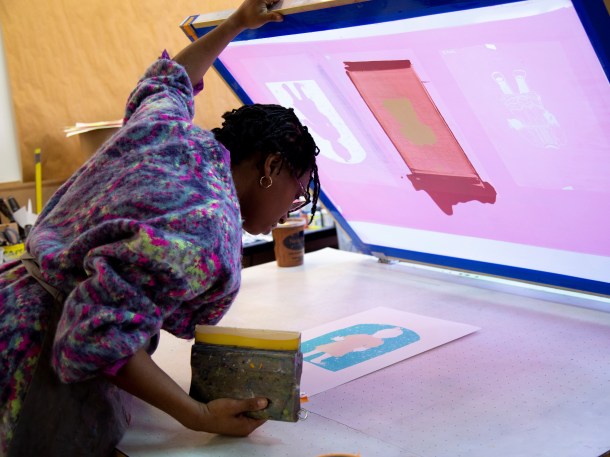
BRATTLEBORO — When Jennifer Mack-Watkins received an invitation from the Brattleboro Museum & Art Center to produce her first solo show, the New Yorker initially replied, “Where?”
When the Black printmaker learned the offer came from the nation’s second-whitest state, she followed up that question with dozens more.
“I wanted to know about the history of African Americans in Vermont,” she said, “because I’m always interested in putting some type of historical aspect into my work.”
Mack-Watkins soon discovered the story of the late Daisy Turner, the Grafton-born daughter of formerly enslaved people who was 8 when she rebelled against an 1891 school assignment to hold a caricatured Black doll and recite a white-written poem about Africa.
“Instead of saying the piece that the teacher had taught me to say,” Turner told the Vermont Folklife Center before her death at 104, “I was saying what I wanted to say on my own.”
Such a sense of self-worth, hope and resilience is at the heart of Mack-Watkins’ resulting show, “Children of the Sun,” whose colorful prints of empowered Black dolls are drawing national attention from publications ranging from The New York Times to Vogue.
“She wants her show to reach children,” the Times wrote, “so they can know that Black is beautiful.”

Mack-Watkins, a mother of a young son and daughter, drew inspiration from not only Turner but also the late NAACP founder W.E.B. Du Bois, who sought to encourage young readers 100 years ago with “The Brownies’ Book: A Monthly Magazine for Children of the Sun.” The first issue featured a photograph of 10,000 African Americans dressed up and marching down Fifth Avenue in New York City.
“At first, I thought it was a celebratory parade,” Mack-Watkins said in the show’s artist statement, “but when I looked further, I discovered that it was the total opposite.”
The parade was a protest after 40 people lost their lives in a 1917 race riot in East St. Louis.
“Historically, and still today, the Black body has been mutilated, warranted, violated, attacked, targeted, protested, kidnapped, abused and mocked in the media,” Mack-Watkins said. “My current body of work is part of an ongoing celebration of the beauty, importance and complexity of positive representation of African American children in literature, media and pop culture.”
The show’s playful silkscreens and lithographs picture dolls named after African American historical figures standing under divine arches and, in one case, on the moon.
“As a child born and raised in South Carolina, it was hard for me to find toys that looked like me,” Mack-Watkins said. “The dolls I have reimagined here represent that very hope, joy and awareness of the world that I seek for my own children.”

Mack-Watkins will discuss her work at a public online program Wednesday, April 28, at 7 p.m. The exhibit will be on display Wednesdays through Sundays from 10 a.m. to 4 p.m. until June 13, with more information and a virtual tour available at the museum’s website.
“Through my art, I seek to provide a sense of assurance for all African American children and hope the work encourages imagination and aspiration,” Mack-Watkins said. “In the same way, I hope to encourage children to enjoy childhood — while being aware of the injustices and challenges that lie ahead.”
