


Editor’s Note: This story is part of an invitational series chronicling the varied, complex experiences surrounding the Black Lives Matter flag in Vermont’s school communities. The first installment in the series offered a snapshot of the current debate; the second profiled Noel Riby-Williams, who led the effort to raise the BLM flag at Montpelier High School. The Underground Workshop is an open platform for student journalism from across Vermont. For more information please contact Ben Heintz, the workshop’s editor, at ben@vtdigger.org.

By Annika Heintz and Morgan Manley of Mill River Union High School
On June 17, 2020, Reese Eldert-Moore, a senior at Mill River Union High School, watched the small squares of a school board Zoom meeting on her television. After she anxiously fidgeted through the administrative updates, the agenda finally reached what she was waiting for: the district’s Three-Year Equity Plan.
The school board had been developing this plan since 2019 and officially adopted the plan in May. It addresses educator professional development, curriculum and representation, among other concerns.
In the week leading up to the school board meeting, Reese had drafted, revised and introduced a four-point proposal to the board, involving both Black history education and the raising of the Black Lives Matter flag. Although she’d considered this before, she was newly motivated by George Floyd’s murder in Minneapolis about three weeks earlier. In her initial email to the board, Reese asked that they use this moment to “create as much visible support for Black and brown people as possible.”
The district had been working on its equity plan independent of Reese’s request, but when school board member John McKenna made the motion to fly the BLM flag at all district schools, he emphasized that it spoke to Reese’s concerns.
As the board voted, Reese and her mother, Tabitha, then president of the Rutland chapter of the NAACP, watched, too nervous to sit. The motion to raise the Black Lives Matter flag passed, 8-1-1. “The school is actually going to do something,” Reese remembers thinking.

Ten months later, the Black Lives Matter and Pride flags still have not been raised. The decision fomented intense and divisive public debate among adults in the community. The dialogue among students has been quieter, but has the controversy further segregated students into political groups?
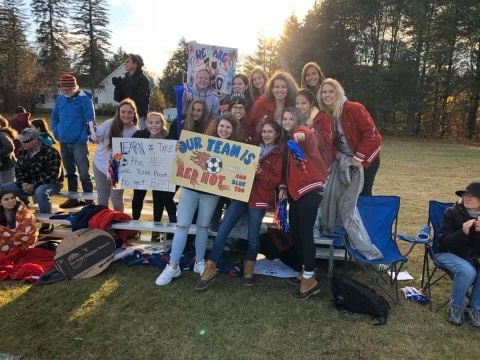
Mill River is a tight-knit school with 397 students in grades 7-12. When the boys’ varsity soccer team made it to the state championship semifinals in 2019, students and teachers drove two hours each way to support them; when they won, an ever bigger group rallied at the championship game in Hartford.
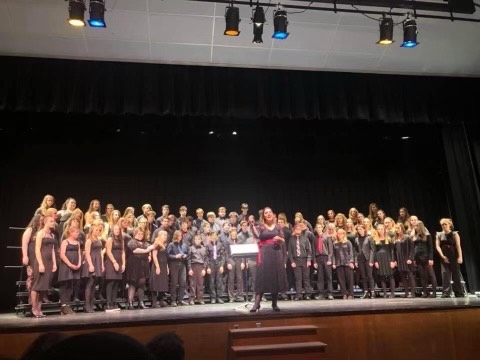
Arts have always been a priority at Mill River, uniting students from different backgrounds, lifestyles and politics. Before Covid, the October showcase concert was reliably standing room only, as hundreds of other students, teachers and parents showed up to applaud the performers.
As in other communities, the student body has become more political in recent years. Social media has evolved into a powerful tool for students to communicate their opinions, share resources, and become educated. Many students who shared posts were in support of the BLM movement. Earlier that summer, on June 2, black squares had flooded Instagram, a virtual protest of George Floyd’s death called Blackout Tuesday.
Students who opposed the BLM flag did not have any unified effort as widespread as Blackout Tuesday, but students still shared posts critiquing police reform plans, supporting Blue Lives Matter, and criticizing Black Lives Matter protests.
Some students felt overwhelmed by the debate on social media. Others felt like it was a place to safely share their opinions. Julia Deppert, a junior at Mill River, said that, because of the pandemic, people had more time to be informed and were “more up to date on everything.”
“Everyone has the right to post what they feel,” Julia said.
Meanwhile, the public debate among the adults in the community began to gather momentum. At a Community Engagement Meeting on June 25, 2020, community members shared their support and criticism of the board’s decision.
Ten people spoke up in opposition to the flags. They gave a variety of reasons: The board should’ve gotten community input first; the Black Lives Matter flag is too political, or morally wrong; it should be a community vote; there should be no flags raised but the American and Vermont flags; the Black Lives Matter flag is divisive.
Art Peterson, who is now one of Rutland’s state representatives, passionately opposed the flags at the meeting, saying the groups represented were involved in violence and that the board had rushed the decision process. He also expressed concern over the Pride flag: “It’s just perverse.”
While there were only four people attending in support, they were united under a common cause. A local mother, Rachael Burch, summarized their sentiments: “Flags give outward presence to anyone on school grounds that it’s a place of safety and a place of equality.”
People also began to express their opinions on the Front Porch Forums for Clarendon, Tinmouth and Wallingford. “This is a human rights issue,” wrote Karen Steever, a young mother in the community. “It is also a matter of human dignity, of feeling valid, recognized, and loved as an equal member of our school community.”
Another Front Porch Forum post referenced a Vermont state law, 16 V.S.A. § 3742, which states that each school district is required to have a flagpole on the premises of each school to fly the state and country flag. Community members were quick to reply, pointing out that the statute did not prevent other flags from being flown as long as the United States and state flag were flying.
By July 13, the opposition had consolidated under a petition. “502 Concerned Citizens of MRUUSD” signed the petition by hand and a scanned copy was emailed to Tammy Heffernan, the chair of the school board at the time. The majority of signatories were parents with students either currently in the school system or recently graduated.
The petition requested an Australian ballot and a special meeting to decide the matter. Heffernan later announced that the board had been advised by its legal counsel that “the request for a vote by the voters by Australian ballot on the issue of flag raising is not within their statutory powers.” In other words, the electorate doesn’t have the power to dictate the board’s policy.
The petition was mirrored by one in support, signed by 454 Mill River staff and graduates from as long ago as 1979 and as recent as 2020. The petition applauded the board’s decision to raise the flags and emphasized that “Mill River has an obligation to reflect the factual history that created the necessity for … the BLM and Pride flags.”
Meanwhile, Reese Eldert-Moore was preparing for her last year of high school. “It was great to feel some support,” she said, especially from people who had gone through the Mill River school system.
However, as the debate remained civil on paper, the divisiveness began to spill over into real life.
As part of a Covid-safe town celebration, Reese and her family painted a pallet that said “Black Lives Matter.” In an effort to protect the family, they placed them in the yard across the street. Maria French, the Moores’ neighbor and a member of the school board, displayed their Black Lives Matter pallet, as well as a cheerful rainbow pallet telling passersby to “Have a great day!”
One morning, Maria checked her phone to see a text from a friend telling her that someone had poured white paint on the pallets. “My first emotion was disappointment.” Maria said. “I can’t say it was a surprise.”

As the sun rose, Maria snapped a quick photo and took the vandalized pallets out of her yard immediately. “I didn’t want Tabitha’s kids to see it right in front of them when they got up that morning,” she said.
The visual of white paint splattered over the message of racial equality hurt Maria. “Of all things to do,” she said, “to throw white paint over them as if it didn’t exist, as if to turn it white, was that much more … disappointing.”
When Reese found out, she thought, “this feels like violence in a way.” In the community where she had grown up, her message was being censored.
As the dialogue surrounding the flags continued, students at Mill River were beginning their school year as remote learners. Many students attended protests in Rutland, Montpelier and Manchester as the summer came to a close. Social media platforms, primarily Instagram, remained a constant source of sharing resources, opinions and information.

Reese often posted on social media as a way of expressing her political opinions, especially during the pandemic. On Sept. 6, in response to criticisms of flag burnings during BLM protests, Reese wrote, “No, actually I do not give a f–k that the flag is being burned.” A screenshot of the private post was shared to a public Facebook group: Rutland Spotlight. In the comments, Reese, who was 17 at the time, received comments from both adults and minors calling her “Black as snow,” “a pos” (piece of shit) and telling her to “leave the country.”
By the start of the remote school year, pressure from both sides had been building for an answer about the flags. The board called a special meeting on Sept. 9, the day after school began. During the meeting, the board said that there had been legal action based on the principle of freedom of speech taken against the raising of the flags, and voted 8-1 to postpone the raising of any additional flags until a district policy could be implemented. Although it is unclear who brought the legal challenge, the chair at the time, Tammy Heffernan, said that it was “in the best interests of the district” to stop the raising of the flags.
When this announcement was made, those who had been in support of the flag, including Reese, felt like the board had gone back on its word. Others, like senior Amelia Jones, felt “political stuff shouldn’t be a part of school” and were relieved by the decision.
As the flag controversy settled, tensions surrounding the upcoming November election increased. Art Peterson, who had been an extremely vocal opponent of the Black Lives Matter movement and the raising of the pride flags, ran for Rutland representative and won in a controversial and competitive race against incumbent Dave Potter. Since he took office, Peterson has not become more lenient toward the matter. He is a sponsor of bill H.92, which would prohibit flags other than the U.S. flag and Vermont flag being flown on public school property.
Some students became more publicly involved in politics as the focus shifted to elections. Emma Steever, a senior at Mill River, supported Bernie Sanders and eventually Joe Biden, and participated in a volunteer Honk and Wave for David Zuckerman, who was running for governor at the time. This prompted a lengthy conversation over social media with a peer who supported Trump. “It was definitely respectful and beneficial,” she said.
On the other hand, Mr. See, one of the social studies teachers at Mill River, has seen the debate among students evolve for years. He’s witnessed more and more conversations where “both sides have become convinced that there is no room for reasonable people to disagree,” contributing to a closed mindset. Mr. See said that, in recent years, conservative students have frequently claimed they are not able to voice their opinions, even when he strongly encourages them to. He said liberal students also tend to have an increasingly difficult time absorbing conservative points of view.
When students discussed the Black Lives Matter controversy in his classroom, Mr. See noticed that students tended to speak in cliches. “All lives matter” and “the flag is stupid to pick out one group” were among some of the more common phrases. “I did have some students speak out regarding the school board elections,” he said, “based on the flag issue.”
Students like senior Valentine Giesey have also observed these trends. “The political lines that existed pre-Covid deepened while communication about such topics decreased,” Valentine said.
In November, when Mill River students returned to school in person, there were fears that the division among the adults in the community and the bubble of social media would lead to a fractured school culture.
For Rachel Clark, a senior at Mill River, the school climate seems more careful and separated now. “It’s hard because we, as young adults, are told to ‘hate’ and disrespect someone who has different opinions and views than us,” she says. Another senior, William Gregory, said the BLM controversy has “made me reconsider how I see people … but I’d never treat [them] differently face-to face.”
On the other hand, some students feel that the controversy hasn’t impacted — or shouldn’t impact — every aspect of school. “At the end of the day,” Rachel says, “it is still the conversations and demonstrations themselves that need to be happening. It’s not about getting everyone to agree on the same issues. It’s about getting everyone to agree to respect others.”
When the divisiveness reached a peak this past summer, Reese Eldert-Moore and her family made the difficult decision to move out of Wallingford. The move gave the Moore family a sense of security that was lost in their old community. Reese still attends Mill River Union High School remotely, and will not stop fighting for equality in her school district. The board has asked her to resubmit a proposal for the raising of the flags, which she has.
Despite Reese describing herself as prepared for backlash, the negativity of the past year has taken a toll. “I’m just saying that my life as a biracial Black woman matters,” she said. “I don’t understand why people are so confused by that.”
