


When second gentleman Douglas Emhoff walked into the Community Health Centers of Burlington on Wednesday morning, the clinic was bustling with patients arriving and waiting for Covid-19 vaccination appointments.
The husband of Vice President Kamala Harris looked on as Bishnu Subedi, a 28-year-old resident of Essex Junction who recently moved to Vermont from Nepal, received her first Covid-19 shot.
“Thank you for doing this so everyone can see it,” Emhoff told Subedi. “And sending such a great message to the rest of your community and the state, and hopefully the country.”
Emhoff was in Vermont on Wednesday as part of the Biden-Harris administration’s multistate tour promoting the federal government’s vaccination efforts and the recently passed $1.9 trillion American Rescue Plan. That legislation, signed by President Joe Biden in March, is sending $2.7 billion to Vermont.
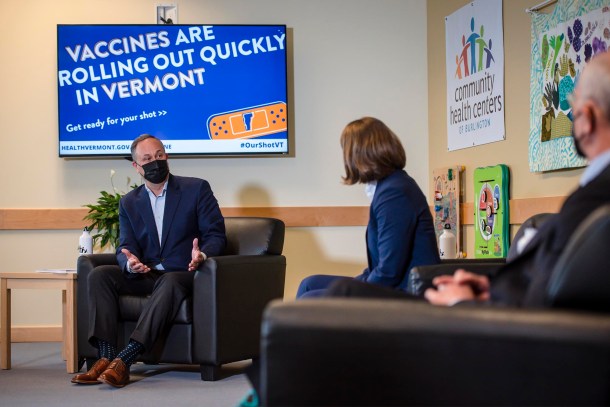
Emhoff also participated in a roundtable discussion with Vermont leaders — including Gov. Phil Scott, Lt. Gov. Molly Gray, U.S. Rep. Peter Welch, D-Vt., and Burlington Mayor Miro Weinberger — about efforts to vaccinate underserved communities.
Emhoff praised Vermont’s pandemic response.
“We have to get through this as a country, and you in Vermont, the leaders here, state, local, federal, are showing the way on how we can all do this. You just come together and solve one of the worst problems we’ve ever had as a country,” he said.

Scott told Emhoff that when the pandemic hit, Vermonters “followed the science, the data, from Day One.”
“This has led us to where we are today: We’re the safest, healthiest state in the country,” Scott said, citing statistics that show Vermont has the second-lowest number of Covid-19 deaths in the U.S., next to Hawaii.
“We have a lot of things going for us. We just need more supply. We need to get more vaccines in people’s arms,” the governor said. “We’re just about to the end. We just have to keep it up and do the right thing because I think we’ll be out of this by the Fourth of July.”
Emhoff said the federal government will make sure there’s enough supply for everyone to be vaccinated.
“We are close, but we are not there, and you kind of see some of the numbers spiking up around the country where folks are letting their guard down a little bit,” Emhoff said. “This is not the time to let your guard down. This is the time to get us over the finish line as one united country, like we’re seeing here in Vermont.”
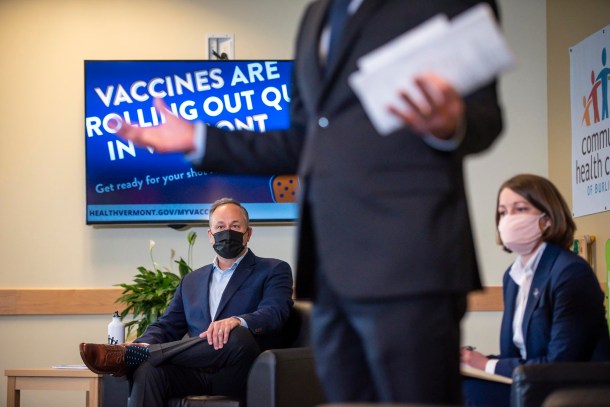
The Community Health Centers of Burlington treat many members of Vermont’s New American community, and on Wednesday held a clinic focused on vaccinating communities of color.
The pandemic further revealed inequities in the public health system. Black Vermonters have faced the highest rates of Covid-19 infection in the state.
“We are not proud” to be one of the least diverse states in the nation, Gray said. She commended Scott for holding vaccination clinics for people of color and establishing the Vermont Multilingual Coronavirus Communication Task Force, which translates pandemic-related information for New Americans.
The lieutenant governor said that providing “equitable, affordable access to broadband for all Vermonters” is an important step to address disparities in the health care system.
“I don’t think we can talk about equity and public health without talking about broadband,” she said.
Emhoff said he couldn’t agree more, noting the importance of telehealth services in rural communities.
Women have been disproportionately affected by the pandemic, Gray said, and 74% of unemployment claims filed in the state last fall came from women.
After the roundtable, Emhoff made a stop at the O.N.E. Community Center in Burlington, where he met with members of the Association of Africans Living in Vermont.
Irene Webster, a case manager for the association, sang a song in Swahili titled “Chanjo,” or vaccine, accompanied by another singer and a dancer. Webster, whose stage name is KeruBo, said she wrote the song to help promote Covid-19 vaccines among members of her community who have been hesitant about getting immunized.
KeruBo released a video of the song in January, and in response more community members have started getting vaccinated, she said.
“It is working, actually. The numbers are starting to rise,” Webster said.
