

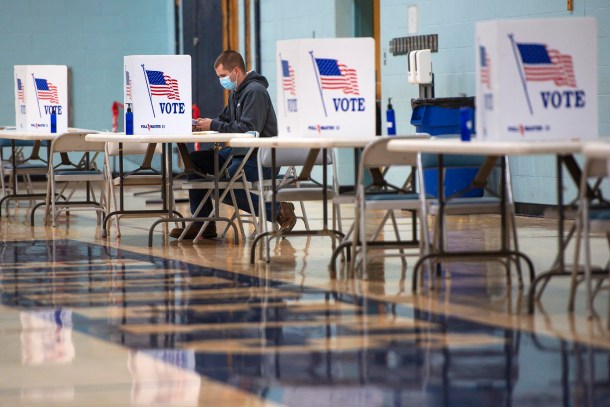
Voters on Tuesday once again rejected a proposal to merge the governments of Essex and Essex Junction.
According to preliminary results from the town clerk, 4,225 votes were cast against the merger, while 4,199 voted in favor. The 26-vote margin was similar to the results from Town Meeting Day in March, when it was originally posed to residents.
The town of Essex and the village of Essex Junction already share the same finance department, the same municipal manager and the public works manager. Tuesday’s merger vote means further consolidation between the two communities is unlikely.
The merger lost by 19 votes on Town Meeting Day, with 3,756 against and 3,737 in favor, following a recount. The close margins prompted some Essex residents to create a petition to put the merger question to the reconsideration vote.
A recount of Tuesday’s results is still possible.
Essex Junction residents, who passed their own merger proposal in November, also voted on a nonbinding resolution to advise the village government to draft a separation charter, in the event that merger failed. That question passed with great support, with 2,689 votes in favor and 709 against, according to preliminary results.
Such a charter would split the village with the town government and create an independent city of Essex Junction. Essex Junction property owners would no longer pay taxes to the town on top of the taxes they already pay to the village and would no longer benefit from town services except in certain agreed cases, like the police department.
Separation would likely undo the work that has gone into the consolidation of certain municipal services in recent years.
The Essex Junction board of trustees will likely convene to create a committee to research what effect separation could have, according to board President Andrew Brown.
Had the merger question passed, the Legislature would have had to square the key differences between the two proposals — namely, the matter of representation.
But residents in the town of Essex passed a separate charter last March to change the format of the town selectboard to a 3+3 model, with three representatives from the town and three from the village, regardless of a merger. An act to approve the charter, H.95, is yet to move out of the House Committee on Government Operations.
It isn’t clear when, or if, that act will be taken up this session.
“The only thing that we had heard a while ago, which makes complete sense, is that the state is working on Covid and financial issues related to Covid,” City Manager Evan Teich said. “They were very clear with us that if there was time, they would address it, but things just keep happening.”
