


With guidance scheduled to relax May 1, a coalition of Vermont restaurant owners is pressing the state to prioritize food service workers for the Covid-19 vaccine.
Many in the industry fear the new guidelines will bring larger crowds and more out-of-state tourists to their establishments, which they say puts their staff at greater risk for infection.
Step 2 of the state’s four-phase restart plan shifts restaurants and bars to “universal guidance” starting May 1. The move would lift current capacity limits for these establishments, so long as parties are spaced 6 feet apart.
“We’re seeing the tidal wave coming, and we have an unvaccinated workforce,” said Jed Davis of the Farmhouse Group, which operates five restaurants in the Burlington area. “That’s a little scary.”
Davis and other business owners formed Vermont Independent Restaurants in March 2020 to advocate for food service businesses while Covid restrictions hammered the industry. In the past week, representatives from the group have met with the Scott administration and organized a social media campaign, asking the state to provide employees a one- or two-day window to register for appointments before the 16+ age group becomes eligible April 19.
That age group includes all remaining Vermonters who are authorized to be vaccinated. Officials have said they expect it to be the largest population to enter the registration system at once.
“We’re just saying crack the door open,” Davis said. “Allow this subsector of this population to have a first crack at getting at the front of the line.”
Several Burlington, Stowe and Waterbury-area restaurants, including Hen of the Wood, Prohibition Pig, ZenBarn and The Reservoir, have joined the campaign, posting similar messages under the hashtag #safetoserve.
Vermont is one of 10 states that did not prioritize food industry workers for the vaccine, according to a Boston University tracker. Twenty-seven states included those workers in Phase 1B of their vaccination schedules, in line with recommendations by the vaccine advisory panel of the U.S. Centers for Disease Control and Prevention, and 13 more offered later prioritization.
“We recognize and appreciate how the most vulnerable populations have been given priority,” Sue Bette of Bluebird Barbecue wrote in an Instagram post Friday. “NOW we are asking for priority to be given to our teams so that they can work and create experiences for our social recovery.”
In March, a VTDigger analysis of state case data by occupation showed that during the first three months of 2021, food service workers in Vermont had the highest rate of Covid-19 infection of any occupation in the state.
Asked Friday whether prioritization for these workers was under consideration, Gov. Phil Scott said, “Bluntly, no.”
Scott applauded workers for wanting to be vaccinated but said establishing a registration system that could be used only by that sector would be complex. “It would take us more time to develop the system in order to accomplish that than it would be to just let this happen on the 19th,” he said.
Scott has also faced criticism for not prioritizing grocery workers or incarcerated people, and teachers were included in the state’s vaccination schedule only after weeks of pushback.
The governor and other officials have emphasized that the state’s vaccine schedule was designed to minimize hospitalizations and deaths, a strategy experts say has been effective.
It has also left younger populations more susceptible to the virus. State data presented last week showed the median age of infected Vermonters approaching 25, down from over 40 in November.
The heightened risk to service staff also has an economic impact, business owners say. A single Covid case among staff can shutter an establishment for 10 days at a time, resulting in lost revenue for the business and lost wages for employees.
“We’re just completely frustrated at the administration’s lack of recognizing that struggle as a real struggle of our industry,” said Mark Frier, who owns four bars and restaurants in Stowe and Waterbury.
The new state guidelines allow businesses to set stricter policies if they choose. Owners say that forces them to choose between the safety of their staff and potential lost business.
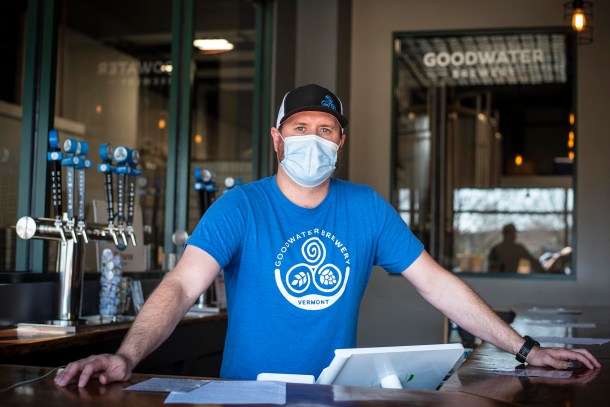
Aaron Smith, the tasting room manager at GoodWater Brewery in Williston, said a shutdown would disrupt dine-in service and brewing operations there.
“It’s tough to be strict because you don’t want to turn people away,” Smith said. “But at the same time, a $6 pint could cost you $10,000 in revenue and lost business.”
Plus, Smith said, communicating with customers about evolving restrictions can be a challenge. In recent weeks, the brewery has gotten pushback from customers who bristled at being quizzed about the state’s travel guidelines.
“I’ve been flipped off,” Smith said. “I’ve been called every name in the book.” Some customers who have been asked to leave have written negative reviews on Yelp and Facebook.
The balance is even trickier for tipped employees, Smith said, who may hold off from asking a customer to mask up, for example, if it could risk lower tips.
Andrew Dennison, a front-of-house manager at The Farmhouse Tap and Grill in Burlington, said he’s repeatedly spoken to unmasked customers from behind the bar who have admitted they are visiting in violation of the state’s travel guidelines.
Dennison said the recent warm weather is already leading customers to gather in larger groups and behave more like last summer, when Covid cases were low — yet current case counts show ongoing community spread.
“Being vaccinated would just make a lot of people feel a lot safer. I think it’d be a sign of good faith,” Dennison said. “I think to a lot of people, it feels like restaurant workers have sort of fallen by the wayside.”
