


For seven days following the Atlanta shooting that killed eight people, including six Asian American women, a group of Asian American Vermonters looked to state leaders for a response.
They hoped for public condemnations of the acts or a renewed commitment to rooting out discrimination against Asian Americans in Vermont.
Instead — from politicians, colleagues and local media — they heard silence.
Weiwei Wang, a member of VT APIDA (Asian Pacific Islander Desi American) for Black Lives, said that, in the first few days after the shooting, her Black and Asian friends reached out, along with other Vermonters of color.
“But there was a distinct silence from white friends, white colleagues, a lot of whom I have known for a very long time — I grew up in the state,” she said. “That was an overwhelming silence, just this lack of acknowledgement.”
On March 23, a week after the shooting, Wang helped co-author a letter from VT APIDA for Black Lives to local politicians, members of the media, “mayors, friends and colleagues,” detailing concerns about the lack of response and calling for action.
Though she emphasized that, when it comes to discrimination, every Asian American has a unique experience and perspective, Wang said the silence from state leaders echoed feelings of invisibility that many Asian Americans living in Vermont have felt for a long time.
“It’s just the gradual awareness of how little people actually see us,” she said. “That’s part of the reason why we wrote the letter. And we decided to send it out exactly a week after the murders, because it’s been a week and nothing has been said.”
The group had originally gathered to express solidarity with Black Americans following the death of George Floyd, meeting monthly to plan events and learn more about racism and advocacy.
“This week, our conversation turned inward,” the letter reads. “It was reflective and pained by silence: moments of silence for the deceased, the silence of our political leaders, friends and colleagues, the silence created when there is an absence of action after a promise or tweet.
“We breathed in that undisturbed air and let it quiet our brown and golden bodies temporarily. But that silence has since turned into anger.”
Discrimination in Vermont
Nationwide, hate crimes against Asian Americans have surged during the pandemic, as former President Donald Trump and members of his administration repeatedly called Covid-19 the “Chinese virus.” A report by national nonprofit Stop AAPI Hate breaks down the nearly 3,800 hate crimes reported in the last year from all 50 states and Washington, D.C.
This violence continued in other parts of the country this week. On Monday, in broad daylight on a Manhattan sidewalk, a man kicked a 65-year-old Filipino woman in the stomach, knocking her to the ground, then kicked her again in the head, telling her, “You don’t belong here.” Rather than helping the woman, who was left lying on the ground, three security guards, standing in a nearby storefront, closed their door. The man was charged with felony assault as a hate crime.
Of hate crimes reported, 68% were targeted at Asian American women.
Xusana Davis, Vermont’s racial equity director, said she hears anecdotally about incidents in Vermont, but doesn’t receive a large volume of formal complaints.
“A lot of people don’t want to come forward, which makes it difficult to pursue them formally,” she said. “It also forces us to grapple with the question of how many more are happening that we never find out about, even anecdotally.”
The letter from VT APIDA for Black Lives said employers and landlords often don’t give the same opportunities to Asian Americans as they do to others, and much of the discrimination comes after those with authority hear the applicant’s name. The letter notes that in Vermont, the average earnings of Asian American women are far less than those of non-Hispanic white men.
“That loss has had an impact on our ability to invest, purchase land, choose the right schools for our children and plan for their futures,” the letter says.

Davis said discrimination against Asian Americans in Vermont predates the pandemic.
“I think a lot of people are under the very mistaken belief that because the AAPI population in Vermont might be small, that therefore it’s either not happening or not as bad as people say it is,” she said. “That’s completely false. It is real. It is happening. It is creating a chilling effect for people who want to be or stay in Vermont.”
Specific incidents have been reported by news outlets around the state. In October, Haiyan Hu was called a racist slur that refers to someone of Chinese descent by a man at the Bennington Monument, which she was visiting with her son. He also repeatedly told Hu, who is from Brattleboro, to “go home.”
In 2016, Charmaine Lam, an intern at the Addison Independent newspaper in Middlebury, wrote about microaggressions she faced while living off-campus for the first time, writing, “I don’t think I’ve ever felt this far from a sense of home.”
Days after the shootings in Atlanta, Castleton University student Lily Doton wrote about her fear and feelings of invisibility, citing disparaging comments she received while waitressing.
Brian Hsiang, a member of VT APIDA for Black Lives, told VPR in a recent interview that he was on a trip with his daughter in 2017 when, while stopping for gas, someone called him a “dirty pig.” He’d been harassed before, he said, but never before in front of his daughter. The experience was exacerbated by friends and family who questioned whether the incident was actually racially motivated.
“As a man who grew up in this country with deep brown skin, a lot of us have a feeling that we know when something is an act of racism,” he told VPR.
That line of questioning — “Are you sure?” — happens constantly and is exactly what makes Asian Americans feel invisible, he said.
Bor Yang, executive director of the state’s Human Rights Commission, told Seven Days in 2019 that she was instructing an implicit bias training when she learned that a participant said behind her back that she should “go back to her own country.” The experience made her want to leave Vermont.

“There is a gap between what is actionable and what offends our community morals and values,” Yang told VTDigger. “It is sad, but it is true that employers, government, business owners and housing providers look to the law to determine their minimal obligation. Those laws are outdated, one-sided and do not reflect a conscious, purposeful and progressive Vermont that seeks to embrace and celebrate diversity.”
And Wang, with VT APIDA for Black Lives, said she often has walked into Vermont restaurants where other diners stare at her and other family members.
“There are a couple of times where we ate really quick because we were scared,” she said.
Since middle school, she said, people around her — including friends — have asked uncomfortable questions and made racist remarks.
“These are things that I experienced, but nobody ever did anything,” she said. “Everybody just laughed.”
Wang said she hopes more officials will publicly denounce the attacks in Atlanta and acknowledge discrimination that takes place in Vermont.
“Asian American issues are wrapped in with all other BIPOC issues,” Wang said. “We’re tired of not being seen or acknowledged. No matter what race you are, if you’re not white in this state, it feels like we’re just left behind.”
The letter’s action items
Along with imploring state leaders to speak out against violence and discrimination, the letter from VT APIDA for Black Lives urges Gov. Phil Scott to issue an executive order that “calls upon every agency, department, university, employer to study and address equitable representation and equal pay on their boards, commissions, and positions of leadership.”
The letter asks leaders to support a number of bills that would implement protections against discrimination, along with forming and expanding task forces and working groups that can continue to address institutional racism.
In a statement provided to VTDigger, Scott decried the murders in Atlanta, calling them “heinous.”
“The increase of hate crimes against the Asian American community is something we should all condemn,” he said. “Unfortunately, no state is immune from hatred, and we all have a role to play in ending these acts of violence.
“It is also critical to address systemic racism and biases in government and throughout our communities, which is something we are working to do on a daily basis here in Vermont — as led by the state’s Office of Racial Equity, but also involving every agency and department.”
Davis said her office is working toward some of those goals through Scott’s executive order — in response to George Floyd’s death — to form the Racial Equity Task Force.
“It was an explicit item that the task force was supposed to examine about getting more people of color into positions of leadership in Vermont in all levels, including boards and commissions,” Davis said.
VT APIDA for Black Lives also has a message for criminal investigators: “When the victim of crime is a person of color, assume from the start that it is a hate crime until a full and thorough investigation proves otherwise.”
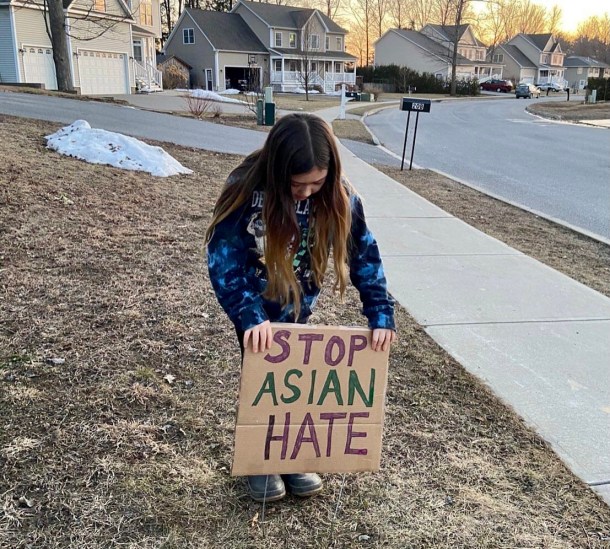
The latter call-to-action follows criticisms of officials who did not immediately link the murders in Atlanta to racism and misogyny. A sheriff’s deputy in Atlanta, Capt. Jay Baker, was removed from his spokesperson role after he said the shooter “had a really bad day” before he committed the murders. The deputy had also promoted anti-Asian T-shirts on his personal Facebook page last year.
Particularly painful was hearing that the gunman told authorities that he committed the killings to quell his sexual desire for the victims. Asian American women are often fetishized in popular culture, perpetuating the cross-section of sexism and racism.
“I think that all BIPOC women experience this in one way or another,” Wang said. “You’re just sexualized.”
In Vermont, media outlets (including VTDigger) didn’t pick up the story immediately after the shootings but instead responded to the letter from VT APIDA for Black Lives, which was sent to a flurry of reporters last week. Wang said it reminded her of last summer, when George Floyd’s murder precipitated protests and quickly became the biggest story in the country, even though racism and police brutality weren’t new issues.
“Suddenly there’s a giant scramble to help out,” Wang said. “It’s like, well, how long is this going to last for us? Is this awareness going to be there moving forward, or is this going to be something where people are posting on Instagram and writing stories now because it’s the cool thing to do?”
Yang, who leads the Human Rights Commission, held a town hall about discrimination against Asian Americans last spring. She said she hopes to see more proactive work about marginalized communities.
She said education is a key component in creating change and hopes schools will adopt curriculum that includes the contributions of Asian American leaders.
“We are a nation and state that continuously responds to crisis but not one that is motivated to do the hard and controversial work proactively,” she said. “As a member of the AAPI (Asian American Pacific Islander) community, we want to see our state leaders, white Vermonters, media and friends denounce the attacks, reach out, believe us and educate yourself about what is happening. Do not wait until something happens in Vermont before responding.”
“Our stories, as well as the stories of other BIPOC people,” she said, “must permeate every fabric of Vermont life.”
