

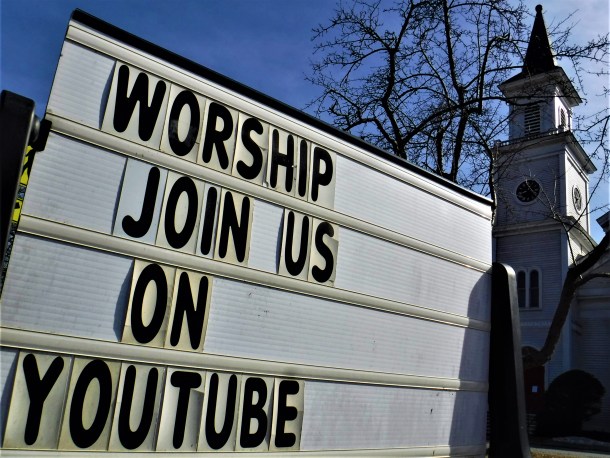
A year after moving to online offerings, some Vermont spiritual communities are returning to in-person services this Easter, Passover and Ramadan, while others continue to restrict gatherings to virtual ones.
“If you recall, none of our churches were open for the Easter celebrations last year as we began the initial struggle to contain the Covid-19 pandemic,” Vermont Catholic Bishop Christopher Coyne said. “Unlike last year, Easter this year is a bit more festive, a bit more celebratory.”
As the state’s largest religious denomination, the Roman Catholic Diocese has scheduled Easter Masses this week at most of its churches. But other faith groups, including many Protestants, Jews, Buddhists and Muslims, have yet to return to their buildings as they stay plugged into the internet.
“Although people are getting vaccinated, we’re nowhere near the rate for us to feel confident,” the Rev. Lynn Bujnak said as leader of the Vermont Conference of the United Church of Christ. “We’re continuing to suggest the safest way to do worship is on Zoom.”
Gov. Phil Scott originally prohibited large gatherings at the start of the pandemic but now allows religious facilities to operate if they follow mandatory health and safety guidance and limit attendance to 50% of fire safety occupancy or one person per 100 square feet.
Vermont’s Catholic churches — with 118,000 members in 72 parishes — were the first in the state to resume in-person services while retaining a daily broadcast Mass. Attendees must be healthy, wear masks, sanitize their hands, sit 6 feet apart in designated pews and, if required, register in advance.
“Because we have been careful, we have had no major outbreaks or incidents in our churches,” Coyne said. “As a result, we are quietly creeping back to normalcy.”
The United Church of Christ — Vermont’s second-largest denomination with 14,000 members in 135 locations — allows individual congregations to decide whether to open while recommending they don’t.
“We only have a handful of churches meeting in person — almost everyone is online,” Bujnak said. “There still are questions about if we’re going to end up with a fourth wave and what happens with variants. I would love to have a crystal ball that could see into the future, but I don’t feel we have that right now.”
The Green Mountain District of the United Methodist Church, the third-largest denomination with 8,200 members in 115 congregations, encourages online services or, if in person, careful screening and signing-in of participants.
“We are receiving many questions about whether or not the availability of the vaccine and the decline in infection rates in some areas mean churches should consider returning to in-person worship,” leaders wrote in a recent letter. “We do urge extreme caution.”
The Episcopal Church in Vermont, the fourth-largest denomination with 5,700 members in 47 congregations, will continue to provide online prayer after suspending its option for outdoor worship just before Thanksgiving.
“With more people receiving vaccines every day, it is tempting to relax some of the restrictions under which we continue to operate,” leaders wrote in a recent letter. “However, we must remain vigilant in order to protect the vulnerable Vermonters in both our congregations and communities who have not yet had the opportunity to be vaccinated.”
American Baptist Churches of Vermont, the fifth-largest denomination with about 6,000 members in some 75 congregations, is an association of local, autonomous parishes that make individual rather than regional plans.
The First Baptist Church of Manchester, for example, will offer both in-person and online Easter services as well as an egg hunt on the town green.
“To keep it in line with safety guidelines, each family will have the park to themselves for a five-minute time slot,” the church website said about the egg hunt.
Christians aren’t the only religious community observing a major holiday this spring. Vermont Jews are marking Passover by retelling the Exodus story of how the Israelites saw a deadly plague miraculously “pass over” them some three millennia ago, helping lead to their emancipation.
The conduit organization Jewish Communities of Vermont, representing a Green Mountain State population estimated as high as 25,000, is posting online programs and information on its Facebook page.
For their part, Muslims at the Islamic Society of Vermont will begin the holy month of Ramadan April 12 by performing good deeds and praying and fasting from dawn to sunset — all with help from video teachings on the society’s Facebook page.
Most Buddhist sanghas are taking similar Covid precautions. The Brattleboro-based Vermont Insight Meditation Center, for example, is meeting daily online as it looks for a new home.
“Whatever space we choose for in-person gatherings, we imagine that all events will also be accessible on Zoom,” leaders wrote in a recent newsletter.
