

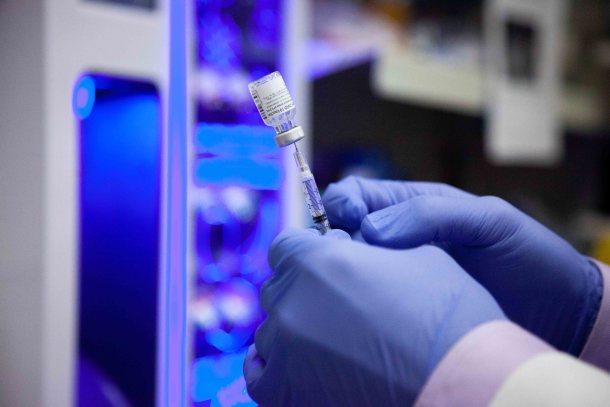
Covid vaccines by three different manufacturers are going into Vermonters’ arms every day. Which one is best?
That question is misguided, experts say — although there may be rare cases in which one brand would be preferable.
“The best one you can get is the one you can get right now,” said Dr. Mark Levine, commissioner of the Vermont Department of Health, at a press conference Tuesday. All three vaccines have been proven to prevent illness and death, he said, and time is of the essence when it comes to suppressing the coronavirus.
But Levine also said that sometime in April, the state will likely begin listing the brand of vaccine being offered at each clinic, allowing Vermonters to sign up for the vaccine they prefer.
Some Vermonters seeking a specific vaccine for medical reasons have reported difficulty signing up for the correct one, an issue that would be alleviated by the change. Yet experts warn that offering too much choice among brands could slow the overall pace of vaccinations.
So when is “vaccine shopping” appropriate, and when is it unnecessary or even harmful?
Basic differences
The three Covid vaccines authorized for emergency use by the Food and Drug Administration — made by Pfizer/BioNTech, Moderna and Johnson & Johnson — are all safe and effective, experts say. But there are key differences.
The Pfizer and Moderna vaccines use mRNA, a type of genetic material, to help the body fight the coronavirus. Both require two doses of the vaccine, about 3-4 weeks apart, to be fully effective.
The Johnson & Johnson vaccine has a chemical makeup more similar to previous vaccines for Ebola, flu and Zika, and it requires only one dose to be effective.
Only the Pfizer vaccine has been approved for use in people age 16 and 17 — meaning most eligible Vermont teens will be seeking out Pfizer shots as soon as April 19, according to the state’s eligibility schedule.
All three vaccines also include potential allergens that could lead a patient to seek out a specific brand, according to the Centers for Disease Control and Prevention. (The CDC adds that allergies not related to vaccines or injectable medications, like food and pet allergies, do not increase risk for a reaction to any Covid vaccine.)
‘Vaccine shopping’
The three vaccines also have varying efficacy, according to clinical trials. But experts warn that placing too much weight on this metric obscures the overall effectiveness of all three.
“The vaccines appear to all uniformly prevent severe disease and death,” said Dave O’Connor, a professor of pathology and laboratory medicine at the University of Wisconsin. “Really, that’s the thing that we need a vaccine to do above all else.”
Pfizer and Moderna reported efficacy of about 95% before their FDA authorization, while Johnson & Johnson reported an overall efficacy of about 66%.
O’Connor said those numbers don’t tell the full story. Johnson & Johnson conducted trials later than Pfizer and Moderna, at a time when Covid cases were higher across the globe. The company’s trials also took place in certain countries, like South Africa, where new variants of the virus were just beginning to emerge.
Those differences make comparing efficacy ratings less valuable, O’Connor said.
“It’s kind of like looking at the scoreboard at the end of a basketball game without seeing how the game was played,” he said. “The score could be an accurate representation of how the game was played, or it could be somewhat deceptive. And all we have is those final numbers.”
Shopping around could slow down the vaccination effort, O’Connor said.
For individuals, waiting for a specific vaccine to become available creates a window of time during which a person could become infected. In aggregate, a mass of people calling around to look for a specific vaccine could strain public health resources, he said. “They’re creating unneeded stress on a system that really should be focused on speed above all else.”
Age and allergies
Some seeking out a specific vaccine for medical reasons — age or allergies — have received conflicting information from the state.
Vermonters age 16 or 17 with a qualifying health condition are eligible for the vaccine now, but they must seek out the Pfizer vaccine. Health Commissioner Mark Levine said on March 16 that making an appointment by phone is the best way to ensure those patients will receive the proper vaccine.
Levine added that most pharmacy locations are using Pfizer exclusively, in part because they were initially involved in a federal program that prioritized Pfizer doses.
Those with certain allergies are in a different boat.
According to the CDC, people who are allergic to polyethylene glycol, or PEG, should avoid the Pfizer or Moderna vaccine and seek out Johnson & Johnson.
But so far, Vermont has used Johnson & Johnson doses only at specific clinics for teachers and school staff. “As supplies increase and we near vaccination of these groups, the vaccine will be made more widely available,” health department spokesperson Ben Truman said Wednesday.
Tracy Dolan, deputy commissioner of the health department, told Vermont Public Radio on Tuesday that the issue was supply. “We don’t have enough of [Johnson & Johnson] to allow for that kind of choice,” Dolan said. “However, we anticipate in the next few weeks we will have a more obvious choice when you sign up.”
Wadi Sawabini, whose wife, Mary, has a PEG allergy, has been frustrated by the state’s lack of accommodation so far. “There’s just no plans to take care of people who have these allergies,” he told VTDigger.
Sawabini has tried and failed to get clarity from the health department. “You call the helpline, and they have no idea what you’re talking about,” he said.
Jen, who is also allergic to PEG, had a similar experience. (She asked that only her first name be used to avoid sharing personal health information.)
Jen said she called the health department twice to find out whether she could register for a Johnson & Johnson shot. The first operator told her she could specify her preference online, which was incorrect. The second operator told her Johnson & Johnson would not be available and suggested she accept a Pfizer or Moderna shot despite the risks. “I just thought that was outrageous,” Jen said.
Jen questioned the logic of reserving Johnson & Johnson doses for school employees when those with certain health conditions should be eligible to get vaccinated now. “It just feels that specifically for people that have medical contradictions, why would we not save those?” she asked.
Politico reported Monday that several states appear to be reserving their supplies of the Johnson & Johnson vaccine for specific groups, in some cases against the wishes of the Biden administration.
At a White House Coronavirus Task Force meeting on March 1, federal health officials stressed that all three vaccines should be distributed equitably to the general public.
Jeff Zients, the panel’s chief, said, “If we were to see that vaccines were going to certain communities, we will take action … to ensure supply is distributed evenly.”
Truman of the Vermont health department said that as of Wednesday morning, 4,486 Johnson & Johnson doses, 52% of what the state had received so far, had been administered.
“The complex logistics of supply and distribution may impact how quickly we can move the doses,” Truman said, “but the state’s vaccination programs — planned and implemented in cooperation with a broad network of community, health care and federal pharmacy partners — are designed to meet the goal of fully vaccinating every eligible Vermonter as quickly as possible.”
To register for a vaccine appointment or get information on walk-in clinics, visit healthvermont.gov/MyVaccine or call 855-722-7878.
You will be asked to provide your name, date of birth, address, email (if available), phone number, and health insurance information (if available, but not required).
