


Maple syrup season has come to Burlington. Normally, you’d have to go into the woods to find the taps, buckets and tubes that gather the raw material for Vermont maple syrup.
But a group called Tap Old North End is bringing sugaring equipment to Burlington’s public spaces and backyards.
“It’s actually super grassroots,” said Sage King, one of the organizers behind tapping the city’s public maple trees.
Tap Old North End isn’t a business or a nonprofit; “it’s way more like a group of friends,” King said — friends who share an interest in the outdoors and want to make better use of Burlington’s land.
“We felt like people needed something to connect with,” as Burlington marks the first anniversary of isolation brought on by Covid-19, King said. “And we figured that being outdoors was such a perfect place to do it.”
In the past few weeks, the group has organized tapping trips to Lakeview Cemetery along North Avenue. Vermont’s sugaring season typically runs from late February to early April, as the first thaws of spring are occurring. The changing temperatures change the pressure in the trees, which drives out the sap.
King said the group contacted the city’s arborist, Vincent “V.J.” Comai, for permission to tap Burlington’s maples.
“My initial reaction was, where do you plan on doing this?” Comai said. He had some concerns about tapping maples close to roads or populated parks. He didn’t want sap buckets to be vandalized or used as cigarette butt disposals.
He helped the group settle on Lakeview Cemetery because it had a healthy grove of maple trees away from densely populated areas and because those trees aren’t affected by stormwater runoff or road-salt treatments like those closer to city streets.
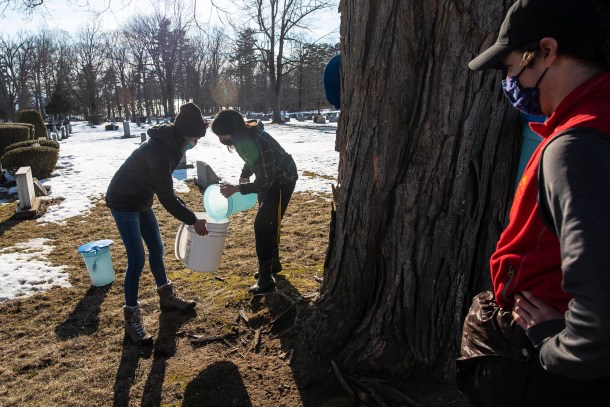
The city government supports the idea, and Comai said he hopes that the partnership can continue in coming years if things go well this season.
“We all agree the mission is a good one,” Comai said. “They want to get people out in nature; they want to get people to connect. That’s what the Parks and Recreation Department is all about.”
The group obtained equipment — such as sap buckets and drills — from University of Vermont lecturer Walter Poleman, director of the university’s ecological planning program. He said he’s collected sugaring equipment over the years, including a portable maple syrup evaporator. That’s the device needed to boil gallons of sap into Vermont’s famously sugary, sticky maple syrup.
The first sap boil
Poleman’s daughters, Maeve and Wynne Poleman, hosted a socially distanced sap boil in their backyard Wednesday afternoon after the first batches had been harvested from Lakeview Cemetery.
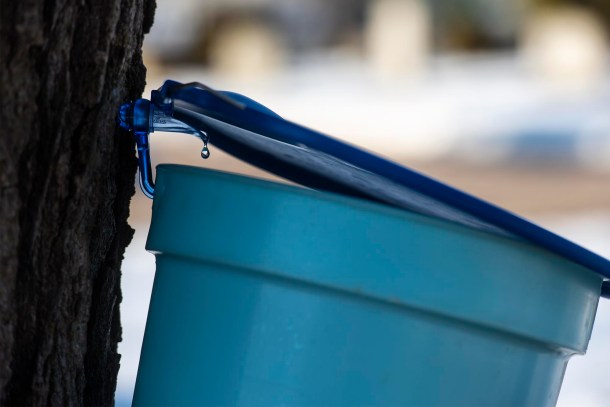
While Wynne was headed to the cemetery with a few friends and five-gallon buckets to collect what sap they had, she explained that a standalone maple can produce more sap than trees in a sugarbush, a cluster of maples where commercial syrup is typically harvested.
She said maples are incredibly absorbent trees, and the nutrients they take in around them will affect the taste of the syrup that’s made.
Tap Old North End planned to make its first batch of syrup Wednesday evening.
“It might not filter right; it might be a bit gritty,” Wynne said. “But we’ll have pride in it.”
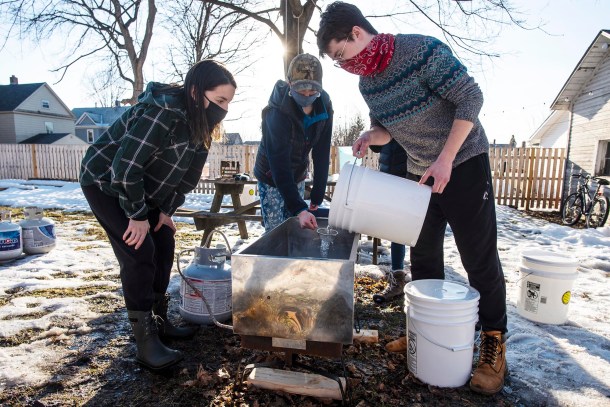
When the sap arrived in the Polemans’ backyard and was dumped into the evaporator, Maeve gave a maple-syrup quiz to a small group of neighbors and friends who had gathered for the occasion.
“Does anyone know how many gallons of sap you need, from the tree, to make one gallon of syrup?” she asked.
“Two hundred!” someone responded.
“Not 200, thankfully,” Maeve said.
It takes about 40 gallons of sap to produce one gallon of syrup. The first tap of about 20 Lakeview trees produced about 10 gallons of sap on a day when the temperature rose to almost 50 degrees.

It takes a few hours for the sap, which is as clear as water and has a slightly sweet taste, to boil down to the brown, sugary properties of syrup. The batch’s temperature has to be checked frequently, Maeve explained — 220 degrees Fahrenheit is the sweet spot; too high, and the batch could be ruined.
The group embraces its novice status. Complex questions about maple syrup production might be met with a humble shrug or a confession of ignorance.
“I mean, I didn’t even know how to identify a maple tree when we first started,” King said.
But the interest the group has drawn from neighbors — alerted through Front Porch Forum and Reddit — has proved that others want to learn, too.
“We want to offer people the chance to learn about something that is such a quintessential Vermont trade,” Maeve said.
Vermont is the top producer of maple syrup in the United States, turning out more than 2 million gallons in an average year; New York is a distant second.
Maeve said she hopes that as the group and the supply of sap continue to grow, community groups can get involved and maybe syrup sales could benefit the neighborhood or local businesses. Right now, the group’s goal is to provide community.
“Definitely getting people outside, getting people connected with the trees and the land, which can be harder to do in a city,” Maeve said. “We love living in Burlington, but there is that draw to be more outside. … So we just want to offer people a chance to do that.”


