


BENNINGTON — After students were asked to role-play an interview between an undocumented immigrant and an immigration official, school officials have agreed to make several policy changes in curriculum related to marginalized communities.
Rutland Area NAACP President Mia Schultz had predicted that schools would dive into discussions about race in February, which is Black History Month, so she distributed a document with recommendations to teachers across the state about teaching Black history.
Years ago, a middle school teacher had asked Schultz’s son, who is Black, to role-play as a slave. She reached out for support after the experience, which embarrassed and hurt her son, and that was how she was introduced to the local chapter of the NAACP.
“Anybody can Google and do the homework on why that’s not a good idea, to ask kids — especially Black and brown kids — to re-create trauma like that,” she said.
Schultz wanted to make sure other students didn’t have similar experiences. In the 36-page NAACP document, she emphasizes that simulations, like the one from her son’s class, are particularly harmful.
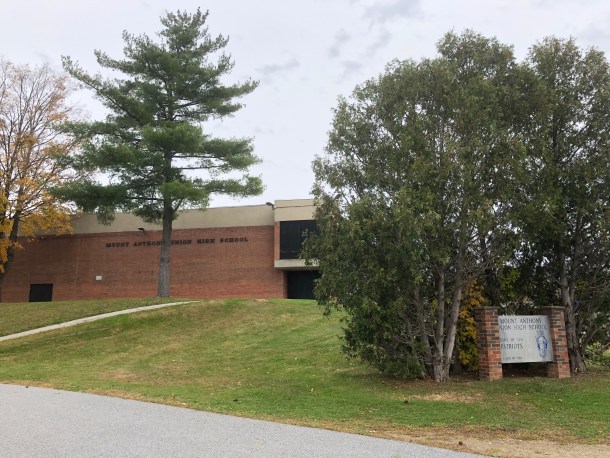
So Schultz was surprised when, in late February, she learned that her son’s history teacher at Mount Anthony Union High School had incorporated an immigration-focused role-playing activity into the curriculum.
The assignment required two students to act out an interview between an “illegal alien” and a U.S. immigration official.
“Be nervous,” the worksheet says, instructing the student playing the undocumented immigrant. “You are about to get deported, along with your children.”
The worksheet guides the student playing the immigration official through a series of questions about the immigrant’s status, children, home country and occupation. At the end of the activity, the worksheet suggests that the remainder of the student body ponder whether the immigrant and his or her children should be deported.
“Would you allow this alien to stay, or would you deport him or her?” the worksheet asks the students. “What about his or her children? Explain your reasoning.”
Schultz said she got goosebumps as soon as she saw the words “role-play” and “immigrant” on the description of the assignment, and removed her son from the class. Schultz said she’s upset with the system, not individuals at the school, but wanted to see swift change.
“This is not acceptable, and this is twice,” she said.
The activity, along with a second worksheet that asked students to give opinions about the connection between immigration and terrorism, was the subject of a meeting between administrators from the Southwest Vermont Supervisory Union and several advocacy groups, including the Windham County and Rutland County chapters of the NAACP and the Education Justice Coalition of Vermont.
Members of the advocacy groups left the meeting on March 4 with a spoken promise from the supervisory union that teachers would discontinue role-play in history classrooms and reevaluate the history unit.
District officials are also auditing the history curriculum and providing professional development for teachers — measures that were in place before the meeting, officials told Schultz.
The pledges were not put down in writing, Schultz noted. Neither Mount Anthony Principal Stephen Nixon nor James Culkeen, the superintendent for the Southwest Vermont Supervisory Union, responded to messages seeking comment on Tuesday. Both attended the meeting.
Alyssa Chen, coordinator for the Education Justice Coalition of Vermont, said the meeting represented a larger, statewide conversation.
The coalition was formed to support implementation of Vermont’s Act 1, which established a working group to analyze public school curriculum to ensure it fully recognizes “the history, contributions and perspectives of ethnic groups and social groups.” The group must present its recommended standards to the State Board of Education by June 30 of this year.
“When there’s curriculum being taught out there that is violent to these specific groups and causing harm to them, then we want to play a role, not only to support those individuals that are being impacted,” Chen said, “but also to leverage it as an opening, to shift not just that one lesson, but what’s being taught more generally in schools.”
Chen saw multiple problems with the immigration role-play activity. First, she said, it repeatedly used the term “illegal alien,” which places immigration in a negative context and doesn’t represent many immigrants in Vermont.
She also said teachers should generally avoid asking students to role-play history.
“Students from marginalized groups may be really impacted by these role-plays by having to basically reenact trauma,” Chen said. “Students from majority groups might feel … a false sense of empathy, as though they’re understanding it.”
Finally, Chen said the activity links immigration to terrorism, which underlines harmful steotypes and often false associations that can affect marginalized students.
Schultz posted about the incident on Facebook, and her message was shared more than 130 times. She received a number of messages from community members who were concerned about the curriculum.
Schultz doesn’t think anyone within the district, including the teacher, intended to harm kids. She understands that the district was intending to teach them about the nuances of immigration policy and implicit bias.
“This was part of a critical thinking skill,” she said. “But there’s other ways to teach implicit bias. By no means am I saying, ‘Do not teach implicit bias.’ I’m saying, ‘Do it in a way that doesn’t harm other people.’ And there are lots of resources about how to do that.”
Steffen Gillom, president of the Windham County NAACP, attended the meeting as an advocate for Schultz. He earned a master’s degree from an international school, and he wondered how some of his friends who are immigrants would feel after reading the activity.
“A lot of those friends come from Middle Eastern countries, or Asian nations that have been stereotyped negatively,” he said. “So when I saw that language, I thought about how hurtful it would have been for the people that I care about, how harmful it would have been.”
Gillom said the process Schultz is going through may create a blueprint for similar incidents, should they occur around the state. He was encouraged by the district’s response, but hopes to see follow-through.
Chen agreed, and said she plans to follow through with the school throughout its implementation of new procedures.
“It’s great to have a meeting,” she said. “It’s great to make promises to each other. But the proof is in the pudding. We’ll see what actions are followed up on, and if it actually impacts the students and parents that the school district is trying to serve.”
