

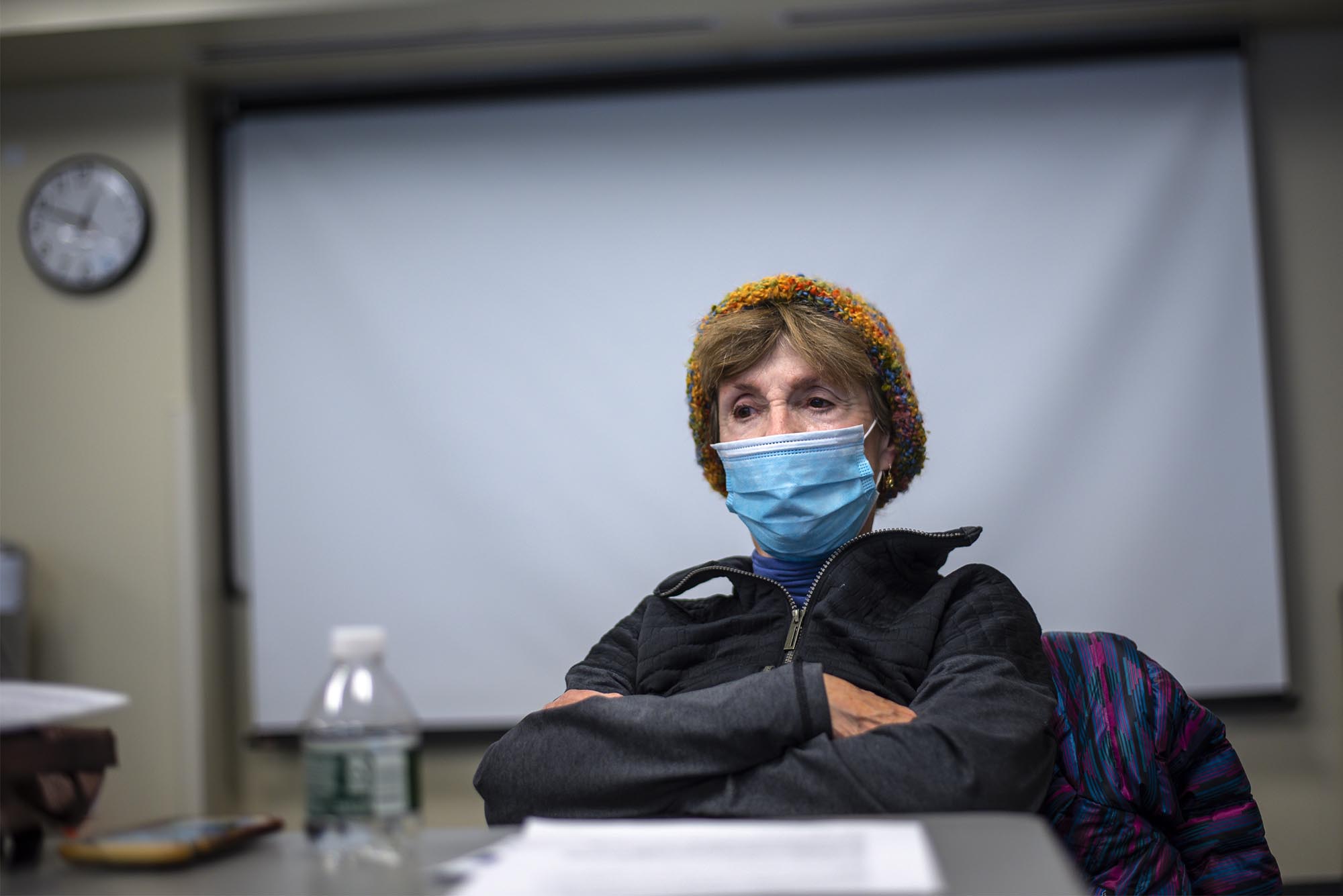
When Diana Bander turns onto the state highway to drive to her doctor’s office in southern Vermont, she finds herself confronting her own mortality.
It’s not just because Bander will turn 80 in July, nor is it merely due to her lengthy battle with Covid-19 last spring.
It’s the growing and unfamiliar undercurrent of fear that gets to her. Bander has found herself confused about the route to take; other times, she finds herself beset by dizziness, or overwhelmed by the number of speeding cars.

“It’s frightening,” she said. For that reason, she avoids Route 9.
Such episodes are part of a deeper reckoning with Bander’s newfound limitations, inflicted by the aftereffects of Covid. The virus has wrested from her grasp the very things that keep her oriented in the world: her self-reliance, her independence, her certainty.
“There’s something very deep going on inside my body that I have no control over,” she said. “And that scares the living crap out of me.”
The 79-year-old has spent her life, as she put it, feeling “extraordinarily capable.” Bander lives alone while remotely managing care for her 74-year-old autistic brother as well as her cognitively impaired son in Boston. Decades ago, she attended Harvard and got a Ph.D. She worked for former Gov. Madeleine Kunin. Until recently, she hiked and volunteered on numerous local boards.
Then Bander got Covid. She tested positive for the virus in late March and spent more than three months with a low-grade fever, rash and debilitating fatigue. She recovered — sort of.
By midsummer, she put the pieces together: The ongoing exhaustion, appetite loss, and dizziness fit the descriptions she had read about. She was a “Covid long hauler.”
At least 10% of Covid survivors — and as many as 75%, according to some studies — will have lingering symptoms that have come to be called Long Haul Covid. Symptoms are bewilderingly diverse: inability to smell or taste, fatigue, diarrhea, cough, rash, pain, brain fog.
In spite of the prevalence of the condition, it remains largely a mystery: Doctors don’t know what causes it, who is most susceptible and whether or when those inflicted with it will recover.
For Bander, the symptoms come and go: Insomnia at night, exhaustion during the day. She gets through the day by resting on her couch — usually listening to Dvořák after lunch. She’s no longer hungry; she’s lost 25 pounds.
Worst of all, she finds herself forgetting things: email addresses, the items she needs at the grocery store.
“It’s not my age,” she retorted, though this reporter hadn’t asked.
Along with her Covid long-haul symptoms came a debilitating self-doubt, Bander said, and a deeper reckoning about her new limitations. There was the driving — were her reflexes quick enough to swerve in the case of a distracted driver, she wondered. She can’t hike or do her tai chi classes online; she recently decided against an excursion to the Vermont Country Store in Rockingham with her son.
Bander has considered asking for help with some tasks, she admitted — but only briefly.
She could pay for a service such as Instacart to do her grocery shopping, but, “I don’t want anyone picking out my tomato.”
She definitely isn’t interested in assisted living, she said.
The tasks Bander would like help with — navigating the state website to sign up for a Covid vaccine, managing her finances and appointments, organizing the care of her family members — aren’t covered by Medicare.
This is the moment she should be embracing her Buddhist philosophy, she said wryly: living in the moment and accepting her own fragility. Bander would like to meditate on such metaphysical matters — but not now, she said, exasperated.
Such musings would be ideal for a Buddhist retreat. But “not [when] it’s Tuesday, and I have to get someplace.”


One solution? Bander hopes the vaccine will help her avoid grappling with her coporality by returning to full health. She teared up when she received the vaccine at Brattleboro Memorial Hospital in late February. Receiving the shot was sheer relief. “I got scared; this has been in my body for way too long,” she said.
“To think,” she said, pausing to relish the prospect, “we’re one step forward. We’re on a path forward.”
Correction: A previous version of the story incorrectly identified where Bander got her vaccine.

