

It was 40 years ago this week the last time Burlington voters saw a mayor’s race this close.
In 1981, Bernie Sanders claimed the mayor’s office from Democratic incumbent Gordon Paquette, who was seeking a fifth term. Sanders won the election by just 10 votes — 4,330 to Paquette’s 4,320.
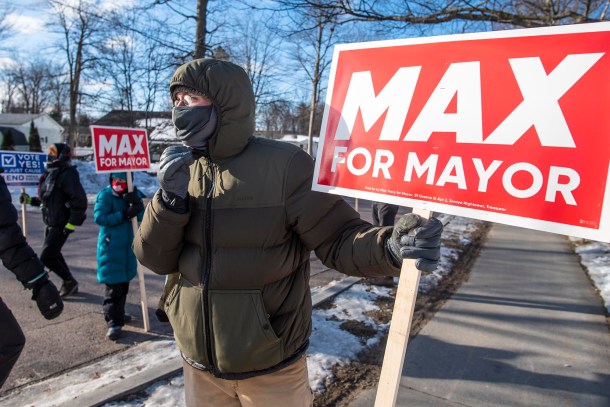
The dynamics of the race were not unlike those that played out Tuesday night as Democratic Mayor Miro Weinberger secured his fourth term over his closest competitor, Progressive City Council President Max Tracy. Unlike Sanders, now Vermont’s junior U.S. senator, Tracy fell 129 votes short of felling Weinberger.
The tremendously close results — Weinberger received 43% of the vote compared to Tracy’s 42% — were a reflection of the heightening partisan divide between Progressives and Democrats in the city.
It was also Weinberger’s poorest showing yet. In 2018, he garnered 48% of the vote; in 2015, 68%; in 2012, 58%.
While supporters say the results are proof that Weinberger’s promise of steady leadership during the Covid-19 pandemic won the day, others say that the mayor could have easily lost the race had it not been defined by public health and safety issues.
As he addressed supporters late Tuesday night, Weinberger said he was “humbled” at how close he came to losing his seat. He attributed the loss of support to his long tenure in office.
“You have to make a lot of challenging decisions over the course of almost a decade,” the mayor said. “And sometimes those decisions don’t break the right way or they’re polarizing.”
When asked Tuesday night why he hadn’t been able to secure a victory, Tracy said he didn’t immediately know.
“I feel like I need to kind of sit with that question for a little while,” the council president said.
City Councilor Brian Pine, P-Ward 3, said he sees a direct parallel with what Burlington experienced in 1981 — and not just because the margin was so close. Sanders and Paquette were also challenged by independent Richard Bove, who peeled off 1,091 votes.
Bove diverted considerable voter attention away from the frontrunners in 1981. That dynamic also played out in the 2021 race. City Councilor Ali Dieng gained 1,830 votes, or 13%. He positioned himself as a pragmatic third option for voters who had questioned decisions made by both Weinberger and Tracy.
Pine, who lost to Tracy in the Progressive mayoral nominating caucus, said Dieng could have drawn voter support away from Weinberger or Tracy equally because of his more centrist appeal as an independent councilor. Some believed he could have diverted even more attention, forcing a runoff if no candidate had received at least 40% of the vote.
“I think he appealed to people who were looking for something a little more on the moderate side,” Pine said. “But also, I think, because of his passion, his energy, his zeal and the fact that Burlington has reached a time when we need to bring someone other than a white male to the mayor’s office.”
A central message of Weinberger’s campaign was that the city needed steady leadership through the pandemic. He regularly referred to his financial successes after the Burlington Telecom scandal brought on by former Progressive Mayor Bob Kiss.
Tracy’s resounding message was that Burlington needed transformational change, specifically for those who are low-income or who have marginalized identities. He criticized Weinberger for not moving the needle enough on housing affordability and police accountability.
If it weren’t for the pandemic, Pine said he thinks Tracy would have won the election.
“There’s lots of folks who are facing the inability to pay their rent and pay their mortgage. There’s just a lot of folks who are really struggling,” Pine said. “And that does generally put a sense of fear in the voters’ minds and their hearts, and caused them to stick with a known quantity, if you will. And that makes an incumbent have an immediate advantage in a situation like this.”
The pandemic also kept Tracy from knocking on doors and holding rallies to energize supporters. This in-person dynamic is critical to Progressive campaigns pitching an agenda of change, Pine said. It was much more difficult for Tracy to communicate excitement and enthusiasm through mailers and phone banking.
Rep. Emma Mulvaney-Stanak, D/P-Burlington, said Tracy’s loss is not an indication that the Progressive tide in the city is waning. She pointed to Progressive Councilor Perri Freeman’s win in the central district against Tiki Archambeau, who criticized Freeman’s left-leaning leadership style as too polarizing. Progressive Councilor Jack Hanson didn’t see any competition in the East District, while Democrat/Progressive Kienan Christianson narrowly lost to more-centrist Mark Barlow in the North District.
Mulvaney-Stanak pointed to the record-breaking turnout in Burlington, with over 14,000 people casting ballots, as an indication that Progressives are capturing more voters.
One of the defining issues of the campaign that Mulvaney-Stanak says ultimately led to Weinberger’s victory was the police staffing issue. The City Council had voted over the summer for a Progresisve initiative to cut 30% of the Burlington Police Department through attrition and move that funding to racial justice initiatives as calls to “defund the police” engulfed the country.
But in December, officers were leaving fast, and Chief Jon Murad warned the city could lose proactive police overnight coverage. This prompted Weinberger to criticize the council for creating a “staffing crisis” in the department.
Burlington is an overwhelmingly white city. And while activists and residents called into City Council meetings by the hundreds to express concern over the way Black people have been disproportionately and violently policed in Burlington, Mulvaney-Stanak doesn’t think the majority white population supported the cuts.
“When you make more space for other folks at the table in a critical conversation like police reform and public safety, other people, meaning white folks, sometimes feel unheard,” Mulvaney-Stanak said. “And I think that mix really was kind of a core issue that I think had folks lean toward Miro in this round because they felt his more, in my opinion, status quo approach to police reform made them feel … safer.”
Many saw Weinberger as vulnerable this election season due to controversial actions involving police accountability.
In December 2019, it was revealed that then-Police Chief Brandon del Pozo had used an anonymous Twitter account to troll a critic. Weinberger placed him on leave but did not disclose the reason for del Pozo’s absence until December. It was also revealed in a court deposition almost a year after the incident that del Pozo had shown Weinberger the fake Twitter account the day before he tweeted from it.
Weinberger was also criticized for contesting the chief medical examiner’s determination that the death of Burlington resident Douglas Kilburn was a homicide. Kilburn had been punched in the head by Burlington Police Officer Cory Campbell in March 2019, causing skull fractures. Critics saw Weinberger’s interference as a form of pressure.
But as concerns about staffing issues in the Burlington Police Department grew, resulting from the council’s actions, Weinberger was able to flip the script when it came to criticism around policing. In one mayoral debate he asked Tracy, “Are you ready to act to fix the crisis you created or not?”
“He had to do it,” former Progressive City Councilor Jane Knodell told VTDigger. “And if he hadn’t done it I don’t think he would have won.” Knodell endorsed Weinberger for mayor.
Some criticized Weinberger for “fear-mongering” when he drummed up concern around the staffing cuts. Knodell agreed with Mulvaney-Stanak that policing was a major deciding factor for Burlington voters in the race. But she thinks the 30% staff reduction fed into disillusionment in the city for Progressive decision-making styles, which some view as rash and unwise. This could have helped Weinberger win the election, she said.
Knodell said she thinks Tracy was able to do so well in the race because he accurately understood the anxieties of younger people in Burlington. Burlington is one of the youngest municipalities in a state in which income inequality is growing.
“The youth vote was a definite factor. And it’s not just students, it’s young people generally, and for many of whom the status quo is not really working,” Knodell said. “Their housing is expensive. They’d like to stay in Burlington but there’s not a lot of economic opportunity.”
Adam Roof, the party chair of the Burlington Democrats, said he thinks Weinberger should be commended for his resiliency in this race. It’s not often that a three-term incumbent can weather the criticisms that come with the city’s top job to land a fourth term.
Roof said he thinks Weinberger ultimately won the race because he campaigned well — via phone banking, text messaging and mailers. He also thinks the mayor’s reputation for leading the city through the pandemic helped his reelection.
Additionally, he thinks Tracy’s message wasn’t the right fit for this race.
“This message of change is really typical. It’s not unique to this race,” Roof said. “However, when you try to use that argument during a time like we are in now, for the pandemic, I think that it’s a double-edged sword.”

