


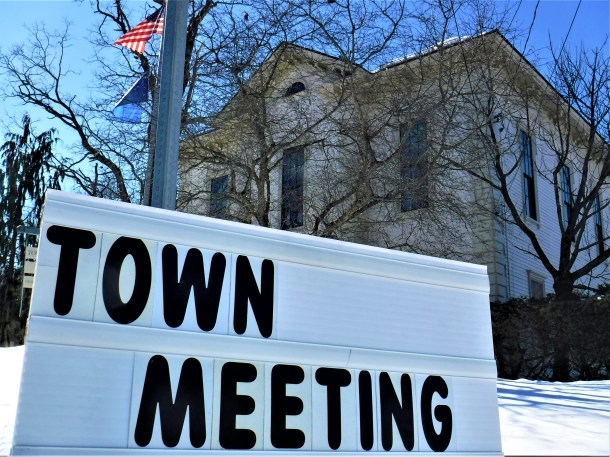
The Covid-19 pandemic is upending this year’s traditional March town meeting season from northwestern Alburgh to southeastern Vernon, with 80% of Vermont’s 246 municipalities temporarily replacing shoulder-to-shoulder decision-making with safer Australian balloting.
All but one of the 28 cities and towns with 5,000 or more people are set to vote for local leaders, spending and special articles as they do annually on or around the first Tuesday in March. (St. Johnsbury, tapping a temporary state law allowing election options, won’t do so until April 6.)
But of the 218 communities with smaller populations, only five — Addison, Kirby, Norton, Stratton and Woodford — will stick with some sort of floor meeting, with each having little on the agenda or being gaveled in for the sole purpose of recessing to a later date, according to a VTDigger survey.
The rest of Vermont’s towns and villages, heeding a state recommendation that “meetings are strongly discouraged this year,” will trade sugaring-season debate for mailable ballots or spring outdoor gatherings.
“We didn’t opt to postpone,” Town Clerk Deb Tanguay said in Coventry, population 1,057, “as we do not have any big item this year that would require extensive conversation. Our ballot is pretty basic.”
Compounding this year’s changes: Not all communities and their school districts are voting on the same day. Kirby, population 615, will cast ballots Tuesday for an education budget, then commence a floor meeting just long enough to elect a moderator who’ll accept a motion to recess the meeting until May.
As a result, election officials are urging Vermonters to check the timing of all their local meetings and votes, with the secretary of state’s office sharing a “2021 Annual Meeting Polling Places and Voting Methods” spreadsheet on its website.
“There are three criteria we’re operating under,” Secretary of State Jim Condos said. “One is to protect the voting rights of every eligible voter, two is to protect health and safety, and three is to protect the integrity of our elections. We’ve worked with the Legislature to give towns as much flexibility and resources to make sure they conduct elections in a safe and secure way.”
Local marijuana sales, other heady questions
Last March, Vermont’s 20 largest municipalities voted on special one-time-only spending requests — everything from new schools to infrastructure improvements to public swimming pools — totaling an eye-popping $250 million. This year, the same communities — now proposing less than one-tenth that amount — are joining their smaller counterparts in focusing on issues without hefty price tags.
A request to allow the local sale of marijuana will appear on ballots in at least 23 communities, including Barton, Bennington, Berlin, Brandon, Brattleboro, Brownington, Burlington, Danby, Danville, Duxbury, Lyndon, Middlebury, Montpelier, Newport City, Pawlet, Pownal, Randolph, Richmond, Salisbury, Strafford, Waitsfield, Waterbury and Winooski.
Vermont last fall became the 11th state to legalize such business starting in 2022, although the law requires communities to “opt-in” in order for retailers to seek the proper permitting.
Vermont’s largest city, Burlington, will decide a mayor’s race featuring incumbent Miro Weinberger and six challengers, several contests for city council, as well as proposed charter changes to protect residential tenants from evictions without “just cause,” adopt ranked-choice voting to elect its councilors, and regulate thermal energy systems in housing and commercial buildings.
The nearby town of Essex and its village of Essex Junction — collectively the second-largest population hub in the state — will decide whether to merge into one municipality with a shared governance structure that supporters say would cut costs. Some 70% of village voters approved the plan last November, leading to the larger town ballot.
In Rutland City, one of its most crowded ballots in memory will have Mayor David Allaire facing six challengers, as well as 17 candidates running for six aldermanic seats, seven candidates for three school board seats, seven candidates for the position of assessor, and three candidates for the post of treasurer.
Barre City, site of contentious debate over calls to raise Black Lives Matter and pro-police “thin blue line” flags, will vote on whether to limit the choices on public property to banners of the municipality, state, country and National League of POW/MIA Families.
Winooski will consider an advisory article on whether to urge the state to halt Vermont Air National Guard F-35 training flights that have sparked high noise levels since their start in 2019.
In southern Vermont, Bennington will reconsider a proposal rejected in 2018 and 2019 to replace its current town manager system with a mayor, and will weigh a new “Penny for Parks” reserve fund that would add a cent to the property-tax rate to generate $100,000 annually for recreational improvements.
Brattleboro will decide whether to join a growing number of communities asking the Legislature to let them adopt local charter provisions authorized by the state for other municipalities.
School governance, municipal infrastructure
More than a dozen communities will decide whether to affirm or abandon the state’s Act 46 education governance consolidation effort.
Brattleboro, Dummerston, Guilford and Putney will consider a call to disband the Windham Southeast School District they formed just two years ago.
Athens and Grafton will confirm or cancel nearby Westminster’s recent vote to leave their shared Windham Northeast Union Elementary School District.
And Bridport, Cornwall, Middlebury, Salisbury, Shoreham and Weybridge will cast ballots on neighboring Ripton’s request to withdraw from their Addison Central School District.
Several cities and towns are proposing special one-time-only spending requests above and beyond their regular budgets.
South Burlington, which last year rejected a $210 million plan to build a new middle and high school and athletic center, is seeking $4 million for a series of highway improvements and $2.5 million for replacement of a school roof and related building work.
St. Albans City, which last year unsuccessfully proposed a community pool with neighboring St. Albans Town, will consider tackling the $5 million project alone. It also will vote on a $1.5 million streetscape improvement plan and $2.3 million potable water storage tank — all to be paid through other sources, including its local option tax.
St. Albans Town will vote on whether to build a new $4.5 million town hall, while Shelburne will decide whether to buy land for $1.12 million for a potential fire and rescue station.
Several communities will cast ballots on water system improvement bonds. Newport City will vote on a nearly $5 million plan for a new water-storage tower and related infrastructure, while Brandon will consider spending $5.7 million and Castleton $2.5 million to upgrade their respective sewage treatment plants.
Wilmington will weigh a $5.5 million bond to replace its police and fire headquarters with new public safety facilities.
Most special requests, however, range between five and six figures. Perhaps the most explosive: A call in Dummerston for $18,540 to boost its highway blasting and ledge crushing reserve fund.

Although some 200 communities will hold March votes, about three dozen are postponing local debate and decisions until they can hold outdoor gatherings this spring.
Communities pursuing April meetings or ballots include Marshfield, Plainfield, Stamford, St. Johnsbury, Vershire and Winhall.
Those pursuing May meetings or ballots include Barnard, Brookfield, Corinth, Dover, Hartland, Holland, Jamaica, Londonderry, Readsboro, Sharon, Sheffield, Stannard, St. George, Tunbridge, Vernon, Wardsboro, Westminster, Weston and Whiting.
Those pursuing June meetings or ballots include Baltimore, Belvidere, Eden, Jay, Sudbury, Troy and Waterville.
A majority of communities, however, are sticking with the traditional first Tuesday of March — in part because their ballots offer little to debate.
“We kept our budget minimal, as well as our warning,” said Town Clerk Karen Lathrop of Chelsea, population 1,383. “We will really miss our Town Meeting Day the way it was.”
