

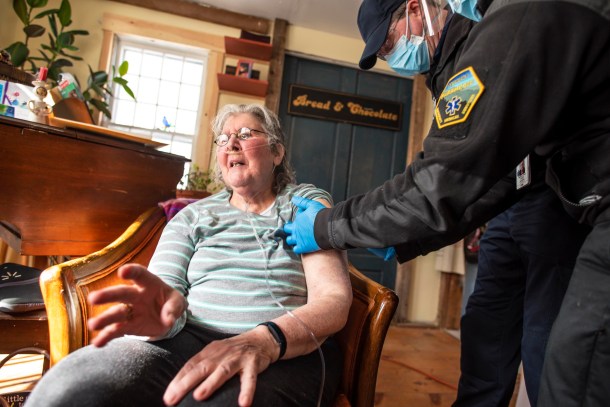
Drew Hazelton and Dave Mannion were running 47 minutes late as they pulled up by a ramshackle farmhouse in Newbury.
They had been on the road since 7 a.m., and the two EMTs from Rescue Inc. emergency services had just over two hours to deliver the last three doses of Covid vaccine before they would be unusable at 3 p.m.
There was a problem: The woman who was supposed to receive a Covid vaccine had already left for a doctor’s appointment.
“If there’s not a fire, it’s not exciting,” said Hazelton, the Brattleboro-based department’s chief of operations. He phoned Rescue Inc.’s operation center for advice.
Logistical snafus are par for the course for Hazelton and his squad as they race to deliver Covid vaccines to elderly homebound Vermonters. The crew of 20 workers traveIed a combined 3,500 miles in less than a week, crisscrossing the southern part of the state.
They navigated long, snowy driveways, last-minute scheduling changes and a complicated planning process to make sure that they had enough appointments to use all the doses in a given vial.
The operations center in Townshend ultimately delivered a revised plan to Hazelton: The two could grab lunch, travel to Topsham to give two doses to an 83-year-old couple, and drive back to Newbury. If all went as planned, Hazelton and Mannion would have 15 minutes of extra time before the doses were no good.
“There are days we haven’t been as efficient as we could have been,” Hazelton confessed as the pair stopped briefly to buy a turkey sandwich at a shop in Bradford.
Still, it had proved gratifying to offer the most vulnerable Vermonters protection against Covid. “People are celebrating our arrival,” Hazelton said. As emergency medical technicians, “they don’t usually do that.”
Vermont has rolled out Covid vaccines to health care workers, nursing home staff and residents, and now, those age 75 and older. But offering doses to those who can’t get to a hospital or vaccine distribution center is a daunting operational lift.
The state doesn’t have a comprehensive list of every homebound Vermonter. Officials must contact patients, schedule the appointments and administer the doses, taking into account the short shelf life and temperature requirements for the vaccine and the maze of remote, snowy roads they must navigate.
The Department of Health tapped seven of the state’s EMS departments to help. The emergency responders are working with visiting nursing associations that provide home nursing or hospice care.
The ‘magic box’
The state started vaccine deliveries on Feb. 5, said Dan Batsie, EMS chief for the Vermont Department of Health. By Sunday, the emergency responders and visiting nursing association teams had inoculated 538 residents at home.
Rescue Inc., a Brattleboro-based department that serves 15 towns, has done much of that work. The agency recruited 20 of its 70 members to help with the effort, and over the last week has sent them traversing across Windham, Orange, Windsor and Bennington counties.
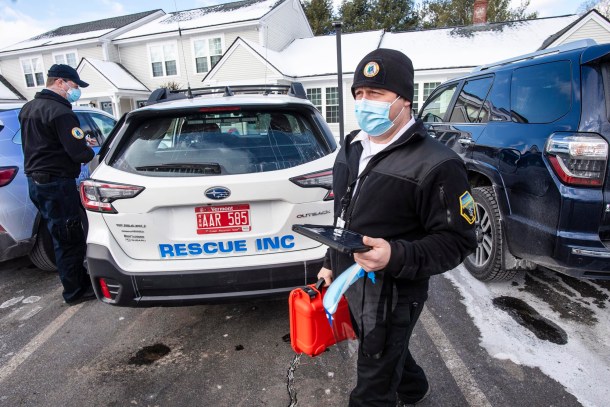
On Thursday, four Rescue Inc. vehicles arrived just after 9 a.m. in White River Junction, where they reconstituted the vaccine, diluting and mixing the 25 doses of Pfizer-BioNTech vaccine they were to deliver for the day. Once the vaccine is reconstituted, workers have six hours to administer it.
On this particular day, Hazelton warned this reporter that he wouldn’t know exactly where he was going or when he would get there until hours, possibly minutes before he arrived. All he knew was that he aimed to get vaccines to all VNA patients over age 75 in Orange County that day.
They headed out on routes programmed by the operation center. In Townshend, Rescue Inc. workers call patients who are eligible for the vaccine identified by the local VNA. They determine whether the patient wants a vaccine, can get a ride to a clinic or already has an appointment. When necessary, they iron out logistics — helping someone find a ride or assisting them in signing up on the state’s website.
For those who want a dose, but won’t be able to get to the doctor’s, the Rescue Inc. staffers agree to send a car.
They arrived at their first stop in Bradford at 10:20 a.m. In one hand, Mannion clutched an highlighter orange “magic box,” which contained the vaccines, syringes and emergency supplies.
They knocked on the door of Rosemarie Duffy, who was celebrating her 73rd birthday. She teared up, as she sat in an armchair surrounded by an array of artificial plants and stuffed animals in her Bradford condo.
“Oh my god, I’m so happy,” she repeated.
Hazelton and Mannion spent 15 minutes after the shot to ensure there was no adverse reaction, leaving them time to socialize.
Duffy had spent the last year going nowhere but to the doctor’s, her church and the grocery store, she said. Her only companion over that time was her dog, Sunny, who yipped mournfully from the bedroom. The vaccine would allow her to see her 4-year-old great-grandson who she hadn’t seen in more than a year, she said.
They talk online, but it’s not the same. “He doesn’t even call me ‘Nana’ anymore,” she said. “He calls me ‘Daddy’s friend.’”
‘A momentous occasion’
State officials don’t know exactly how many people they’ll have to vaccinate.
VNAs of Vermont has about 3,000 people on its rolls, said the organization’s director, Jill Mazza Olson. But many have already gotten the vaccine, or don’t want it.
Jim Finger, the EMS chief in Rutland, has 200 people on the list; only 45 had to be delivered.
So far, Hazelton estimates that Rescue Inc. has delivered 200 vaccine doses.
“I thought everyone would want a vaccine,” Hazelton said.
Down the road, Phyllis Nemhauser wasn’t expecting Hazelton and Mannion when they knocked on the door; she had been a late addition, as part of an effort to make sure they had the right number of patients to use all the doses in the vial.
Nemhauser’s daughter, Emilie Perry, let them in. “She wants it,” she said, following the two EMS workers into the clapboard house in downtown Bradford.
The 70-year-old, who has stage 4 cancer, opened her mouth wide in exaggerated pain as Mannion offered the shot.
“I’m a big baby,” she said afterwards with a grin. “If I cry, don’t put it in the paper.” She offered Mannion and Hazelton Lindt chocolates to celebrate “this momentous occasion” and then popped one into her own mouth.
Once the vaccines are reconstituted, the teams have six hours to deliver them. Each Pfizer vial has between five and six doses; the workers must find ways to provide doses in the allocated time, make sure patients are available, and configure driving routes to allow the workers to get to the homes in time.
They’ve traversed all manner of roads and routes, he said. “I’ve realized if there’s a house on a mountaintop, it’s a [VNA] patient,” Hazelton joked.
So far, Rescue Inc. hasn’t wasted any doses, but it’s been a close call.
In one case, when they went to Bethel last week, they drove 38 miles only to find that the resident wasn’t at home. The operations center scrambled to find a nearby VNA patient who wanted the vaccine and fit the criteria. They found and vetted a new recipient, arriving with eight minutes to spare before the vaccines were unusable.
“It makes us nervous,” Hazelton said.
No end in sight
Rescue Inc. has an ultracold freezer to keep the doses cold. For VNAs or groups that don’t, they also have a limited time to dole out the doses.
Franklin County Home Health Agency in St. Albans received its first doses of the thawed vaccine on Friday, Feb. 5, leaving 120 hours to deliver the doses to its patients. The home health staff pulled out a map and sent the local ambulance service, AmCare, to Enosburg while they headed to Swanton, said CEO Janet McCarthy.
Five staff members worked through the weekend, calling, scheduling appointments, and driving to homes.
They received an overwhelmingly warm welcome. “I don’t think I’ve ever been with a group of people who have been so relieved,” McCarthy said.

According to Batsie, the state EMS chief, the Department of Health will be 75% through the first batch of inoculations — for home health patients over age 75 — by this weekend. Then they’ll offer second doses in three weeks. And at the same time, they’ll start providing vaccines to people over age 70 who are homebound.
“It’ll be months” of work, Batsie said.
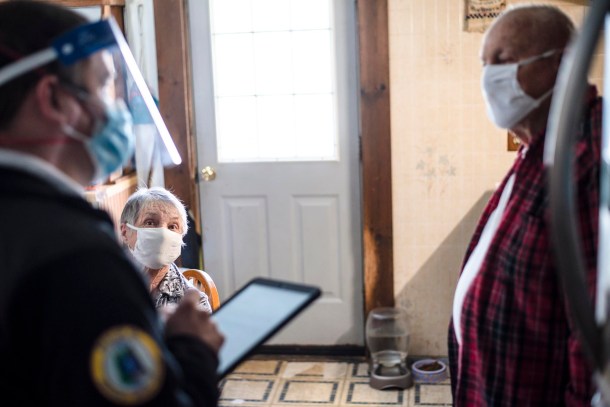
Hazelton and Mannion said they’re happy to meet the need. They stopped in Topsham to provide doses to Clarke and Annette Tabor, both 83.
“I think that people who are more deserving should get it first,” Clarke announced, before rolling up his sleeve.
Mannion handed them a card with their appointment — they, or a colleague, would be back by March 4 to administer a second dose.
They made it back to Newbury to administer their last dose. Just in time.
