

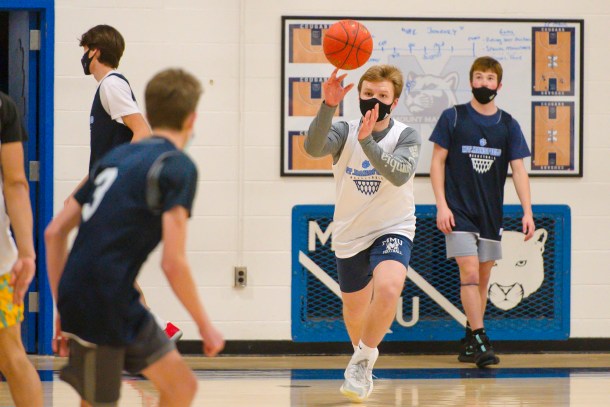
Vermont has for weeks been inching toward a restart of youth winter sports. Last Friday, Gov. Phil Scott finally pulled the trigger, announcing that interscholastic competitions could resume Feb. 12.
In support of this decision, administration officials pointed to contact-tracing data over several weeks of practices — and an apparently unblemished record.
“While there have been close contacts identified within teams, we have not seen evidence of teammates transmitting the virus to one another,” Natural Resources Secretary Julie Moore said at the time.
That rang false to Brooke Olsen-Farrell, a superintendent in Rutland county, who told VTDigger that she had learned just the opposite from the Vermont Department of Health. Her district recently sent more than 30 high school students home to quarantine, she said. And while the virus’ presence in schools was largely the result of community transmission, athletics did play a limited role, the department told her.
“It’s tough to be in a situation when you’re told by one entity who we trust — that’s working with us in contact tracing these cases — one thing and then to hear something different at a press conference,” Olsen-Farrell said. “It just creates confusion and leads to uncertainty.”
State epidemiologist Dr. Patsy Kelso declined to speak to the experiences of specific school districts, citing confidentiality concerns. But she confirmed Monday that the natural resources secretary was indeed wrong.
Moore “did not have a fulsom analysis” from VDH’s epidemiology team “when she made that statement,” Kelso said.
“There have been a couple of instances of limited transmission that is sports-related,” Kelso said. “So it’s not zero, but it’s a very small number.” It appears athletes were following required precautions, she added.
Nevertheless, Kelso said she supported the administration’s decision to move forward with sports this winter, stressing that state officials would be closely monitoring case data for “concerning trends.”
“At this point, there’s not sufficient data to say that it’s not something we could allow,” she said.
The question of what to do about sports — and in particular winter, indoor athletics — has been an agonizing one for policymakers across America.
In Vermont, an advisory panel made up of local school officials and two University of Vermont doctors was tapped to discuss the pros and cons of athletics and how to offer programming as safely as possible in the pandemic.
Jay Nichols, Vermont Principals’ Association executive director, who sits on the panel, said the body has never really been in full agreement about the best path forward. But he said he has occasionally felt a disconnect between the committee’s discussions and subsequent announcements by the administration.
“I think there’s been times where I think as a committee — especially the medical people on the committee — have been very cautious about how to go forward,” Nichols said. “That said, the governor and [state Health Commissioner Mark Levine] are coming at this from a much wider perspective because they’re also weighing in things like students’ mental health.”
State officials have acknowledged that there may be dissenting voices on the committee — but they have also said that it was never really the panel’s decision to make. The governor makes all restart decisions in concert with Levine and Kelso, Scott spokesperson Jason Maulucci wrote in an email.
“If [the Department of Health] was not comfortable taking the steps announced on Friday, Vermont wouldn’t be moving forward,” Maulucci wrote in an email.
Ice hockey has been a particularly difficult call for policymakers.
The sport has been associated with outbreaks and clusters in several states, including Vermont, but researchers often say it is difficult to parse whether transmission occurred during the game or off-ice. In the case of Montpelier’s ice rink outbreak, public health officials have repeatedly said that transmission appeared to have taken place during carpooling and social events, not gameplay.
Still, researchers found that at least 13 adults were infected at an indoor ice hockey game in Florida this summer. The players did not have common exposure in the week before the game, according to researchers. They also did not wear masks.
“The indoor space and close contact between players during a hockey game increase infection risk for players and create potential for a superspreader event, especially with ongoing community COVID-19 transmission,” Centers for Disease Control and Prevention researchers wrote in the study.
Athletics play an outsize role in the wellbeing and sense of identity of many students, and administration officials have repeatedly cited mental health as a key factor for pressing ahead with sports. Teens are also far less likely to suffer severe consequences from the virus than older adults.
“Vermont has taken one the most cautious approaches in the nation regarding school and youth sports, because we believe in monitoring the data before taking additional steps,” Maulucci wrote in an email. He cited data from the National Federation of State High School Associations, which noted, for example, that 42 states have already allowed basketball games to begin.
But in certain sports, such as hockey and basketball, some mitigation measures that have been the cornerstone of Covid prevention are impossible. State officials acknowledge that some athletics-related transmission is likely to occur and appeared to walk back Moore’s earlier statement at a subsequent press conference this week.
“There’s a very occasional case here or there, where a member of the team came to practice, and indeed may have transmitted the virus to one other teammate,” Levine said Tuesday during the governor’s twice-weekly press conference.
Still, with other restrictions in place, officials say transmission will likely be limited to one-offs, and the hope is that other precautions will keep larger outbreaks from taking place. Vermont is banning spectators at sporting events, and teams will not be allowed to play more than two games a week, spaced three days apart. Masking is required for all, including athletes.
Dr. Benjamin Lee, an associate professor of pediatrics at the University of Vermont Larner College of Medicine, who sits on the school sports panel advising the administration, said he agreed with the mitigation measures put in place by state officials.
But on the question of whether it was wise to resume interscholastic competition at all, the infectious disease specialist was less direct.
“I respect the decision of our state leaders, but again will restate what I said previously: there is inherent risk here and our margin for error is razor-thin,” he wrote in an email.
Many school leaders on the ground expressed concerns about the safety of resuming practices. But whether or not the virus will actually wind up transmitted during games, many worried that athletics-related quarantines could disrupt the already limited in-person instruction they were currently able to provide.
And they noted the winter sports season comes at precisely the same time as state officials are pressing schools to increase opportunities for in-person learning.
Brian Ricca, superintendent in the St. Johnsbury School District, said that, as a parent, he understood the need for interscholastic competition for his own children’s mental health. But as a superintendent, he said he was “struggling.”
“We’ve worked so hard to keep our communities separate, and it seems to me that this is a risk to increase community spread. In addition, this seems ill-(timed) with the plans to expand in-person education,” Ricca said.
Because of the physical distancing guidelines in place in most classrooms, entire classes are not necessarily required to quarantine when a student comes to school and later tests positive. But if an athlete playing a close-contact sport comes to practice or a game with the virus, a greater number of people are likely to be ordered to stay home.
“If we have to start quarantining students and having them miss academics, we will NOT continue,” Windsor Southeast Supervisory Union superintendent David Baker wrote in an email. “We already had to have the JV boys squad miss 5 days of school in-person.”
