


The Deeper Dig is a biweekly podcast from the VTDigger newsroom, hosted and produced by Sam Gale Rosen. Listen below, and subscribe on Apple Podcasts, Google Play, Spotify or anywhere you listen to podcasts.
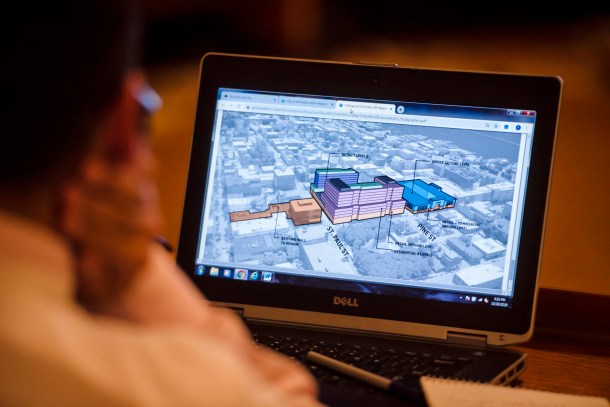
The developers behind the perpetually stalled CityPlace development in downtown Burlington are drumming up support to restart the project. Three local developers have joined the site’s owner, Don Sinex, to move forward with a newly redesigned plan for the $174 million mixed-use development.
But the push comes while Sinex has just settled legal action from the city over construction delays — and he’ll need to restore trust with both officials and residents before the project can move ahead.
On this week’s podcast, VTDigger’s Grace Elletson discusses her reporting on CityPlace. The transcript below has been edited for length and clarity.
Grace Elletson: The story with CityPlace Burlington begins in 2014.
Miro Weinberger: Welcome, everyone. Thank you for joining us on short notice and being part of this exciting event…
Grace Elletson: It was announced in 2014 that the city and Don Sinex were moving forward on this public-private partnership to build CityPlace, which was going to be a combination of retail space, office space, and 200 to 300 units of housing.
Miro Weinberger: We’ve got a whole vision of the mall becoming — shifting from being this important property that is part of the vitality of the downtown and Church Street, but at the same time, in recent years, has been recognized as being underutilized, as having some real flaws to it, I think, when we’re being honest…
Grace Elletson: It was pitched as a public-private project.
Miro Weinberger: I want to introduce Don Sinex, from Devonwood Investors LLC. Don is the energy and the force that is behind making this announcement.
Grace Elletson: Sinex was the owner of the land. The city didn’t have any control over who was going to buy the old mall that a lot of people agreed was taking up wasted space in the city, and was not performing well.
Miro Weinberger: I’m very excited that really just a year after the council approved this vision, here we are announcing that the city and Don Sinex, the owner of Burlington Town Center Mall, are committed to moving forward, and committed to a partnership to comprehensively redevelop this property.
I’m guessing for a lot of Burlingtonians, that was their first introduction to this developer, Don Sinex. Who is Don Sinex? And what was he trying to sell the city on here?
Grace Elletson: Don Sinex is managing partner with Devonwood Investors, which is a firm that’s investing in real estate projects across the country. He had gotten into the project because it was an opportunity to develop out Burlington’s downtown. And it was really ambitious.
Don Sinex: I’m very passionate about what I do. And this mall has captured my energy and all my passion. When I stood here not too long ago, and stood on Church Street and looked at the mall, I saw a single-purpose single-story structure. And I thought, how could it be? Burlington is so prosperous and so important. How could this be? Mine is not to wonder why. I didn’t care. I knew there was a grand opportunity here.
And this public-private partnership that the mayor and I and the governor are announcing today is so important in how we develop the site.
Grace Elletson: The city comes in with the public investments around the project — reconnecting some of the roads, refurbishing those surrounding sidewalks — that was going to be funded by tax increment financing, which voters needed to approve, and it went to voters in 2016. They approved that TIF, tax increment financing, bond. And that’s kind of what kickstarted the development of this.
When this project was first announced back in 2014, what kind of a relationship did Sinex and Weinberger seemed like they were putting forward?
Grace Elletson: Their relationship was positive, was strong. Both saw each other as benefits to building downtown Burlington.
Don Sinex: We have private interest, the public has its interest. The mayor and I will work extremely hard to produce something that you all want to use, and you’ll all be very, very proud of.
Grace Elletson: From Sinex’s perspective, he’s a real estate investor who wants to get this thing up so he can start making money off of it. From Weinberger’s perspective, he’s this freshly elected mayor who was elected in 2012 with a development background — with affordable housing, nothing to the scale of what Sinex is working on here. But he also has a development background. Looking to prove to Burlingtonians that his perspective is a strong one for the city and a beneficial one for the city. And so when Sinex comes along and proposes this big project, of course Weinberger is going to get on board. And as we saw from that 2014 announcement, he was excited.
Miro Weinberger: Don, I’m excited to be taking this step with you and looking forward to working together in the months and years ahead to make this a great project and accomplish the vision of PlanBTV.
Grace Elletson: The CityPlace proposal tied into the PlanBTV 10-year development vision for what downtown Burlington was going to look like. So CityPlace presented political capital for Weinberger, and the public-private partnership also presented its advantages to Sinex. Because the public element of this provided more funds for him to tap into to be able to develop this project — like the TIF, the tax increment financing, that provided another couple of million dollars to be able to invest into this project. So to an extent, there’s a symbiotic relationship happening here. At the beginning, at least.
What does that relationship look like today?
Grace Elletson: Certainly not as positive. As the CityPlace saga has played out, and all these twists and turns have developed with the project, that relationship between Sinex and Weinberger has certainly soured for many different reasons. The political capital Weinberger was hoping to get out of the project — and of course, the economic development that was proposed for the city of Burlington that’s currently not coming out of the project — is certainly disappointing to him. And Sinex isn’t getting any returns on his money. So nobody is content in how things have played out.
Let’s talk about what’s happened in that intervening time. I imagine this is pretty familiar territory for anybody who lives near the site. But could you give a quick overview of what has happened with this project that has caused it to become so delayed, to have left this pit in the middle of the city?
Grace Elletson: It’s hard to give a quick overview, because there’s so many different details as to how this has just not moved forward. Let’s just start with the financing, because I think that’s a big crux of the issue. In 2017, Rouse Properties was seen as CityPlace’s best chance of financing for this $200 million project that was being proposed. And in a bit of foreshadowing, that company was a subsidiary of Brookfield Asset Management, which is this mammoth, one of the largest real estate investment firms in the world. Financing never came from Rouse. But the old mall was demolished in 2018.
2018 rolls around. Brookfield shows up and shows its intent to get into the project and to be a primary financer of the project. The building is torn down. The city council approves a permit to lay the foundation, but that permit is never pulled. Brookfield kind of pulls back on the project as they took control of it.
The city began seeing a whole cast of characters from Brookfield. There was never any consistency on exactly how this thing was moving forward. Brookfield eventually presents an entire redesign of the CityPlace project, which scaled down the retail and the office space, lowered the buildings from 14 stories to 10.
2020 comes; pandemic hits. By the summer of 2020, Brookfield is out. And so CityPlace has been sitting with this pit. And in downtown Burlington, for the past two years, the pit has become like a running joke in the town.
What exactly went wrong? Who’s to blame for this whole pattern of delays?
Grace Elletson: It depends on who you ask. Mayor Weinberger, who a lot of people have blamed for this project going so south, and for there being a pit in downtown Burlington, is adamant that he brokered a development agreement that adequately protected the city from things going south. And that agreement essentially ensures that any financial losses that this project experiences, the city is not on the hook.
Miro Weinberger: The risk to a municipality in a tax increment financing deal is that the city can go out and bond for the new public infrastructure, expecting tax revenues to come in on a certain schedule. And then if the project is delayed, the city can be left holding the bag.
This agreement was fundamentally structured so that couldn’t happen.
Grace Elletson: So despite the blame that he’s gotten, Mayor Weinberger is defending himself here. He says the pit in downtown isn’t advantageous for anyone, but that old, underperforming mall that didn’t fit in with the rest of where downtown Burlington was heading — he argues that it needed to come down and that it’s better being down. So that at least there is some progress made to move forward, to building something new and better. That’s his argument.
Miro Weinberger: We went forward knowing you’re starting into demolition without all the financing lined up. And we put a number of additional protections in place as a result of that. We knew that this was a possibility, we were prepared for it, and we protected the city. … That was the right decision. I, from my perspective, I think we are in a better place today, as frustrating as it is for there to have been this extended delay.
I guess I’m still curious, what is his defense of why this project that was announced back in 2014 would still be so stalled? How does he kind of explain and defend the delays that this project has faced all throughout?
Grace Elletson: The blame, from his perspective, relies solely on the developer. He said the city met its obligations to approve the rezoning for the space, to provide the development agreements. He said it’s on the developers. And he pointed to this revolving door of financers. No one has committed to putting enough money into this project to get it off the ground. He points to that disorganization as kind of the central reason as to why this didn’t hold up.
I guess then the developer here, Don Sinex, would probably disagree with that characterization. Tell me about how you came to talk to Don Sinex about all this.
Grace Elletson: I had never talked to him in person. I’ve only communicated with him over email, and even then I could feel his very strong personality coming through on defending this project. Which is why it surprised me, when I got him on the phone, that he took some blame in this.
Grace Elletson: Throughout this whole ordeal, there’s been blame put on you from city officials, specifically coming from Weinberger. He said at one point that it would be unacceptable if you were to continue moving forward on this project. Do you feel like you deserve any blame for the way that this project has been stalled?
Don Sinex: Well, I’ll say yes to that. Because I chose Brookfield. I brought them in. I gave them control. And nothing happened. So in that sense, yes. I feel partly responsible.
Grace Elletson: He pointed to Brookfield as kind of the central reason as to why we lost so many years here.
Things really did start to go wrong in 2018 when the mall was demolished, and there wasn’t financing to get a structure built. Brookfield had come in and said, yes, we’ll finance you. But that never happened. They did this whole redesign. And so, Sinex’s theory is that Brookfield was getting weighed down with some of the other acquisitions it was making at this time. They had bought up Oaktree Capital Management and Forest City Realty Trust, both multimillion-dollar development firms.
Brookfield is a massive, massive company, one of the largest development firms in the world. And as much as CityPlaces one of the most ambitious development projects Burlington has ever seen, it’s small fish compared to what Brookfield is dealing with on a daily basis.
Don Sinex: And I think it took their focus off of some of the things they were doing. And Burlington was a small project for them. And I think they generally started reassessing their interest in the project.
Grace Elletson: Covid hit in March 2020. They pulled out in June of 2020, when the market was incredibly volatile for not just Brookfield, but every real estate developer in the country.
Don Sinex: That was the last straw as far as Brookfield is concerned. And I think they made a determination in good faith. And I think they just decided that they’re not the right party to carry this project forward.
Grace Elletson: This project had proposed office space and retail space, which had become obsolete in a Covid world. There were those, business decisions, and then also the Covid impacts that eventually shut Brookfield out of this project. At least that’s Sinex’s theory.
How does he characterize his relationship with the mayor at this point?
Grace Elletson: I think Sinex wants to move forward. It’s financially advantageous for him to move forward.
Don Sinex: You’ve never heard me say a harsh thing about him. I’ve always had a good relationship with him up until he blames me for all the delays. And like I said, I’ll take some blame for it. But we’re trying to find a path forward. I think we can. And can I work with him? Of course.
Grace Elletson: The city is moving forward without a lot of trust. And that is shown by an email that we had collected in a public records request from Jeff Glassberg, who was hired as a consultant from the city to serve on the project, that he sent to Max Tracy. He basically said, the only thing that’s holding this project together is verifiable legal documents.
If things do move forward in the next few months, what’s going to be different this time?
Grace Elletson: The key difference here is that we have three new local developers on the project: Dave Farrington, owner of Farrington Construction, Al Senecal, owner of a mega electric construction company, and Scott Ireland, who is the owner and president of S.D. Ireland, concrete construction. And a lot of people have good faith in these guys as local people who want to see this project get done.
I had asked Don Sinex along the lines of the same question: Why should people trust you to get this done now, when it’s been years and years of stalling? And he basically said, hold us to our word.
Don Sinex: We are committed to doing it. They should watch what we say, and see if we do what we say. We are where we are. Now it’s time to plan and move forward. So what would we do here, what we said, and if we don’t, then be mad at us. But try to lighten up and support us to get us through this next year to get under construction.
Grace Elletson: And as much as they’re trying to reassure people with sentiment like that — the new website that they’ve kind of rejuvenated to educate people about what CityPlace is, they have this petition put out there that has about 2,000 signatures right now to show support for the breaking ground of CityPlace — it’s gonna be up to whether residents want to buy that or not.
It’s a private project. As much as the developers need the cooperation of the city to get the permits, to get the zoning that they need to make this to get it done, the city is kind of held at whim to the success of this private development moving forward. So it’s up to residents whether or not they want to be reassured by Sinex.
On Friday, Mayor Miro Weinberger announced a settlement with the developers. The agreement states that if construction doesn’t begin in two years, they won’t be reimbursed for their work to rebuild surrounding streets. The agreement also ensures that the city is reimbursed for lost property taxes on the project, due to the unanticipated delays, at $150,000 a year.
Weinberger was cautiously optimistic in announcing the agreement.
Miro Weinberger: We think it’s a credible, feasible path forward. We think it could succeed and we wish the developers well and we’ll be supportive of them going forward.
The settlement agreement and the new development agreement will still need to be approved by the city council.
Correction (Feb. 10): An earlier version of this podcast mischaracterized statements made by Jeff Glassberg in an email to Max Tracy. The audio and transcript have been updated.
