


Three years ago, Megan Job and Destini Armstrong left New York City to attend Middlebury College in rural Addison County. Moving from one of the most diverse cities in the world to the second-whitest, second-least-populous state in the U.S. induced a powerful dose of culture shock.
Now seniors, the two students, who are Black, recount having felt isolated and homesick during college.
“I find myself a little bit on edge when I’m [at school],” Armstrong said. “There’s something you have to switch when you get here. Something has to give.”
The presence of the college’s Department of Public Safety has at times compounded the pair’s discomfort. For Job, uniformed officers patrolling campus evoked images of the NYPD, the department that has faced thousands of racial-bias complaints in recent years and that she came to distrust as a Black teenager growing up in the city. “When I heard about Public Safety, that they’re here to protect you, all I heard was ‘NYPD,’” she said.
Although Middlebury Public Safety officers are unarmed and are not sworn police officers, Job’s first impression of the officers was: “That’s a cop.” The conflation of public safety with police is one made frequently by students, according to Middlebury College senior Lynn Travnikova.
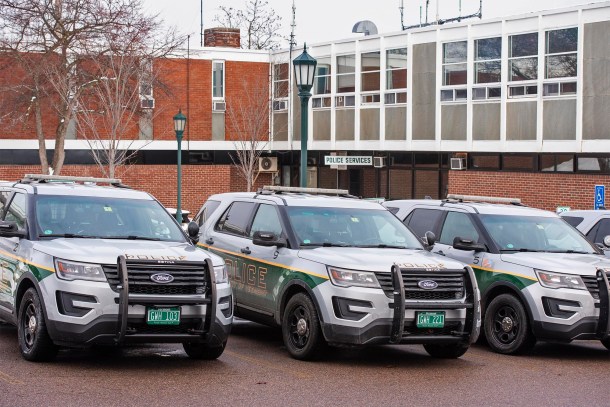
“Public safety has cruisers that are meant to look like police cruisers, they dress like police, they have their little radios on their belts, little notepads like police,” Travnikova said. “I feel like several decades ago, someone should have asked: Do we really need a force that imitates the police on a small, rural college campus in Vermont?”
Cops Off Campus — a student activism group at Middlebury, of which Travnikova is a leader — began asking questions about the role of public safety at Middlebury last summer. The movement was formed amid the swell of anti-police activism across the country, and has worked with parallel movements at Bennington College and the University of Vermont to reform campus safety and police forces.
Student demands aim for the kind of systemic overhaul that police abolition activists advanced on a national scale — and in Vermont — after the killing of George Floyd by police in Minnesota last May. The student groups are asking for a reinvention of campus policing structures in hopes of shifting colleges toward community-based responses to issues like mental health, sexual assault and breaches of alcohol and drug policies — all student life issues to which campus police have historically been assigned to respond.
The three groups have demanded the removal of officers from campuses, and they have pushed college administrators to rely less on disciplinary officers for responses to students in crisis. At Middlebury, campus police have racially profiled students of color, which is “incompatible with Middlebury’s stated goals of committing to racial justice and anti-racism,” Cops Off Campus organizers wrote in a list of demands signed by more than 1,000 community members.
Distinct differences
Policing looks different at the three campuses: UVM has a full-fledged police force, staffed by more than 30 armed officers, while Middlebury’s smaller Public Safety Department and Bennington’s Campus Safety office don’t employ officers formally trained in professional policing.
“We are not sworn [officers],” said Lisa Burchard, Middlebury’s longtime director of public safety, who is set to retire in April. “Here at the campus, we just deal with our campus rules and regulations, policies and procedures. We’re not enforcing the law — even local ordinances and state laws — and we’re not armed.”
Middlebury Public Safety officers operate with what amounts to a no-use-of-force policy. “We don’t have any force other than our communication skills that we use,” Burchard said.
Despite structural differences in each college’s police presence, activists across the three schools collaborated on their platforms.
“I think that collectively leveraging our power as students … is a way that we can leverage schools,” said Alice Jennings, an organizer at Bennington. “Schools are more likely to concede to demands if there’s a precedent set by other schools.”
A national movement
Student activists at colleges around the country, from the University of Minnesota to Northwestern University, this summer and into the fall pushed universities to change the way they police students.
That activism mirrored efforts by organizers in communities across the country to defund and re-imagine city and county law enforcement. Despite the slow response from college administrations, college campuses may be better positioned to implement change than municipal departments, according to Dr. Gabrielle Isaza.
Isaza, a researcher at the University of Cincinnati, helped lead reform efforts after a campus officer shot and killed an apparently unarmed black man in 2015, and since then has focused her research on campus policing.
“I think that campus police departments are well-suited to do a lot of the reform that’s being called for,” Isaza said. “Because a lot of these departments are part of college institutions, they’re inherently more progressive than their city or county or state-level counterparts. Administrators are more likely to make them implement changes because of how they’re structured.”
Activists point to histories of bias
Mirroring the message of police activists around the country, racial bias reflected in campus policing emerged as a core concern of the student movement across the three schools.
In the spring of 2017, a Middlebury Public Safety officer accused a Black Middlebury senior named Addis Fouche-Channer of joining the controversial protest against conservative author Charles Murray. The demonstration, which shut down the talk and pushed Middlebury into the national news, led to a professor being injured in the melee outside the building where Murray had been slated to speak. Dozens of students were eventually disciplined for participating in the protest.
Fouche-Channer claimed she hadn’t been anywhere near what happened that March afternoon. But she was brought before a judicial committee to prove her innocence that spring, where she presented logs of her WiFi activity at the time of the protest; they showed she’d been at a dining hall and Middlebury’s Athletic Center, according to a report in the Middlebury Campus newspaper.
The panel eventually determined that Fouche-Channer hadn’t been involved. But Fouche-Channer, certain that the Public Safety officer who accused her of being at the protest was racially profiling her, later filed a Title IX complaint against the officer.
“I pulled a student off the car with the name of Addis,” the officer at the scene told private investigators hired by the college, according to a transcript of a conversation published by The Campus. “… And I thought she was going to get into this racial thing with me.”
“I went back to Middlebury for homecoming that fall, and I read the logs of that second case that was basically like, ‘the WiFi wasn’t enough evidence’” to prove she had not been at the protest, Fouche-Channer said.
The Title IX office found that no racial profiling had occured in the case — a conclusion that Fouche-Channer believes contradicts the judicial committee’s earlier determination that she hadn’t been at the protest.
While college students, particularly Black students, have long advanced conversations about police reform at their schools, activists said the surge of nationwide activism this summer makes racial profiling by campus police like that experienced by Fouche-Channer — an aspect of campus life that could no longer be ignored by institutions.
“For me, the demands and the movement are important because Black and Brown bodies at [UVM] make the university better,” said Nyria Stuart-Thompson, a recent graduate of UVM and leader of the coalition. “As human beings, we matter. When multiple racist experiences happen to us, should we not talk about it?”
Making demands
The Black Lives Matter UVM coalition sent a letter, drafted by members including Stuart-Thompson, to the university administration and police department in June. They demanded disarmament of the campus police, termination of UVM’s partnership with the Burlington Police Department, and eventual abolition of the Campus Police Department.
People of color face disproportionate scrutiny from UVM campus police, according to a statistical analysis by Stephanie Seguino, a UVM professor of economics. Her research shows racial disparities in traffic stops for both the UVM and Burlington police forces.
Traffic stop data can be used as “a window into other types of policing practices,” Seguino said.
The UVM police department did not reply to repeated requests for comment for this article.
Bennington and Middlebury’s campus safety departments don’t publish traffic stop data, but students like Armstrong say similar issues exist on their campuses.
Armstrong recalled Middlebury Public Safety officers disproportionately targeting students of color for breaking rules in her freshman dormitory. Travnikova said she has sensed white friends feeling more at ease in situations where Public Safety intervention might arise than her friends who are Black.
“It annoys me that white students are so much more able to do what they want on this campus and to just feel free, while my friends of color are limited in how they can interact with this environment and claim it as theirs because of Public Safety,” Travnikova said.
Cops Off Campus have asked that public safety take input from student groups focused on racial justice issues. Dan Gaiotti, Middlebury’s interim public safety director, said it’s important that the department remain “aware of the issues and the concerns that are a part of that movement, so that we can try to do the best work that we can.”
Anti-racism training has become a regular part of Middlebury Public Safety’s monthly training sessions, according to Gaiotti, either through webinars or meetings with representatives from the college’s Office of Diversity, Equity and Inclusion.
Administrators at Middlebury included Cops Off Campus organizers in a meeting of the college’s Community Council in early December to gather student input on the search for a new director of public safety. Gaiotti asked the people representing Cops Off Campus to provide two names of student representatives to sit on the search committee.
However, Travnikova expressed concerns about Gaiotti’s apparent sense of urgency to find a new director and administrators’ suggestion to replace the director with an ex-police chief.
“There was a large lack of understanding of what we were trying to say,” Travnikova said.
In an email to Patton on Dec. 8, Travnikova asked that the search for a new director be halted until the Community Council conversations on the future of Public Safety have reached a conclusion. She also reiterated Cops Off Campus’ desire to meet with senior administrators to clarify the movement’s vision. The group has been trying to schedule a meeting since last summer, she said.
Reenvisioning student health care
Students also want campus police to take a different approach to mental and physical health emergencies.
Emergency therapy services at Bennington have historically been accessible only by calling Campus Safety, which Jennings believes deters students from seeking essential care.
At UVM, senior and activist Ari Kotler voiced particular concerns about responses to sexual assault. Kotler described instances of students “being interrogated” by campus police officers after traumatic experiences “instead of receiving warm, kind, compassionate support.”
Part of the training UVM police officers receive involves “identifying persons in crisis and connecting individuals with appropriate services,” said Enrique Corredera, a UVM spokesman.
UVM police are “close and daily partners” with campus groups like the CARE team for UVM students at risk, Corredera said. They also receive training as first responders in sexual assault investigations, and several the officers have experience working with the Chittenden Unit for Special Investigations.
Still, Kotler said the presence of armed officers in the aftermath of a sexual assault can cause heightened distress for students navigating already traumatic situations.
“I don’t see why it’s reasonable to have some armed guy, usually a man, come to your door when you’ve been raped and start asking you questions,” he said.
Organizers at all three schools believe a police-free emergency crisis service would better serve students. At Middlebury, Cops Off Campus proposed replacing Public Safety over the course of the next two years with a community response team of paid students, faculty and staff. The team would focus on providing medical first aid, mental and sexual health information, drug and alcohol harm reduction, de-escalation and conflict resolution.
Training and staffing
The Middlebury and Bennington safety teams are made up almost entirely of white men — an expected reality for employers building a workforce in the second-whitest state in the union (Vermont’s population is 94% white).
Burchard, Gaiotti and Ken Collamore, the director of Bennington’s Campus Safety department, all expressed interest in diversifying their staffs.

“It’s certainly boring and nearsighted not to have a diversified staff. You are selling yourself short and you’re certainly selling the community short,” Collamore said. But all three have found diversification difficult because of their locations and the nature of public safety work, which Burchard pointed out does not attract droves of out-of-state applicants.
Collamore has tried to fill those gaps by hiring work-study students from diverse backgrounds, which he found “did wonders for my staff and myself to grow, and for the students to see what it means to do this work.”
One of these students, recent Bennington graduate Deja Haley, who is Black, worked with Collamore from her first semester onward. In her role as a Campus Safety office assistant, she spoke with officers about how they could improve interactions with students.
By the end of her time at Bennington, Haley said Collamore had become a kind of father figure to her. “He would ask me questions about what [Campus Safety] could do, personally, to ensure that POC students felt safe on campus,” she said.
Collamore said he tries to take a “humanistic” approach to his work, and believes his department’s role at the college is to “support the community’s overall welfare,” rather than enforce rules. He tries to hire former teachers, counselors, psychology majors and social workers — in his words, people who have an intrinsic desire to help others.
The department’s hiring practices have nonetheless come under fire recently. In a letter sent to Collamore and administrators on Dec. 6, the Bennington Student Union demanded that Campus Safety fire a campus safety officer, alleging he is a white supremacist and “anti-masker.”
According to a Bennington Banner report, the officer was seen protesting with white supremacist Max Misch at a Black Lives Matter counterprotest in June. After sending the letter, Student Union leaders later discovered that the officer had left the college for reasons unrelated to their demands, according to a post on the Union’s Facebook page.
The letter criticized Collamore’s “choice to continue hiring former police officers, ICE agents and prison guards” and demanded binding decision-making power for student participants in the Campus Safety hiring committee.
Collamore said he encourages staff to take responsibility for mistakes.
Jennings, however, says the department is opaque and lacks accountability processes. “Everything happens behind closed doors,” she said.
Covid and community change
In the fall, when students returned to campuses dramatically altered by the Covid-19 pandemic, the activists’ momentum slowed. Faced with strict regulations around in-person gatherings and at-times-unresponsive administrators, activists have struggled to achieve their demands.
“Student concerns are being addressed,” Corredera said. UVM administrators — including provost Patricia Prelock and Wanda Heading-
Grant, vice president for diversity, equity and inclusion — have participated in lengthy meetings with students who raised the concerns and have followed up with the students after each meeting, he said.
But Kotler said two meetings over the summer between organizers and UVM administration yielded few results. During the first two weeks of fall classes, the activists held a “die-in” on the university’s Waterman Green to protest police brutality and the potential ramifications of UVM’s Covid-19 reopening plan.
“There’s been remarkably little in the way of progress” since then, Kotler said in September. “Mainly just the university acknowledging the issue and putting forward some pretty milk-toast, unsolicited plans that nobody actually wants or agrees with.”
Since then, Stuart-Thompson said, the movement’s demands — which included redirecting UVM police funding to health and community-based resources and hanging a BLM flag outside of the student center — have continued to go unheeded.
“It’s month seven. Student activists are burnt out, not respected, don’t trust the systems of UVM and higher education, and feel unwanted,” Stuart-Thompson said.
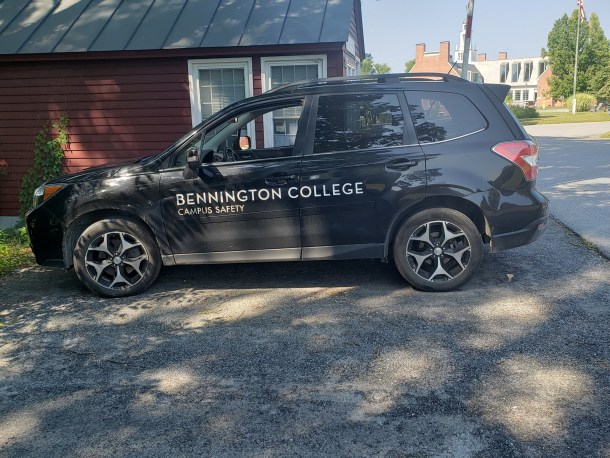
Activists at Bennington and Middlebury expressed similar frustrations at lagging administrative responses. Yet Covid-19 has presented occasional opportunities for the kind of student-to-student care that activists hope to instill more permanently, as officers take on fewer enforcement obligations in spaces like dorms and student apartments.
“Covid is a very tangible example for everyone of how your actions can impact everyone around you,” Travnikova said. “Obviously, it’s awful for so many reasons, but as far as opportunities to go foster a culture on our campus in which people actually acknowledge that their actions have impact that go way beyond just them, Covid is a fantastic example of that, and I think a great starting point to have people start viewing how they navigate campus and their actions toward their peers.”
A change in approach
At Middlebury, Public Safety officers have been more absent from dorms than in semesters past, as student residential life leaders have taken on more responsibility around enforcing Covid-19 rules and substance use.
That was intentional, according to Middlebury administrators. The administration entered the fall semester attuned to the national narratives around both policing and partying college students, college President Laurie Patton said, and wanted to tread lightly in both areas.
Rather than have Public Safety officers crack down on dorm gatherings and write up students for not wearing masks, administrators instead walked the school’s grounds themselves, along with faculty and staff members, to ensure students weren’t straying from guidelines.
“Many, many different departments have stepped in and said ‘we want to be the people walking around and checking in’ — doing OK and feeling safe, No. 1, and No. 2, following the rules,” Patton said.
After this summer’s national push for racial justice, according to college treasurer David Provost, the administration felt a more community-based approach was the best way to ensure rules were followed.
“Did we want to reinforce and grow the size of the Public Safety office and hold that as a truly just enforcement policy,” Provost said, “or was this a community opportunity to learn about holding each other accountable?”
In spite of setbacks last fall, student activists continue to push for incremental changes in hopes of ultimately achieving more robust transformation.
“I think that a lot of people, myself included, have been energized and mobilized by being a part of Cops Off Campus, which could lead to other changes happening along the way,” Travnikova said.
Travnikova was especially inspired by an incoming freshman at Middlebury who joined the group in the summer. “This student hadn’t even set foot on campus but was already getting involved,” she said.
