

After Mike Mayer’s mom died, he found himself stranded in a CVS parking lot crowded with President’s Day traffic. His mother’s dead body was on the back seat.
The car stalled and he had to get a jump-start from a AAA attendant with the nickname “Stiffy” emblazoned across his chest pocket.
After the jumpstart, Mayer got his mom home to the land where she had lived and where she wanted to be laid to rest — a 245-acre plot of conservation land in Williamsville where his parents, Pamela and Dave Mayer, started the Manitou Project 30 years ago. Mike describes Manitou as a blend of conservation and spiritual interests. Williamsville is an unincorporated section of Newfane.
“When my mother died eight years ago, her last and most fervent wish was that she might be buried on the land which she and so many others loved in such extraordinary ways,” Mayer said. “And so, for the last year of her life, we explored what it meant to do a natural or green burial here.”
After he buried his mother, friends started asking Mayer if they could be buried on the land, too, and that put him in a difficult position. While Vermont has allowed home burials for family members on their own land, local bylaws limit how cemeteries are allowed to operate.
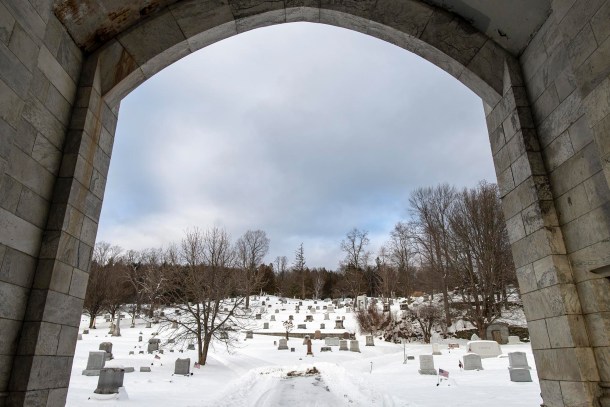
Then in 2015, Vermont passed a state law allowing green burials. The idea has been gaining traction since, and many towns around the state are allocating space in cemeteries for natural and green burials.
Natural burials forgo the traditional vault, embalming fluids and casket. Bodies instead are buried with biodegradable materials, such as a cotton shroud or a wicker box, about 3 and a half to 4 feet underground.
“It’s an extension of people’s own recognition that we can live a conscious life, but what about our passage?” Mayer said. “You can take a very direct role in consciously laying your loved one to rest in a manner that is consistent with your values, the value of your loved ones, and the value that you really want to instill for generations to come.”
‘It seems to be catching on’
People are turning to green burials as an environmentally friendly option. While traditional burials emit carbon, green burials can actually sequester it by forgoing the use of hardwood for caskets. About 20 million board feet of hardwood is used in the U.S. for caskets.
The U.S. also uses about 4.3 million gallons of embalming fluids per year, including about 827,060 gallons of formaldehyde, methanol and benzene, according to Mary Woodsen of Cornell University. Plus, according to Woodsen, caskets and vaults leach iron, copper, lead, zinc and cobalt into soils.
“I am not fond of poisoning the ground with embalming fluid,” wrote Plainfield cemetery commissioner Ed Hutchinson in an email to VTDigger. Plainfield recently set aside the Bisson Cemetery for natural burials. Reserving a plot costs $1,200.
Demand for green burials has been going up in recent years. The conversation in Plainfield started years ago, after a resident asked if the town cemetery would start offering natural burials, Hutchinson said. He thinks it’s a great idea and so far residents seem to agree.
Plainfield’s sexton, Joseph Mangan, works with 60 other cemeteries in Central Vermont. He’s supportive of green burials and has been working to get more towns on board.
“It seems to be catching on in Central Vermont,” Mangan said, noting that Peacham is in the process of allowing green burials. He says Calais was the first, and others, like Montpelier, have followed suit. Mangan hopes Marshfield and Brookfield will be next.
“The process of doing a green burial takes a little community,” Mangan said. “They just feel like it’s not a commercialized system.”
Still, it’s not for everyone. “I tried to get the town of Williamstown to move that direction, they really didn’t want to,” Mangan said. Town officials were concerned about upkeep, including the possibility that graves would sink without the support of a vault.
What could go wrong?
Patrick Healy, president of the Vermont Cemetery Association, is working with Green Mount Cemetery in Montpelier to offer natural burials.
“We’re trying to figure out all the things that could go wrong,” said Healy, who has been working in the cemetery for 34 years. Concerns include smell, and the logistics of doing a winter burial when the ground is frozen. While Healy said he was a staunch opponent at first, now he’s come around to it.
They’ve tailored the concept to the cemetery. While green burials don’t include a marker of any kind, Healy chafes at the idea of disrupting Vermont’s granite industry. “We can’t shut that out,” he said. So they’ve held on to monuments at Green Mount.
Mangan, who is responsible for maintaining the cemeteries where he works, said he doesn’t mind taking care of the green burial plots. “Really, the green burial is set aside as kind of the wild area,” he said.
The number of green burials remains relatively low, Mangan said, but “there’s been a lot more sales of lots in green burials.” He expects full acceptance will take another five to 10 years.
“Everyone’s buying their plots now; not everyone’s ready to go,” Mangan said.
It’s hard to say how many green or natural burials have actually occurred. The state doesn’t seem to track them. Green Mount Cemetery has had about nine, Healy said. Mangan said he’s had five.
But there are other ways to track its rise. Among them: the exponential increase in membership over the past few years in the Green Burial Council, an advocacy and educational nonprofit.
Lee Wester, who recently stepped down as president of the Green Burial Council, said phone calls and emails are multiplying weekly, whether she’s hearing from old ladies down the street or the Department of Homeland Security. In Vermont, she’s considered a green burial guru, and helps municipalities draft bylaws to allow green burials.
Webster lives in New Hampshire, but grew up in East Montpelier. Back in 2016, she gave a presentation to an interested group in Plainfield, which recently decided to offer green burials.
“I would say we’re going to double the opportunities in Vermont within the next year,” Webster predicts.
Her parents were cemetery trustees and commissioners, but it took years for Webster to make the connection between her parents’ work and her own.
For Webster, green burial is a consumer choice that is affordable, environmentally friendly and a meaningful way to say goodbye to a loved one.
“There’s an automatic understanding that people will come and participate. The physical act of burying a loved one. Actually shoveling the dirt, lowering the body. There’s no mincing around,” Webster said. “It’s the healthiest thing you can do.”
While cremations are another alternative to traditional burial, Webster says there are environmental problems associated with using fossil fuels to burn a body at high temperatures for two hours. “Having mercury go up into the air. The amount of CO2 that’s emitted is enormous,” she said.
Conservation burials
Mayer is planning something a little bit different at Higher Grounds.
“Our approach is to use our woodland sanctuary as a site for natural burial because we see that using human remains as compost, if you will, for the specimen trees we most value and as a way to support the wildlife habitat that we cherish,” he said.
There are 180-year-old trees growing on the land, a rarity in a state that was heavily logged 150 years ago. The old growth includes yellow birch trees, a variety that Mayer is particularly proud of. He said that having cemeteries in the woods is another way of caring for the trees.
“There’s this extraordinary exchange, and human remains, particularly the soft tissues, support the regeneration of that ecosystem underground and in that way we’re actually feeding the roots of trees we most value,” Mayer said.
Mayer hopes people will enjoy the land his mother loved. For two years, Mayer worked through zoning issues and met with the Vermont Land Trust to find a way for people outside of his family to be legally buried on one section of Manitou’s conserved land. This year, he plans to open Higher Grounds, offering conservation burials to the public.
Lee Webster says Mayer’s project is exciting, and relatively unique. “He’s not the only green cemetery in the area, but the only one who will have a conservation-level situation,” she said.
It’s also a way to financially support conservation efforts. “If you have a loved one buried on conservation land, you’re more likely to go back there and support it and keep the funds flowing,” Webster said.
“You’re rolling along with your stroller or wheelchair, the opportunity to be in a beautiful place, to appreciate the stillness, and to appreciate that someone you have loved is actually there helping to feed that system,” he said.
