

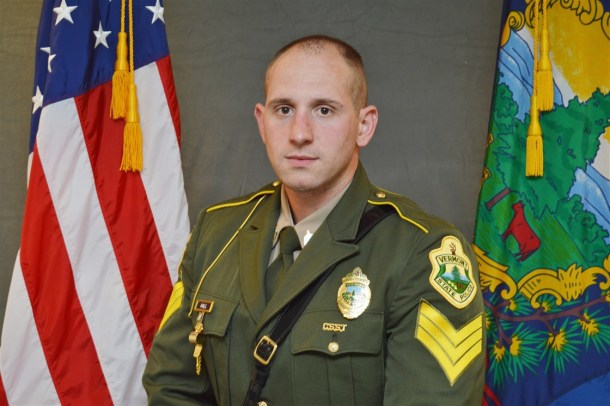
A Vermont State Police sergeant, suspended for an off-duty Facebook post in support of the riots this week at the U.S. Capitol, has also had problems on-duty.
In November, a Vermont judge issued a strongly worded ruling questioning Sgt. Lucas Hall’s credibility when his statements did not match up with video footage from an arrest, leading to the dismissal of charges against a woman, Seven Days first reported Thursday night.
Now, a second case involving another traffic stop leading to a drug arrest more than two years ago shines another light on Hall’s credibility. In the case, a defense attorney sought to throw out evidence collected from a large drug bust in western Rutland County.
That case was not dropped, although federal prosecutors never responded to the defense motion to suppress the evidence or to hold a court hearing over an allegation that an officer lied to obtain a search warrant.
The suspect in that case, who had been facing a sentence of at least 10 years, eventually took a plea deal on a reduced charge with a much shorter prison term.
While those two cases didn’t cost Hall his job, his Facebook postings this week might. Vermont Public Safety Commissioner Michael Schirling suspended him without pay pending an investigation. Vermont Attorney General TJ Donovan has called for Hall’s firing or resignation.
“Cheers to the great Patriots in Washington DC. The time has come… Let’s gooooo!!!” Hall posted Wednesday to Facebook, the same day supporters of President Trump stormed the U.S. Capitol. Then, in response to a commenter, Hall wrote: “it might be war… We are beginning to see good, law-abiding citizens stand against a corrupted government.”
Hall could not be reached for comment. He posts on Facebook under the name Luke Hall.
Just two months ago, Judge John Pacht issued a scathing ruling questioning Hall’s credibility in a 2018 arrest involving a woman in the Rutland County town of Chittenden. The judge, after hearing testimony and reviewing video footage of the incident, tossed out the charges of simple assault on a protected professional and resisting arrest against Stephanie Baron of Ayer, Massachusetts.
The charges stemmed from a traffic stop in Chittenden involving a vehicle Baron was riding in after attending a wedding. As the driver was being taken into custody on a charge of drunken driving, Hall pulled Baron, dressed in formal attire, from the vehicle and threw her to the ground, Pacht wrote in his ruling.
The judge said changing testimony from Hall, as well as his statements conflicting with the video footage, warranted the dismissal of the misdemeanor charges in the “interest of justice.”
“The court assumes Sgt. Hall prefer that this case not be dismissed. Certainly, the court understands that, from his vantage, he does not think he did anything wrong,” Pacht wrote. “However, given the facts found by the court, as outlined in this opinion, the court believes it would be helpful if he reviewed this incident with fresh eyes.”
According to the ruling, Baron had been unable to obtain her teaching certificate while the charges were pending against her.
Pacht wrote that the incident had been “physically and mentally” debilitating to Baron. She suffered from a concussion during the incident, and developed migraine headaches she hadn’t had before.
In an earlier federal case involving Hall, Elizabeth Quinn, an assistant federal public defender, filed a motion to dismiss charges or suppress evidence in a case against her client, Shane David of Brooklyn, New York. That motion was based, in large part, on Hall’s actions regarding a search.
If the motion hadn’t been granted, Quinn planned to seek a hearing on whether the officer misrepresented information or lied to get a judge to approve a search warrant.
According to court records, David was pulled over for speeding on Route 22A in West Haven on Oct. 14, 2017. A later search of the vehicle led to the seizure of more than 3 pounds of crack cocaine, plus some marijuana. David was charged with possession with intent to distribute more than 280 grams of crack cocaine and possessing marijuana with the intent to distribute.
Hall was one of three troopers who responded to the scene. In an affidavit seeking a search warrant, Hall described David as deceptive when responding to questions, offering conflicting answers, according to the defense motion. And when the suspect was asked for consent to search the vehicle, which he refused, Hall described David as having a changing and erratic demeanor.
But, Quinn wrote in the filing, the video showed that wasn’t the case.
“In fact,” the defense motion stated, “he is smiling through most of this interaction as if he does not understand why they would want to search his car.”

The defense filing also pointed to conflicts in Hall’s affidavit, including one about a police dog called to sniff the suspect’s vehicle to obtain probable cause to search it.
“Again, the affidavit suggests the dog alerted to drugs immediately and the handler played at most a disinterested role,” Quinn wrote. “In actuality, the dog did not alert on its first pass and alerted only after the handler physically and verbally cued the dog. The omission of these facts removes from the magistrate’s review the possibility that the dog did not actually alert to drugs and instead simply responded to his handler’s many cues.”
No ruling was ever made on that motion, which appeared critical to the case, and the prosecutor did not file a response. Instead, a plea deal was reached so that Hall didn’t have to testify; it also took the 10-year mandatory sentence off the table.
The charge of possessing with the intent to distribute more than 280 grams of crack cocaine was reduced to possession with the intent to distribute more than 28 grams of crack cocaine. That lower-level charge reduced the mandatory-minimum prison sentence to five years, and ultimately David was sentenced to 72 months.
Late last month, Judge Christina Reiss granted a defense motion for a “compassionate release” for David. That motion was based in large part on concerns over Covid-19 in the federal prison system. Reiss amended the sentence for David to time served — a little more than half his initial six-year prison sentence.
Quinn, reached Friday, declined comment. Abigail Averbach, the prosecutor on the case, no longer works for the U.S. Attorney’s Office in Vermont.
Asked if any disciplinary action was ever taken against Hall in either case, Adam Silverman, Vermont State Police spokesperson, replied, “As you know, generally speaking any disciplinary matters are confidential as a matter of law.”
Schirling, Vermont’s public safety commissioner, said Friday that he had received many more comments about Hall’s Facebook posting case than he typically does for any issue — with most of them criticizing the decision to suspend Hall.
“While I’m not actively looking at social media, I have been surprised by the number of calls that have come into the Department of Public Safety complaining about the suspension of the trooper yesterday,” Schirling said. “We have received calls also in support of that action, but the surprising part was the calls in the other direction.”
Schirling said the comments coming in were similar to a comment on Guy Page’s website, “The Vermont Daily Chronicle,” calling for the public safety commissioner to be fired or resign because he’s un-American and squelched the trooper’s First Amendment rights. The comments are at the bottom of a posting on the right-wing-leaning website about Hall’s current suspension.
Schirling, speaking at a press conference Friday on the state’s response to Covid-19, was also asked about Hall’s suspension and when the investigation into the sergeant’s Facebook postings would be completed.
“We do anticipate having that concluded by very early next week with updates to follow,” Schirling replied.
Anne Wallace Allen contributed to this story.
