This story was updated at 10:42 p.m.
In his third inaugural address Thursday evening, Gov. Phil Scott pledged to focus this legislative session on “weathering the remaining storm” of the Covid-19 pandemic and “laying a foundation” to rebuild the state’s economy.
Scott’s remarks came 10 months into a global pandemic that plunged the state and nation into a public health and economic crisis last March. He noted that it had been 306 days since Vermont saw its first case of the virus, and he lauded the doctors, first responders, frontline workers and ordinary Vermonters who had made sacrifices to slow the spread of the virus.
But the governor cautioned that there was still a long road ahead before recovery from the pandemic was complete.
“You are saving lives,” Scott said. “But we need to keep looking forward, stay focused and committed because our work is far from over.”
Scott’s speech came one day after supporters of President Donald Trump descended on the U.S. Capitol and participated in violent riots that sparked national unrest. In response to the chaos in Washington, D.C., Scott called Wednesday for Trump to resign or be removed from office.
In Thursday’s address, he called the event “a shocking attack on our democracy.”
“And make no mistake: President Trump is responsible for fanning these flames,” the governor said.
Scott, who won reelection to a third term in November, was sworn into office earlier Thursday just outside the Statehouse in Montpelier. Typically, Vermont governors deliver inaugural addresses directly after taking the oath of office in the House chamber. But administration officials said Scott opted to give his speech remotely during the evening due to Covid-19 health restrictions.
The prime-time slot, at 7 p.m., likely gave the address a larger audience than usual.
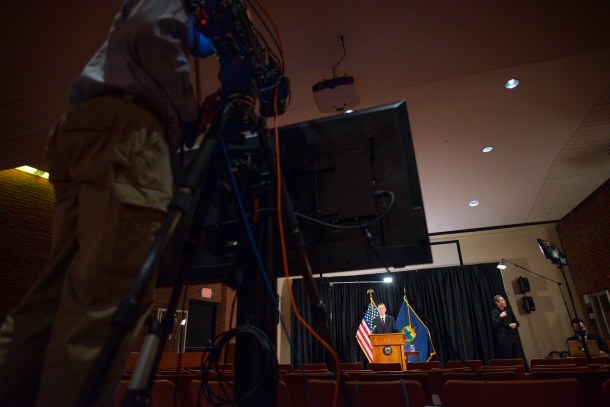
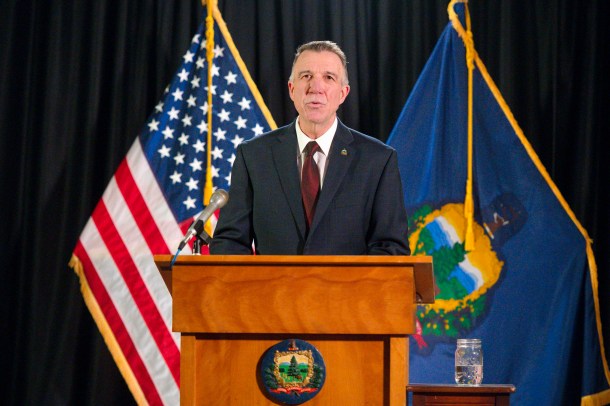
Scott delivered his remarks alone, in front of a camera in a suit and tie in Montpelier’s Pavilion Auditorium, where he also holds his bi-weekly press conferences. There was no applause or reaction, as there would be in a typical year in which the governor would address a packed crowd of legislators, cabinet officials, dignitaries and the press.

(See the full text of the governor’s address.)
Scott laid out his plans for leading the state through Covid-19 recovery in 2021, and he outlined some of the proposals he plans to bring to the Legislature in the coming weeks.
The governor said that state officials were developing a plan to safely return every child in the state to the classroom full time before the end of the school year, and perhaps as early as April.
“The fact is: We have some of the best conditions in the world to begin this work. For our children and their future, we must reestablish full in-person instruction, routines and relationships as soon as possible,” Scott said.
He unveiled a plan to streamline oversight of the state’s child development system under the Agency of Education. Currently, responsibility is divided between that agency and the Department for Children and Families.
“This move will break down another unnecessary bureaucratic silo,” Scott said. “It will finally unite the state’s experts on child care, preschool, K-12 and technical education, which is long overdue.”
Scott also said he planned to set new limits on the growth of health insurance premiums.
“I believe it’s time to set a cap on annual increases and continue moving to a system where we pay for quality, not just quantity — and do so in a way that prioritizes prevention on the part of the patient as well as the provider,” Scott said.
The governor noted that 20,000 Vermonters had received the Covid-19 vaccine so far and that he expected that at the current rate, 120,000 could receive it by the end of winter. That would allow the state to reduce Covid-19 restrictions as the year goes on.
“It’s our hope that sometime this summer — possibly earlier — we’ll reach the point where life will begin to feel normal again,” Scott said. “But a lot depends on how many doses of vaccine the federal government makes available and how many Vermonters choose to get vaccinated.”
Scott also returned to familiar proposals and themes. He said he would pitch modernizing Act 250, Vermont’s land use law, “to eliminate duplication and reduce costs” and to make it easier to revitalize downtowns and village centers. He suggested he would invest money to weatherize homes. He said he planned to propose a property tax exemption for licensed preschool programs.
The governor added that he would invest in “more tools to recruit and retain working families,” noting that many new residents had moved to Vermont during the pandemic.
“This is a real opportunity because we know our demographics have been our Achilles’ heel,” Scott said. “With an aging population and shrinking workforce, we just don’t have the people we need.”
Responding to Scott’s speech, Sen. Randy Brock, R-Franklin, the Republican majority leader, said he shared the governor’s desire to attract more workers to the state.
“We do have critical shortages of people nurses, for example … and other medical professionals because we can’t hire and retain them here. That’s significant,” Brock said. “And to the extent that we can use incentives to attract some of those people to actually come here and stay here is really important.”
House Speaker Jill Krowinski, D-Burlington, and Senate President Pro Tempore Becca Balint, D-Windham, responded to Scott’s speech in televised addresses from next door in the Statehouse. Krowinski echoed Scott’s call for Trump’s ouster, noting that the Vermont House had passed a resolution earlier Thursday calling for his removal or immediate resignation.
The Democrats refrained from criticizing Scott and sounded messages of bipartisanship in the wake of the turmoil in Washington.
“On some matters we all agree on the end goal, but we’re not going to agree, necessarily, on how we get there,” Balint said. “But that’s all part of the lively, robust conversation that happens in a healthy democracy.”
She added, “And here in Vermont, we still have a healthy democracy. We can show the nation and those who seek to undermine our ideals just how the people’s work gets done.”
The Democratic leaders reiterated that their work this year would be focused on responding to the pandemic.
Krowinski said that in recovering from the Covid-19 crisis, the state needed to address “fundamental infrastructure issues” such as access to child care and broadband.
The House speaker said that the lack of high speed internet access in some parts of the state had had “an incredible impact on our small businesses and with Vermonters struggling to work or learn from home.”
“This is not a new problem, nor is it easily solved, but we can no longer allow some areas of the state not to have access they deserve,” Krowinski said.
Scott didn’t mention expanding access to the internet as among his priorities in 2021, though he said he believed state officials already made “smart investments” in broadband earlier this year using federal Coronavirus Relief Fund dollars.
Brock, who has said that internet expansion is a priority for him during the pandemic, said that Scott’s mention of broadband suggested it was on his mind.
“I know that it is and I would expect to see more coming up,” Brock said.
Scott is expected to unveil his specific proposals for the Legislature, and his spending plan for the next fiscal year, in his budget address later this month.