


David Nicholls, a student at George Washington University Online High School, produced this story for Underground Workshop, VTDigger’s platform for student journalism. It is the second in a series; the first is here.
Editor’s Note: Vermonters cast 112,704 votes for Donald Trump and 248,412 votes for Phil Scott last November. The people behind these numbers often have little in common with each other or with traditional political labels. The interviews in this series explore just a few of the wide-ranging perspectives and attitudes among Vermonters who identify as conservative or Republican. They do not represent the views of Vermont’s Republican Party, the student journalists who conducted the interviews, or VTDigger — each of these Vermonters speaks only for themselves. Interviews have been edited for length and clarity.
Correction: An earlier version of this article described Randy Brock as the third african american lawmaker in Vermont.
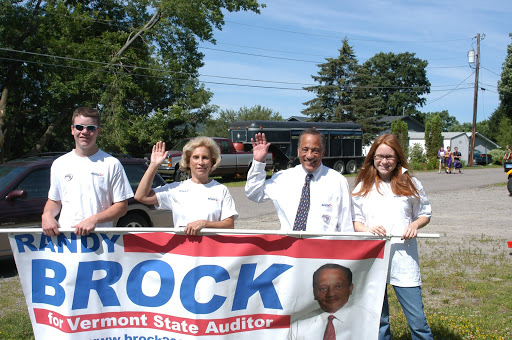
Photo courtesy of Randy Brock.
When Randy Brock first ran for state auditor as a Republican in 2004, it was one of the first times a Black person was elected to office in Vermont.
The first African American state legislator in the entire United States was Alexander Twilight, who was elected to represent Vermont’s Orleans County in 1836. In 2018 Kiah Morris resigned from representing Bennington in the House after being harassed because of her race.
Despite this, Brock says that only one of the articles about his 2004 race mentioned that he is African American.
“I have no doubt that in that race, and in any other race, that some people did not vote for me because of my race,” he said. “There were probably some people who voted for me because of my race. But neither was significant.”
Race has never been an integral part of Brock’s political identity.
“I realize that a lot of folks are so consumed about perceived discrimination,” Brock said. “It’s not that there’s no discrimination — there is racism — but you can’t let it manage your life.”
Brock lived a full life before running for office for the first time. He grew up in Philadelphia, served in the military, and commuted to Boston to work at Fidelity Investments before he became state auditor in 2005. Now he is the Senate minority leader in Vermont.
In terms of politics, he prides himself on being the old kind of Republican, the kind who can go out with a member of the other party and have a beer.
You were part of the board for the Alzheimer’s Association, and you were on the commission for Alzheimer’s disease. What is your commitment to Alzheimer’s?
My father suffered from and died from Alzheimer’s disease. And my wife’s mother suffered from and died of Alzheimer’s disease. So it is something that we have a family connection with and, obviously, an interest in finding a cure. Kind of a passion. I was involved in the association nationally, I was a member of the board, the executive committee of the association for eight years. And then I was also chair of the Alzheimer’s Association here in Vermont.
What role did your father have in your life?
He was my father. We were close. He was the first in his family to attend college. He went on a basketball scholarship. He was 5’7” tall. He told me how he discovered that he was old: He said it happened the day that he learned that he was older than the pope.
Fortunately, I am not older than the pope, nor older than Vermont’s two U.S. senators, nor older than the president-elect. My father and mother were married for 63 years.
Did he influence your political point of view? Did he show you politics?
We had debates, but we were a family. They weren’t particularly acrimonious. He was a Democrat. Later in life, I was probably more vocal as a Republican than I was earlier.

Was he against the Vietnam War?
No, no, there was never a debate about that. I think he was concerned. Both he and my mother were concerned when I went to Vietnam. My mother was on pins, obviously, the whole time that I was there.
And in those days, you know, you didn’t talk. You didn’t have the internet, or the kind of communication that they had, let’s say, during the Iraq War, in which you could talk to your family, and so on. So you know, we wrote letters.
You were in the Vietnam War. What stuck with you? How did it affect you?
It was interesting. It was, at times, trying. It was difficult. It was not a place that you really want to be. That’s on the one hand. On the other hand, some experiences lasted a lifetime. I met lots of interesting people. I could see policy being made and I could see policy being executed at the same time. So it was a very interesting perspective. It was very valuable in terms of training, experience, and observation.
What was one of those experiences?
I worked in an organization that was called CORDS. It had a very long title: the Office of Civil Operations and Revolutionary Development Support. That was essentially the shadow government that the U.S. had in Vietnam, and I was a special assistant to the deputy in the central part of the country. There were all kinds of advisers: from public information to agriculture to police to the equivalent of the Vietnamese national guard, the Regional and Popular Forces.
So it was a job in which I traveled throughout the country. I saw operations that we had talked about being executed on the ground. I participated in some of them. I saw the Central Highlands, I saw the Central Coast. And I visited Saigon quite frequently.
For perspective, the head of the CORDS organization in the country was formerly the CIA station chief in Saigon. And when he left there, he became the director of central intelligence. And so it did have that cast to it as well. I found it fascinating.
How did you become part of that?
This is a fascinating story. I was supposed to be assigned to the Saigon Support Command. When I actually arrived, I had been reassigned, unbeknownst to me. I went to Nha Trang, to the First Field Force. And I was there as a staff officer for a short time. Then I got assigned to this CORDS operation.
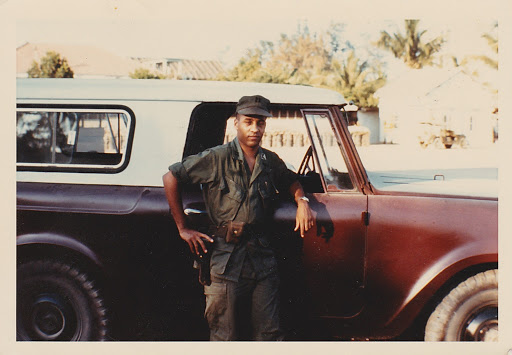
And what I later learned, that I didn’t know at the time, was that I got reassigned from the Saigon Support Command because I was Black. They didn’t want me. That’s how I got reassigned. A colonel gave me the details sometime later. It’s kind of funny when you think back on it. But in any case, I wound up in the CORDS operation, and that’s where I spent a great deal of time.
You often say that you have a problem with identity politics, but is it possible for you to describe a moment in your political career when your race did matter?
Frankly, no, I can’t. And I realize that a lot of folks are so consumed about perceived discrimination. It’s not that there’s no discrimination, there is racism, but you can’t let it manage your life. And, surprisingly, when I first ran for office — I ran for state auditor in 2004 — of all the articles that were in the press about that contest, there was only one that even mentioned race that I can recall.
Now, I have no doubt that in that race, and in any other race, that some people did not vote for me because of my race. Conversely, there were probably some people who voted for me because of my race. But neither was significant, I was a tremendous underdog, and I won. In my first race.
Did the Black Lives Matter movement change that at all?
Well, I mean, there were discussions that I might have, let’s say with some of my peers, as we talked about issues related to it, related to how changes might be needed in a number of areas. I think implicitly there are those in the Legislature who thought that somehow I had some particular wisdom based on my experience. And perhaps I did, but I don’t think that that’s the most important part, because that kind of outlook assumes that because one is of a particular color, that they know everything. And that we’re all fungible, which is certainly not the case. There are as many views as there are shades of color.
What would one of those issues be that you would discuss? Police? How would that look?
Well, it might be on issues like incarceration rates, in which there’s no question that there is a much higher incarceration rate of African Americans. And the question is: “Why?” And I’ve always been of the belief that having a set of high-level statistics and numbers is not necessarily sufficient to draw conclusions from, and that we need to get behind the numbers.
And that’s one of the things that I will be pushing in this next session in terms of my influence. I want to know: “Why is there such a high incarceration rate? Is it because of racism? Or is it because of other factors that still have not been properly correlated to say how that influences?”
I haven’t seen the kind of in-depth analysis that would help us understand that better. And I think we need to understand that better. I have no doubt that some parts of it may well be racism. And some parts of it may well be assumptions that are systemic in nature. But we have to do a much better job of understanding things before we jump to conclusions that make us make decisions that are not helpful and that don’t solve the long-term problem.
So those discussions were controversial, and yet, important.
That’s one of the things that you miss by having the remoteness that we do have right now. Because often those are discussions that a group of two or three of us may have quietly, I wouldn’t say in a corner of the State House, but somewhere in the State House, like the cafeteria. We have to be talking. It’s harder to have those kinds of conversations remotely.
So you’re recognizing the remoteness. You also recognize Covid-19 as a major issue. You wrote about it in VTDigger.
That’s the issue that’s on the table right now. Obviously, it has a tremendous impact throughout the state, just in terms of how we operate as individuals, how we do business, how we govern. It has a great deal of ultimate uncertainty because, as we face tremendous budgetary challenges, we don’t know where to get the money to do the things that we’re going to need to do. A lot of this will depend upon the federal government. The federal government is in a state of uncertainty in terms of what is going to be available and above all what the states can do with it.
There were federal handcuffs which we found in the CARES Act money. It couldn’t be used for certain purposes that were, in my judgment, central purposes in the state. It couldn’t be used to make up for lost revenue. So we had to do a lot of financial gymnastics.
Fortunately, regardless of which party is in power, we’ve been balancing the budget and not doing stupid things that a lot of other states have done. That’s put us in a relatively good position to be able to get through the first part of this without wrecking the state’s finances and without having to raise taxes. Continuing to do that, however, is going to be a challenge.
Can you describe a moment that shows what it’s been like in the past six months trying to solve these issues?
I don’t know if I can cite a particular moment, just a continual state of pressure, stress, difficulty and collaboration. And that’s one of the things that I know I mentioned on the floor of the Senate; that I think the body deserves a lot of credit for being able to work together in such a situation, and pulling together with such a degree of agreement was commendable.
When was that cooperation most evident?
As we constructed solutions. Solutions to the problems of how we continue to operate, how we support businesses and individuals who are going through hard times, how we successfully deal with the homeless problem. I don’t believe we’ve had a single COVID case in the homeless population, although there may be one or two. But we were very, very successful among other states, and I was on the economic development committee that dealt with coming up with the plan for that. We also worked with the administration. So it was a lot of hard work by a lot of people. Politics got put aside.
Republicans in other states disregard Covid-19. How do you feel about that issue setting you apart from Republicans in other states?
Republicans in other states? I think you could say Republicans in some other states but if you take a look at even some recent statements, there are a number of Republican governors that got together and discussed the need to work together in terms of Covid response. You had Gov. Baker in Massachusetts, Hogan in Maryland, Sununu in New Hampshire, Gov. Scott here, Gov. Hutchinson in Arkansas, and so on.
So there was no uniform Republican rejection of Covid as an issue by any means. Certainly, some folks believe, for one reason or another, that Covid is a hoax. Or that it is not a particularly serious illness or that you don’t need to take the precautions that the CDC and others say you should. And there are some folks like that here. But to say that they’re the principal driver, I don’t think that’s the case. There are still different approaches to how to deal with it.
There’s still definitely a difference in identity, though, between being a Republican in Vermont and being a Republican in, let’s say, Montana, right?
There always has been. I mean, you go back over the years, Vermont Republicans have always taken perhaps a somewhat different path. If you go back to the era of McCarthyism as a classic example, in which you had Joe McCarthy doing what he did in terms of the red scares in the 1950s and it was Vermont Republicans who stood out and stood up against that. And it was George Aiken and Ralph Flanders, the two U.S. senators, who were in the lead to putting a stop to that and getting America back on course.
Do you have a story that shows what it’s like to be a Republican in Vermont versus being a Republican in other states? That unity in the Senate was different than maybe it would be in other states?
Well, the fact that we were able to come to an agreement in so many areas in the midst of a crisis, I’m not sure I’m in a position to say how other states handle that. I know how we handled it. I know that when we recognize that businesses are hurting and need support, we need policies that particularly in terms of the use of Covid funding that will help deal with that.
And we have to do it quickly. We can’t argue about this forever because people are potentially going out of business. People aren’t able to meet their responsibilities, feed their families, and so on, and doing nothing is not an option. I suspect that those pressures were not particularly different elsewhere, but I can’t address at this point how they handled it; I can address how we handled it.
It is different, though. If you think about Pelosi, Schumer, McConnell. That’s really divided.
We talk to each other in Vermont. And I get the sense, certainly at the national level, that communication has broken down and the posturing has taken over.
I think what I see certainly in the Senate is that there are issues — and this is a phrase that I’ve used, I think repeatedly — where we can disagree without being disagreeable. You should be able to go with a member of the other party and have a beer. It doesn’t happen in Washington anymore. It used to.
If you think back to some of the cabinet appointments back in the ’50s, and during the Eisenhower administration, you had Democrats in the cabinet and you had situations in which the opposite held true. William Cohen was Clinton’s secretary of defense. He was a Republican. I don’t think that you see that today. You see much more separation and polarization.
Do you see that division ending with Biden at all or do you think that that’s a gimmick?
I don’t know yet. I don’t know. The jury’s still out. I haven’t seen any Republican appointees that he’s announced yet that I am aware of. But you know, it’s still early. This polarization at the national level has gotten to an extreme and it had done so even in the pre-Trump era.
Of course, it’s accelerated in the Trump era, and that’s unfortunate because it makes the government the opposition. The ability of parties to have different points of view that can be expressed is a healthy part of democracy. On the other hand, when the polarization gets to the extent that it drowns out any competing point of view, it becomes paralytic.
We in Vermont have not gotten to that point. Thankfully. And we don’t call each other names.
