

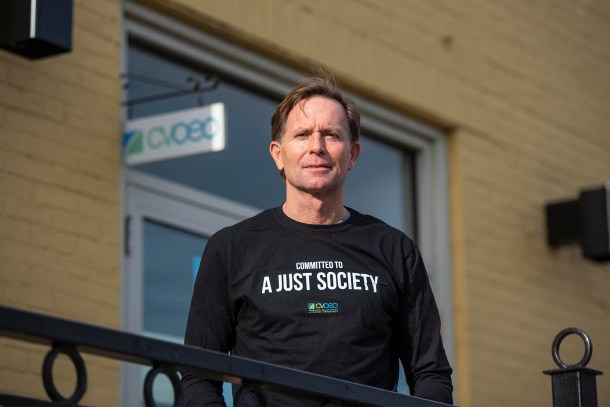
Paul Dragon is executive director of the Champlain Valley Office of Economic Opportunity, one of five community action agencies that address economic, social and racial justice around the state. The Champlain Valley office serves more than 10,000 households with programs aimed at ending poverty and establishing equity.
As many of the federal Covid-19 programs draw to a close this month, VTDigger spent some time talking with Dragon about poverty in Vermont. The interview has been edited for length and clarity.
Q. What impact has the Covid-19 pandemic had on Vermont poverty?
It’s difficult to estimate the poverty rate, but demand for food shelf and homeless services and unemployment insurance went up in April. Homelessness increased in April by over 500 people. At Feeding Chittenden, the largest food shelf in the state, our anti-hunger program rose 38 percent since April and that is with the relief funds.
Without the (federal) CARES Act, I am sure the poverty rate would be up over 20 percent. If we don’t get another stimulus package, the poverty rate is going to go way back up.
Poverty is a disaster that precedes the pandemic. In this country, poverty is a national disaster. We shouldn’t have 17% of our kids living in poverty in Vermont and over 22% of our kids living in poverty nationwide.
But with the pandemic, it is really job loss more than anything. Employment is also tied to child care, so if kids are staying home during the day and not able to be in school, women have left the workforce in great numbers. And it’s proportionately women for sure.
This isn’t Vermont-specific, but nationwide, there were 2.2 million fewer women in the workforce in September 2020 than in September 2019. As families reshuffle roles and responsibilities, we need to promote business ownership as a path forward for women and families.
Q. Aren’t unemployment insurance and state grants programs there to help?
The unemployment rate is linked to affordable child care. Kids being out of school was one effect, and the other one was just that people who were unemployed were being lifted up by the stimulus checks. That was great; it really staved off the growth in the poverty rate for a while, but as that went away, the poverty rate has been driven back up.
Businesses that had just started up when the pandemic struck or have started up since March 2020 have been ineligible for almost all of the small business grants. These are entrepreneurs who had just barely invested their resources into what they hoped would be a successful business. Many are still working to find a foothold in this recession. Start-ups would benefit substantially from support from the state.
Small business ownership gives people greater control over their work schedules, which is crucial for those with younger children. And supporting day cares and after-school programs will be vital for the Vermont economy to recover.
Nineteen percent of Vermonters in the workforce own a small business. Many small businesses run on tight margins. When Covid hit, they used their finite savings, access to credit, time, and energy to figure out how to make it through the initial weeks of Covid. Many businesses have not been able to continue to pay for rent, utilities, and the raw materials, products, or labor they need to keep going.
The grants that were made available to small businesses through the state and nonprofits aimed to help as many as possible, but we know the needs are greater than the support that was available.
Q. What is happening at the end of the year?
Unemployment benefits for workers that weren’t typically covered are running out.
The programs aimed at revitalizing housing and subsidizing people’s rents are going away as well at the end of December.
We hope the eviction moratorium will be extended. When that ends, we’ll be back in the same place where we’ll have a lot of people facing eviction.
If there is no more relief, we’re going to have a lot more people going into homelessness, a lot more people hungry.
Children who have even a short experience with hunger or homelessness — that is a traumatic event in their lives that’s going to last pretty much forever. We’ll see all sorts of learning effects as well. Hunger and homelessness affect children disproportionately.
We’re also running the state’s largest emergency housing shelter at the Holiday Inn and we’re close to capacity now. If people are unemployed, they’re not going to be able to pay their rent, and then there will be a lot more people experiencing homelessness.
Q. How many of these problems existed before the pandemic?
These are systemic issues that existed before the pandemic. Extremely low wages, and the high cost of housing and utilities and medical care, are all just exacerbated during the pandemic. We have done a lot of work on racial disparities because the number of people who are falling into poverty is disproportionately affecting the (Black, Indigenous and people of color) community.
People’s social networks and community networks have been frayed during the pandemic, and that’s been a lot more difficult to navigate during this public health disaster. And then there is access to technology and broadband. You have a lot of low-income people in rural parts of Vermont who aren’t able to get on telehealth and connect with their doctor, not able to apply for benefits.
Q. What are the solutions?
It’s curious to me that during hard times we slap on these Band-Aids, good things like CARES Act funding, and when it goes away, we’re left with the same system.
We’re good at getting people food when they are hungry, getting people shelter. As Community Action Programs, we bridge the gaps well — like our microbusiness program, which works with people to start up new businesses. That’s been really successful.
However, there have to be systemic solutions that go beyond stimulus packages. We need a higher minimum wage, universal access to health care, affordable housing, affordable higher education, affordable child care. Otherwise, while the stimulus is going to help a little bit, no agency on its own, no homeless shelter is going to be able to address the broad systematic issues that are in our society. It has to be all of us together.
A higher minimum wage doesn’t just help people out of poverty; it helps everybody. We need to provide incentives to businesses as well, especially small businesses, so they are able to pay a livable wage for people. That to me is going to be key. It sounds like this radical thing until you’re hit with a pandemic and then you realize you have to give people a $1,200 check in order to survive.
We can’t keep having this disproportionate level of income for the (Black, Indigenous and people of color) community and everyone else. People of color are dying at much higher rates, LGBTQ people are dying at higher rates. Transgender folks have way higher rates of poverty and are disproportionately affected by the pandemic, with higher rates of poverty and social isolation.
These people are already marginalized and much more likely to feel anxious and dispossessed in general, and the CARES Act funding didn’t do anything to fix that. It would be great going forward if we find ways for that money to build community. That’s what we have to get back to, because social isolation affects not only your mental health, but your physical health.
We need to engage our diverse communities in the planning and design of sustainable, effective, fair and equitable local Covid-19 relief initiatives.
Q. What can regular people do to help others?
I’ve been so impressed. Our donations are way up; people are contributing to our food shelves, our warmth program, we have $10,000 worth of new clothing and food for the people who are experiencing homelessness. It’s been remarkable how people have responded. It’s hard right now for people to figure out how they can connect better as a community and how they think about poverty, how they work with reaching out to other people, particularly who might be socially isolated.
These are systemic issues that we need to confront as a country, not even as a state. In lieu of that, reaching out to your neighbors, donating, connecting, those things are super important.
We see lots of successes. Yesterday we had five people from our Holiday Inn shelter get housing, but I also know we’re also going to probably get five more people who will get back into the shelter. The state has committed to keeping the shelter open through June with FEMA funding. That’s a safety net.
