


Editor’s note: Mark Bushnell is a Vermont journalist and historian. He is the author of “Hidden History of Vermont” and “It Happened in Vermont.”
Frederick Feiker had a plan, but he needed the help of several Vermonters in high places to put it into effect. Most critical of all was the help of the president of the United States, Calvin Coolidge.
Feiker didn’t approach Coolidge directly. As an adviser to U.S. Commerce Secretary Herbert Hoover, he lacked the clout to set up a meeting. Instead, he approached Vermont Sen. Frank L. Greene to get him an audience with Coolidge. Greene agreed and the two men met with the president, or perhaps it was with a presidential aide, to explain Feiker’s idea.
Feiker wanted Coolidge to inaugurate a new holiday tradition of having the president dedicate a national Christmas tree that would stand near the White House. The tree, he explained, would serve as the nation’s Christmas tree and honor the importance of Christmas as a religious holiday.
Feiker had another motive he might not have mentioned, though Coolidge perhaps could have guessed. Feiker had more than one job. While serving as an adviser to Hoover, he was also vice president of the Society for Electrical Development, an industry trade group. To Feiker and the society, the tree wasn’t the important part. It was all about the lights.
As Feiker explained years later in a letter to his daughter, “The Society for Electrical Development was interested to have as many people use electric lights at Christmas time as possible, so I thought of this idea of having the National Christmas Tree at Washington, which would stimulate other people to have outdoor Christmas trees.” More Christmas tree lights would mean more electricity use and therefore increased profits for power companies.
Coolidge’s role was vital, Feiker wrote: “In order to get this started, we had to get the President of the United States to light the tree.”
Electric lights on Christmas trees were still seen by many as a luxury in 1923. For generations, people had decorated their trees with real candles. In 1867, an inventor had even patented a counterweighted candleholder that kept the candles upright and lessened the risk of fire. Homeowners still placed buckets of sand or water nearby in case some of the tree’s needles caught fire. “Christmas rugs” placed under the tree became a popular way to protect floors and carpets from dripping wax.
Electric Christmas lights became available to the public in 1903 when General Electric introduced the first set. But at $12 a set, that would have cost the average American worker a week’s wages.
By 1923, however, the cost of lights had dropped and more Americans were starting to use them. But electric lights were still far from the norm. Many rural parts of America, including the president’s hometown of Plymouth, Vermont, didn’t even have electricity yet.
Despite his rural upbringing, the president seemed comfortable promoting technological advances — he was the first president to have a speech broadcast nationwide on radio. So Coolidge agreed to officiate at a tree-lighting ceremony to promote electricity. But Coolidge, who was known for his terseness, had one condition: He refused to speak at the ceremony.
Another key player in establishing a new national tradition was Lucretia Walker Hardy, director of the District of Columbia Community Center Department. Hardy saw it as a community event, rather than a way to promote electricity usage. She approached Coolidge aide C. Bascom Slemp with the idea. Perhaps Hardy and Feiker were working together on the plan. Whoever originated the idea, Hardy and Feiker, as well as other electrical industry executives, were all involved in arranging the event.
Organizers wanted the tree to be placed within the White House grounds, to give the event more prominence, but another Vermonter, first lady Grace Coolidge, said that wouldn’t be possible. She had already approved a caroling performance for the North Lawn and didn’t want competing events on the White House grounds. She suggested the tree be placed on the Ellipse, a 52-acre park just below of the White House’s South Lawn. Organizers reluctantly agreed.
With the basic details established by late November, organizers still had to find a suitable tree. Someone contacted Paul Moody, president of Middlebury College, to see if the school, with its vast landholdings, would donate one. That the honor of providing the national tree would go to Vermont seems hardly a coincidence. Perhaps Sen. Greene’s office contacted Middlebury, or maybe one of the organizers suggested using a Vermont tree to win Coolidge’s support. It had been decades since Coolidge lived in Vermont, but the president maintained strong feelings for his home state.
Middlebury felled a 48-foot balsam fir and a group of alumni paid to have it shipped by train to Washington. Branches on the bottom 10 feet of the tree were badly damaged during transit, so organizers had to arrange for some cosmetic surgery. They had branches cut from other trees and lashed to the fir. The Electric League of Washington spent $5,000 running underground electrical cables to the tree, which was strung with bulbs.
Thousands of people attended the ceremony, which started at 5 p.m. on Dec. 24, 1923. At the appointed moment, Coolidge flipped the lever and 2,500 red, green and white bulbs lit the night. The plan — whether it was to foster community spirit or the use of electricity — had become a reality.
But that night was almost the last National Christmas Tree lighting. In 1924, Coolidge told a group of foresters that he viewed the cutting of Christmas trees as wasteful. How would the president be persuaded to light the national tree again that Christmas?
Feiker said the simple solution came from his wife — why not use a living tree? she asked. So a 35-foot-tall Norway spruce from New York state was planted on the west side of Sherman Plaza and Coolidge again presided over the event. This time he was persuaded to speak, but all he said was “I accept this tree and I will now light it,” before doing just that.
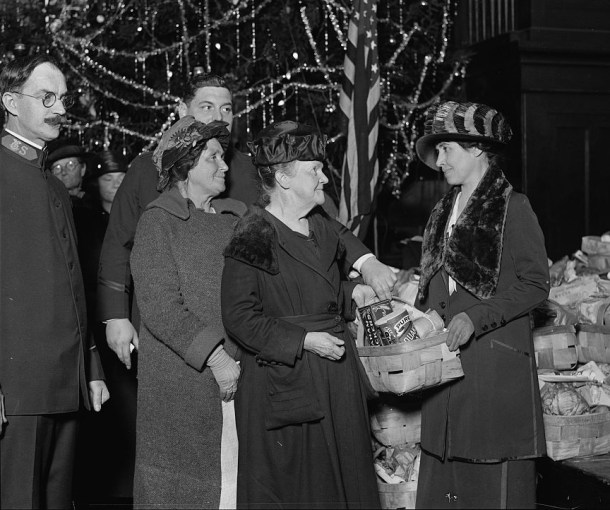
The lighting of the National Christmas Tree has become an annual event. The location of the tree has moved around — from Sherman Plaza to Lafayette Park across from the White House to the South Lawn and now back to the Ellipse. But during that time, Coolidge’s preference for a live tree has mostly been honored. The United States used a cut tree between 1954 and 1972 — the only Vermont tree during that period was in 1967 — but otherwise the National Christmas Tree has been a living one.
The timing of the event, however, has changed. Instead of lighting the tree on Christmas Eve, presidents now typically light it in early December, more as a signal that the Christmas shopping season has begun than to mark a religious holiday.
To Feiker, persuading Coolidge to light that first National Christmas Tree in 1923 was important to his mission, but getting him to do it again in 1924 was just as vital.
As he wrote presciently to his daughter: “If you can get the President of the United States two years in succession to do a thing, he will always do it.”
That was even true this year, despite the Covid pandemic. This year’s ceremony, held on Dec. 3, featured a mix of remote and in person, physically distanced, musical performances.
Another less obvious change has been made to the tradition in recent years. Frederick Feiker’s original goal may have been to get Americans to use more electricity, but the tree has become less of a symbol of consumption. Since 2007, the National Christmas Tree has been lit by energy-efficient LED lights.

