


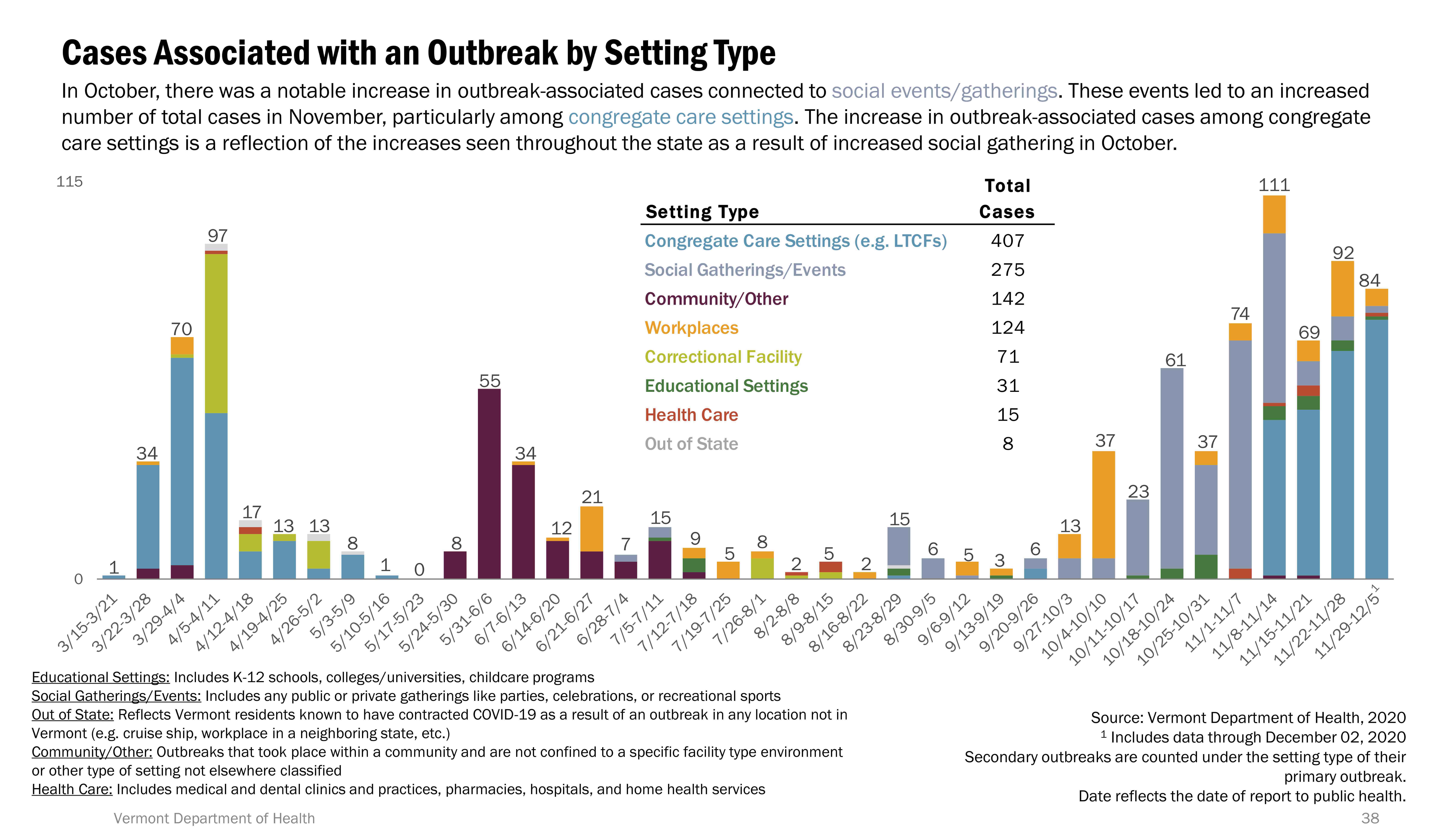
Covid-19 cases attributed to social events receded after the state’s ban on multi-household gatherings, while outbreaks in facilities like nursing homes have become the primary driver of the ongoing surge, according to a new contact tracing data analysis released Friday by the Vermont Department of Health.
Gov. Phil Scott and Health Commissioner Mark Levine had previously cited the statistic that 71% of cases attributed to outbreaks were the result of social gatherings. Scott announced on Nov. 13 that multi-household gatherings would be prohibited, while certain indoor businesses like restaurants and gyms could remain open. Scott and Levine defended those restrictions after some experts doubted the underlying data in a New York Times article last week.
The health department’s new analysis illustrates the rise in cases attributed to social events in the weeks leading up to the gathering ban. From the start of the pandemic until Dec. 2, the health department reports that 275 cases were connected to outbreaks due to social gatherings. Most of those cases are concentrated in late October and early November, with the highest totals reported during the weeks of Oct. 18-24 and Nov. 1-7.
At a press conference on Nov. 17, Levine cited Halloween parties, dinner parties and baby showers as examples of private events where Covid was spreading.
The gathering ban appears to have had an immediate effect. Cases linked to gatherings dropped sharply, from dozens of cases per week before the ban to fewer than 10 the week of Nov. 15-21. (The health department’s analysis does not provide exact weekly numbers for each category.)
While the case numbers bolster the rationale behind the gathering ban, the data also backs up Scott’s claim that the virus is more likely to spread at a social event than in a workplace or school. The 275 gathering cases stem from 11 events, with the majority of those cases linked to nine outbreaks from October and November. Over the same period, 10 school outbreaks and 23 workplace outbreaks sparked far fewer cases.
However, only two social gatherings caused outbreaks in October, and one appears to account for a large proportion of those cases. The department’s criteria includes recreational sports in the social gathering category, and one event — identified only as “social gathering/event B” — matches previous health department reports of the outbreak linked to an ice rink in Montpelier.
The department has reported separately that 124 cases are linked to that event, while a chart in Friday’s analysis links 110 cases. By those estimates, 40%-45% of the cumulative cases attributed to social gathering outbreaks would stem from the ice rink outbreak.
Congregate care outbreaks take over
As quickly as cases linked to gatherings receded, cases linked to outbreaks in congregate care settings, like nursing homes and rehab facilities, have spiked. Starting the week of Nov. 8-14, the department reported dozens of cases linked to these outbreaks, with the total increasing every week since.
Levine said Tuesday that the virus appears to be entering these facilities as a “silent traveler,” carried by asymptomatic people. “The fact that they are infected at all is testimony to the fact that more virus is present in our communities,” he said, “hence our continuing guidance to Vermonters regarding the key ways to prevent the transmission, which of course includes avoiding multiple-household gatherings, no matter how small they may be.”
As of Dec. 2, 407 total cases have been linked to congregate care outbreaks since the start of the pandemic. Unlike with social gatherings, many cases in this category were reported in March and April. But the tallies have resurged, with nine of these outbreaks reported in October and November.
The number of these cases in recent weeks has now surpassed the total from March through May.
On Friday, the state reported 234 cumulative cases from ongoing outbreaks at eight long-term care facilities. The hardest hit is the Elderwood at Burlington nursing home, which logged 78 cases and three deaths as of Thursday afternoon.
Mike Smith, secretary of the Agency of Human Services, announced details of a plan to ramp up surveillance testing for long-term care facilities.
All staff at assisted living and residential care facilities will get PCR tests twice a week, he said, and antigen tests will be available for additional testing of symptomatic residents or staff. Staff at all skilled nursing facilities will be tested daily using antigen tests and once per week using PCR tests, again with antigen tests available for anyone at the facility who shows symptoms.
