


These are the first published stories from VTDigger’s new platform for student journalism, the Underground Workshop. This post includes two articles, part of a series recognizing the people who have kept our schools running this fall. The authors are Anika Turcotte, of Montpelier High School, and Adelle Macdowell, of Lamoille Union High School.
The Referees
by Anika Turcotte, Montpelier High School
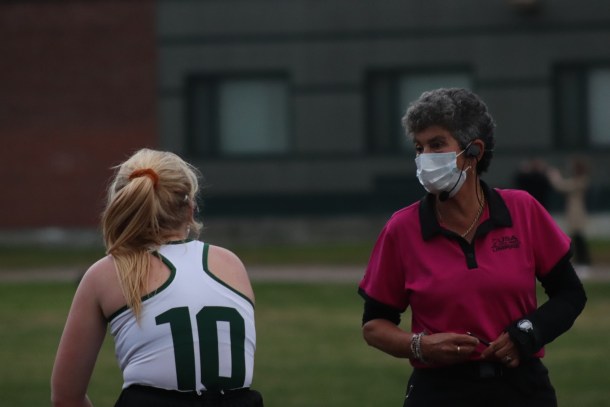
The match began to the sound of an electric whistle. Players on the bench were spread far apart, watching. The cheers of the spectators were muffled by masks. This was not a normal field hockey game.
Lyn Vera has been officiating the sport for over 40 years, but this season she faced new challenges. Due to the pandemic, referees this fall were understaffed and officiating a dramatically shortened season. However, they remained dedicated to the sport they love.
As the game began, Montpelier and Missisquoi players charged across the field at Montpelier High School, calling to each other as the ball rocketed from stick to stick. This year there was a new addition to the uniform: both players and referees were wearing facial coverings.
“We wear masks, even though referees are exempt from it,” Vera said. “For safety as well as empathy.”
The rules of the game had not been changed and the match was just as fast-paced as usual. Sharp whistles broke up play frequently.
When referees wear masks, signaling with a whistle is impossible, so officials came up with a solution. The bright orange electronic whistle is held in a referee’s hand and a button is pushed to release the familiar shrill sound. This presents its own set of issues regarding “Whistle Talk,” a term used in the referee community to describe the intent of a signal varied through the length, tone and volume of a whistle signal.
“When you are trying to emphasize a point with a player you don’t usually speak,” Vera said. The electronic substitute isn’t quite as flexible.
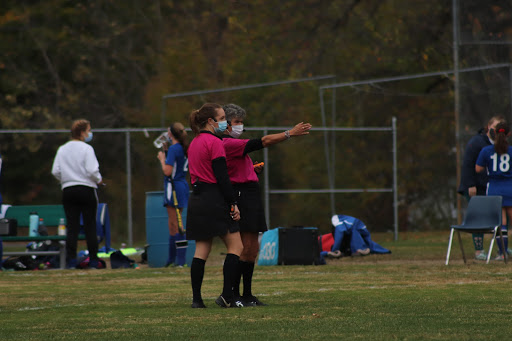
The season itself was cut in half this year, with teams playing roughly seven games less than usual due to a late start in the season. The decrease was also linked to schools attempting to limit exposure to the virus.
The Vermont Field Hockey Umpires Association (VTFHUA) worked closely with the referees. The organization held a Covid Protocol Training for their members and conducted their annual rules seminar virtually.
The organization was also understanding about members backing out. “If people decided they really couldn’t umpire this season, they were certainly not penalized,” Vera said.
Kristina Sickmuller, Vera’s partner overseeing the game, was leaving the match as players and fans headed home. She echoed Vera’s positivity towards the organization. The league’s leadership and communication had been prompt. “It’s exactly what we need right now,” Sickmueller said.
Even with flexibility from VTFHUA, the organization lost referees to injuries, covid cases and quarantines. This left the remaining few spread thin.
Vera is working games seven days a week. “Those of us who are working are working a lot,” she said.
From the bench to the sidelines, players and parents were grateful for the referees sticking with the season.
Cece Curtain, Captain of the Montpelier Varsity team, said she was glad that she was simply able to play. “I think they are doing everything right to keep us safe and happy,” she said.
Reagan Walke, a middle school player watching the game, sat with her friends on the sideline. With restrictions in place she felt comfortable playing.
“We are socially distanced,” she said, “and I trust the people on my team.”
During a break in the game Bob Berger watched the game from his folding chair, clad in Missisquoi Blue:
“I am just very thankful we are able to come and watch them play.”
The Custodians
by Adelle Macdowell, Lamoille Union High School
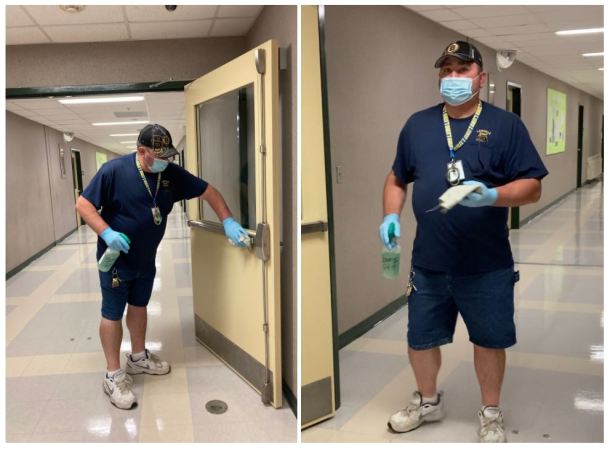
Every now and then the students in room A208 hear the doorknob rattle, followed by retreating footsteps. This isn’t uncommon—each doorknob at Lamoille Union High School is being repeatedly sanitized throughout the day.
Dylan LaFlam is the facilities director for the Lamoille North School District. He’s hired new custodial staff through a temp agency to help with the additional cleaning required during the pandemic.
“I call them ‘COVID cleaners’,” he said. “They start at one end of the building and work their way around and then they start all over again.”
The new staff are employees from the temp agency Westaff. LaFlam said the district is working towards the goal of adding fifteen new employees across all of Lamoille North.
All custodial staff at LUHS are paid 150% of their hourly wage for overtime hours, according to LaFlam.
Adding staff is only one of the many ways cleaning and sanitation has had to change to keep Lamoille North schools safe and allow in-person learning during COVID-19.
An entire new section has been added to the district cleaning standards document—a half-page long list under the heading “14.0 SARS-CoV-2 Disinfecting Procedures.”
“We’ve kind of moved away from some of our soap cleaners and moved back to disinfectants for the time being, anyway,” LaFlam said. “The primary disinfectant we’re using is 64H, which is a Swish product.”
Carrol Metayer is a custodian and nighttime supervisor at LUHS. “Everything that’s being touched in a room is being sanitized,” he said. “All of the chairs, the tabletops, markers, boards…wiping down countertops, walls, anything we can get our hands on that we can sanitize.”
The custodial crew at LUHS puts in half an hour to an hour daily cleaning and sanitizing each individual classroom, sometimes working in teams to get things done more quickly.
LUHS custodian John Lehouiller estimated that he works at least two more hours daily than he used to. “It’s a lot more exhausting, that’s for sure,” he said. “There’s a lot more stuff to do in a little bit of time.”
Lehouiller’s job used to include collecting the compost from the school cafeteria, but now that “pods” of students are eating lunch in classrooms, compost pails are stationed all around the school. He has to collect more than a dozen pails, empty them, and clean them. “That takes about an hour,” he said.
There’s no question that the staff is taking safety seriously. “Everybody wears a mask all the time, everybody’s wearing gloves all the time,” said Metayer. “We want [students] to be protected, but we also want to be protected ourselves.”
Metayer emphasized the staff’s dedication to making sure students stay healthy. “None of us have a problem staying to three or four o’clock in the morning making sure things are done right,” he said.
“We take pride in what we do.”
