

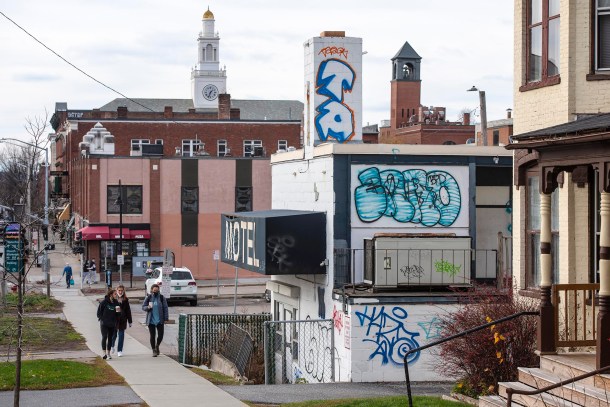
The lowly Midtown Motel in downtown Burlington may soon come tumbling down.
The owners are again trying to demolish the building at 230 Main St., which has sat empty for 15 years, after repeated efforts to redevelop the space.
Jeff Nick, one of the motel’s co-owners, said the skinny, awkward plot of land doesn’t have enough development potential, after hitting snags in proposals over the years to convert the land. He said the current dilapidated building should just come down.
“It’s not bittersweet; it’s sweet,” Nick said. “We’re happy to remove the building. Because it’s an eyesore. It needs to come down.”
Last summer Nick asked the Development Review Board to approve a plan to demolish the building and install a parking lot on the site. But the board denied the request out of concern that the motel might be a historic structure. Additionally, zoning rules prohibit a parking lot there.
But now Nick thinks he’ll get the go-ahead for demolition, thanks to a 44-page report conducted on the Midtown Motel by the state’s Division of Historic Preservation.
The report says the motel, which was built in 1956, should not be registered with the state or national Registers of Historical Places.
While it was previously thought the motel might have historical significance, the report highlights its mediocrity. The motel was built in the 1950s when automobiles were exploding in popularity and road trips to motels became common.
Ultimately, the Division of Historic Preservation determined the Midtown Motel wasn’t built in the context of a historic event or trend and “It does not retain a high degree of integrity of design, workmanship and materials.”
On Nov. 5 Nick filed for a permit to demolish the building. There are plans to install some basic landscaping in its place, including grass and a mulch bed. It would be a stretch to call it a park, he said.
The demolition, which will cost a little more than $100,000, can start in December.
“The Division for Historic Preservation Committee saying that ‘Never mind, it actually isn’t historic,’ was a game changer,” said City Planner Scott Gustin, who had previously told Nick that the building couldn’t be demolished.
The report will likely pave the way for approval to knock down the motel, Gustin said.
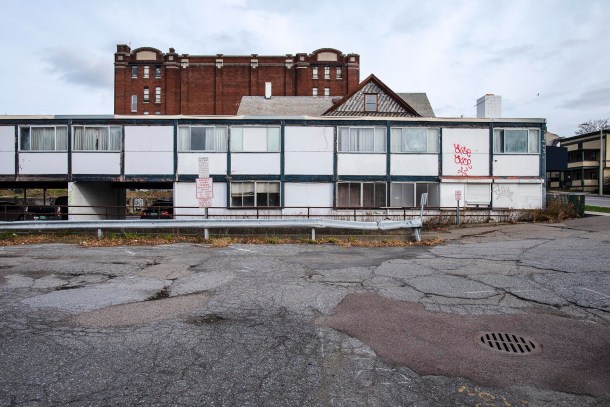
Nick bought the building in 1995 for $132,500, according to city records, although he said he remembers paying over $200,000 for it. It operated as a working motel for 10 years, until renovations to get the building up to code became too costly, and it’s been vacant ever since. City records show the tax assessment is $548,100.
A previously proposed housing development and negotiations for a University of Vermont sports arena on the block both fell through.
In the past, Nick said, he’s worked on proposals to build a two-story Target store in the location and other storefronts. He also pitched the city on a parking lot to keep cars from clogging up Church Street. The narrow parcel of land wouldn’t work well for an apartment complex, he says.
While zoning restrictions have played a role in sidetracking these projects, Nick said over the years there has been a lack of political will to develop the block where the Midtown Motel sits.
“Administrations change. Politics plays a role,” Nick said. “Right now you’ve got a big project in the middle of town that’s (drawing) everybody’s attention.”
The fate of the Midtown Motel land could be tied to the Memorial Auditorium project. The motel is on the same block as the auditorium and the land could be included in a super-block development that would dress up the entrance to downtown.
But plans to refurbish Memorial Auditorium are on hold because of financial pressures caused by Covid-19.
Mayor Miro Weinberger said when the city is ready to move forward on the auditorium project, it could consider buying the Midtown Motel land.
“I don’t think the city is going to buy it speculatively. We don’t have a desire just to assemble land without a plan,” Weinberger said.
“It does seem to open up a lot more possibilities if you take the city’s parcels and Jeff Nick’s parcels and look at their redevelopment together,” Weinberger said. “So absolutely that’s of interest.”

