


State Board of Education members declined Friday to initiate a review of the troubled Kurn Hattin Homes for Children. The board, they said, cannot act until the Agency of Education performs its own investigation and marshals sufficient evidence against the school.
The private residential school in Westminster faces decades of sexual abuse allegations from the 1950s to 2019. In September, following a Department for Children and Families investigation, Kurn Hattin was under pressure to relinquish its license to operate a state sanctioned residential treatment program.
But Kurn Hattin can continue to operate under a license from the State Board to serve students ages 5-15 in grades K-8. There are about 60 students enrolled, the agency said last month, and one is a publicly-funded Vermont student.
Private schools in Vermont must be recognized or approved by the State Board, and the body may also reevaluate a school’s status outside the regular reapproval process under certain circumstances. Last month, Secretary of Education Dan French wrote to the board to recommend it undertake a review of the school’s approval, based on a recent DCF licensing report that found the school hadn’t reported abuse allegations in a timely manner or conducted the necessary background checks on employees.
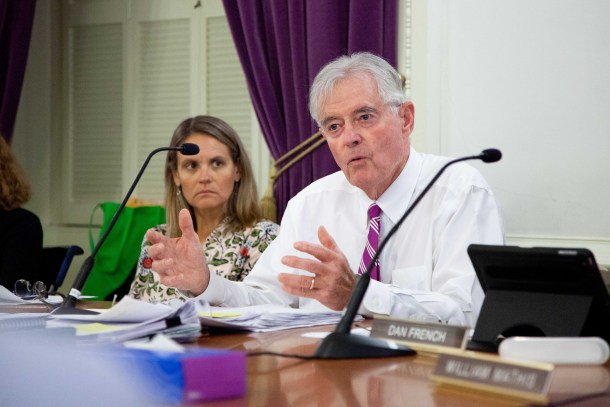
The board does not have its own staff and, for routine matters, typically relies on the agency’s attorneys. It deferred action on French’s recommendation last month to consult with outside counsel, and, following an hour-long closed-door session with attorney George Belcher on Friday, unanimously passed a motion stating their hands were essentially tied.
“The (State Board) has concluded that it has no legal authority to conduct the type of review recommended by the Secretary, and that it is the duty of the Secretary to initiate investigations of approved independent schools,” the motion reads.
In a brief statement following the board’s action, John Carroll, the chair, said the body couldn’t “do a darn thing until the Agency of Education mobilizes itself.”
“In the event there are troubling reports about an independent school – or any other school – it is the agency’s duty to investigate and bring evidence to the board,” he said. “Then, and only then, it is the Board’s duty to conduct a hearing. And that is a quasi-judicial proceeding, in which the board examines the evidence presented by the Secretary of Education.”
“The Vermont Agency of Education is committed to working with the State Board of Education to responsibly address concerns about Kurn Hattin,” Ted Fisher, a spokesperson for the agency, wrote in an email Friday afternoon. “We have received the board’s resolution and are analyzing it and working to identify next steps.”
The argument that the board does not have the right to initiate a review of the school’s status until the Agency of Education has completed its own investigation was first raised by Kurn Hattin’s attorneys, who say that the board’s own rules require the secretary to act first.
“At this juncture, the Secretary’s October 8 letter cites only to records and conclusions it received from the Department (for) Children and Families, and the AOE has not yet undertaken a required AOE investigation of the allegations,” Gary Karnedy, an attorney with Primmer Piper Eggleston & Cramer PC, wrote in a nine-page letter to the Board on Oct. 19.
The board has proactively investigated a private school outside the regular reapproval process before, when the Compass School – also incidentally located in Westminster – briefly lost its tax-exempt status for failing to file federal tax returns for several years in a row.
But the section of law that gave the board the authority to do so only applies to questions of a school’s financial capacity, Carroll said in an interview after the meeting, which is not at issue here.
“The questions that have been raised, the reports that were presented to the secretary don’t relate to financial capacity, they relate to violation of statute, i.e. child safety and well-being, and reporting issues,” he said.
Carroll added the board was “frustrated that the secretary has received reports which certainly deserve attention and has not done what’s required by statute and by rule.”
Kim Dougherty, a Boston-based attorney who represents former students of Kurn Hattin who say they suffered physical, emotional and sexual abuse while at the school, slammed the board for playing a game of “hot potato.”
“The secretary has already presented evidence to the board, they’ve seen the DCF records, there’s already sufficient evidence to call for a hearing, the fact that they are putting it back on the secretary of the Agency of Education with such evidence already in their hands is appalling and callous,” she said.
Doughtery also accused board members of trying to keep survivors of abuse quiet. Before the public comment section of Friday’s meeting, Carroll asked anyone wishing to speak not to talk about “any matter that may come before (the board) as a quasi-judicial matter.”
“You certainly may talk with the Agency of Education about it. In fact, it is their role to gather such information and assess it and make determinations and then bring them to the board,” he added.
“They just essentially want to continue the silence that Kurn Hattin has put into place for decades. They’re complicit in that now,” she said.
Dougherty’s law firm, Andrus Wagstaff PC, represented gymnasts who were sexually abused by Larry Nassar in a lawsuit against Michigan State University. The firm is now preparing a mass action lawsuit against Kurn Hattin on behalf of former students, and over 30 plaintiffs have already signed on, Dougherty said.
