


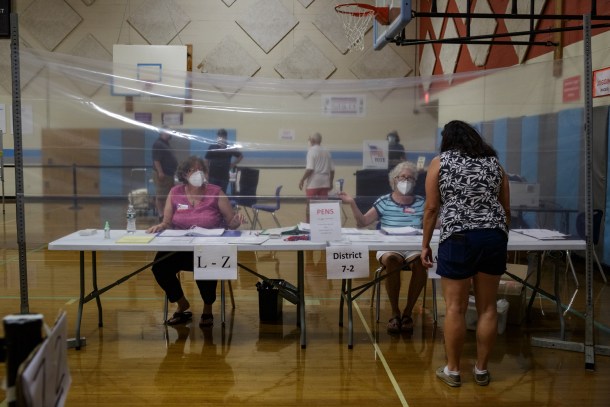
When a would-be voter in a state like North Carolina, Georgia or Pennsylvania has trouble filling out a ballot or figuring out how to get to the polls, there’s a lot of help available these days. And some of it comes from Vermont, where an army of volunteers is working the phones in an effort to ensure voter protection and voter rights in other states.
That army has been mustered by Lean Left, one of the many groups locally and nationally working on get-out-the-vote efforts in other states.
“It shouldn’t be that hard to cast a ballot,” said Dana Goss of Waitsfield, one of seven women who founded Lean Left in early 2017.
The group’s members came to believe that Vermont’s political landscape is not where activist groups needed to focus their energies.
“I felt like we could have a lot more impact (in other states) than in Vermont,” said co-founder Ann Smith.
Lean Left, which is loosely based in Central Vermont, works closely with the Sister District Project, a group founded in 2016 to get Democrats elected to state legislatures and to fight gerrymandering. Sister District says it has 45,000 volunteers nationwide, many from blue states like Vermont. Its volunteers canvass, work phone banks, write postcards, text and fundraise for candidates.
Lean Left reaches out to activists in other states and offers help.
“We don’t want to reinvent the wheel; we’re not going to go into North Carolina and say, ‘This is how to do it,’” said member Drea Thew of Montpelier. “We find Progressives on the ground and say to them, ‘What can we do to support you from Vermont? Can we write postcards to folks for you? Can we make phone calls? Can we fundraise?’”
Other, similar groups
The Central Vermont group’s goals and members are also loosely affiliated with Indivisible, which was started by congressional staffers after the 2016 elections and spawned small autonomous groups, several of which use the name Indivisible in Vermont towns. Ginny Sassaman of Calais, a co-founder of Lean Left, said Indivisible Calais takes on a broader spectrum of issues and topics, such as the Mueller investigation and ICE detentions.
“We were all completely horrified by the election of Donald Trump to the U.S. presidency and his actions immediately showed us we had reason to be horrified, like the Muslim ban, which came right away, and appointing Betsy DeVos as secretary of education,” Sassaman said. “There were many, many signs immediately that it was going to be the horror show and nightmare that it has been. We came together with a commitment to fight back as hard as we could.”
After three years of working to get legislative candidates elected in North Carolina, Georgia, Wisconsin, Pennsylvania and Maine, Lean Left is now focused on getting out the vote. Lean Left’s 1,600 volunteers sent 225,000 postcards from November 2019 through October, said co-founder Rebecca Davison of Montpelier. The cards went to underrepresented voters in Texas, Arizona, Alabama, Georgia and North Carolina to encourage them to sign up for early voting or to request absentee ballots for the primaries and general elections.
Lean Left’s volunteers have also staffed phone banks, fielding calls from voters across the nation who want to know how to make sure their vote gets counted.
“People call in with questions about how to do the simplest things that we take for granted here in Vermont,” said Goss, using as an example a caller in North Carolina who needed a witness to sign the absentee ballot envelope before turning it in.
“If it’s not properly signed, it gets rejected, so they called and found out their ballot had been rejected, and then we tell them how to make sure their vote gets counted,” Goss said. “They are passionate about it, but they don’t know how to make it happen.”
On Election Day, Smith will volunteer as a poll observer outside a voting place in Pennsylvania. “People are in a panic,” she said. “They are afraid the Post Office is undermined; if they live in a Republican county, they are terrified the Democratic ballots are being held back. It’s an incredible amount of fear and anxiety.”
Rules vary from state to state
Voting rights have become a critical issue nationally. Covid-19 safety rules have prompted many changes in the way public officials, activists and everyday voters carry out their roles. And political pressure, too, has played a role, with many states — and in some cases counties or municipalities — altering their regulations this year. Voter turnout has increased, with voters in some states standing in lines for hours to cast their ballots.
The rules vary greatly from one state to another.
For example, 36 states have laws requesting or requiring that voters show identification at the polls. Some states have moved to extend the deadline for absentee ballots. Vermont lawmakers in June authorized Secretary of State Jim Condos to send an absentee ballot to all registered voters in the state ahead of the Nov. 3 general election.
“We live in an amazing place in Vermont where they decided to mail us all ballots and make it so easy for us,” Smith said.
Doing similar work in the region is Rights and Democracy, whose focus is on supporting Democratic candidates in Vermont and New Hampshire, particularly in rural areas.
Hundreds of people have volunteered to help this year, said Executive Director James Haslam.
“The work we used to do — knocking on people’s doors, going to county fairs and so on, all of that work has gone virtual,” Haslam said. “We make tens of thousands of calls and communications with folks every week.”
Another group, Save Our Nation Vacation in southern Vermont, last year auctioned off short-term vacation housing to raise money for the Sister District Project, raising about $25,000.
Because of Covid restrictions, this year the group, which works through Sister District, focused on a soup fundraiser, with volunteer chefs providing 100 quarts of soup to sell each month. The group has raised $37,000 for state-level candidates in Virginia, Florida and Pennsylvania, according to Peg Alden, one of the organizers.
No break after Election Day
Lean Left’s founders don’t expect to scale back much after Election Day, whatever the outcomes.
“Too many people think that every four years you better quickly get involved and vote and then you’re off the hook for four years,” Thew said. “In fact, the groundwork and the organizing is constant, and there are a lot of elections besides the presidency in this country. And a lot of those elected officials impact our daily lives a lot more than the president should.”
Rights and Democracy is organizing vigils and rallies for the days after the election in Vermont and New Hampshire.
“We usually think about things ending on election night, and now we are preparing for encouraging people to get involved after the election in any activities that are necessary to defend our democracy,” Haslam said.
