


An outbreak that started at an ice rink in Montpelier is the source of 87 cases, making it the second-largest outbreak to hit Vermont since the pandemic began, state officials said at a press conference Friday.
So far, the outbreak has spread to multiple schools, a college, and several workplaces, and has made up more than a quarter of cases statewide since it started on Oct. 7. Officials have blamed second- and third-level contacts as a reason for the far-reaching nature of the problem.
“This is not something that was localized to a particular geographic area like we experienced with the Winooski outbreak, but spread quickly to other communities throughout the state, and even within smaller communities in certain particular locations as well,” said Commissioner Mike Pieciak of the Department of Financial Regulation.
Pieciak presented maps showing how the outbreak spread from Montpelier, the epicenter, through two cases in hockey and broomball teams at the Central Vermont Memorial Civic Center.
Within five days, 10 more cases were reported, including in Chittenden and Windsor counties. Officials first reported the outbreak to the public on Oct. 13.
By Friday, the cases linked to the ice-rink teams reached 473 contacts and affected at least 17 different locations within the state.
The Central Vermont outbreak spawned secondary outbreaks, the most notable of which occurred at St. Michael’s College in Colchester. Surveillance testing at the school first detected eight cases in mid-October. Cases at the college total 41 to date, Pieciak said. The school has since gone temporarily all-remote.
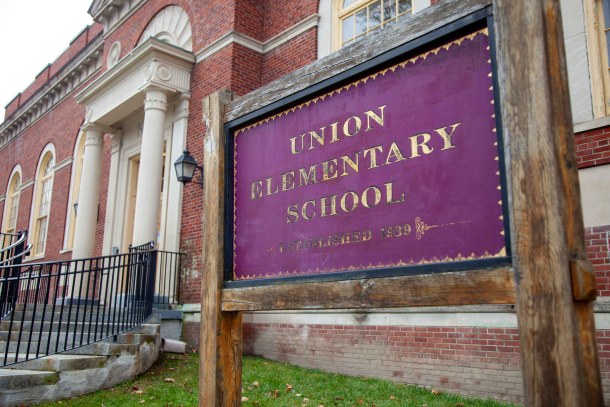
State officials have said that at least six K-12 schools have reported cases ultimately linked to the central Vermont outbreak. But only one – Union Elementary School in Montpelier – has experienced its own “true outbreak,” Health Commissioner Mark Levine said Friday.
The Union Elementary cases are considered the first – and thus far only – case of within-school transmission in a K-12 setting in Vermont. A spokesperson for the health department said Thursday the state’s epidemiologists believe five cases linked to Union Elementary were from exposure at school. Another two cases connected to Union Elementary are believed to be people who were exposed to the virus outside the school setting.
Levine noted Friday that cases have been popping up with increasing frequency in schools and child care facilities, and that while overall numbers still remained quite small – particularly when compared to neighboring states – each case represented a significant disruption.
While young children can catch and pass along the virus, research continues to suggest they are less infectious than teens and adults, and that schools are not important drivers of community transmission. But public health authorities in Vermont and nationally have continually warned that schools would mirror overall health conditions in their area, and that community spread must be kept to a minimum if schools are to stay open.
“Every school reflects what the burden of cases is in their community. And the communities that families, staff and teachers may have traveled to. Keeping our community safe, with a low growth rate of cases, will keep our schools healthy,” Levine said.
The outbreak parallels one in Maine, where a wedding with unmasked family members led to an outbreak with at least 108 cases.
Part of the reason for the spread seems to be the increasing number of Vermonters who are not practicing social distancing the way they were in March, Pieciak said.
“We have noticed in our own mobility data, that individuals are spending more time not just outside of their home, but further away from their home, since the spring,” he said.
Data from the Department of Health shows that the number of close contacts for each case has risen in recent weeks.
Pieciak said he hoped the outbreak would encourage Vermonters to be more careful.
“Think about the impact that even a small behavior can have on a large group of people and on different communities as well,” he said.

Dr. Patsy Kelso, the state epidemiologist, said that contact tracers for the health department have noticed that people have spent more time with their contacts unmasked, have been less careful to comply with travel restrictions, and have at times gone out despite showing symptoms of Covid.
“If you do have symptoms that could be due to Covid-19, It’s important to pay attention to those yourselves, so that you can be monitoring your own health,” she said. “But also if you have symptoms, don’t go to venues or events.”
Pieciak said areas across the country are seeing concerning new numbers — the country has topped 9 million Covid cases and has a doubling rate of only 13 days.
Levine told Vermonters to remember that even with the state’s good track record so far, “Vermont is not safe from Covid-19.”
“We’re seeing what happens when we let our guard down even just a little bit here in Vermont,” he said. “Multiple outbreaks that are growing, cases showing up in an increasing number of child care programs and schools.”
Levine has spoken with health officials in the surrounding states and heard some worrying statistics. Many states are reporting an increased positivity rate, or the percent of people testing positive for the virus. New Jersey’s positivity rate has hit above 6%, compared to Vermont’s 0.5%.
Vermont is also just beginning to see some concerning complications of the virus. Four people are currently hospitalized for Covid, two of whom are in the ICU. Seven people were hospitalized on Wednesday, according to health department data.
“We are seeing cases go up here in Vermont,” he said. “But there’s still time to double down on our prevention efforts. And we can still be proud of what we’ve done and what we still have left to do.”
He was reluctant to classify the rising number of cases as a “second wave.”
“If you look at our data, most of it tracks the larger outbreaks we’ve had in the state,” he said, including the Winooski outbreak and smaller spikes.
Vermont now has another spike, but it’s not clear yet how that outbreak will pan out, he said. The data recently suggests that the outbreak is slowing down.
Still, he does classify it as a resurgence of the virus, as people move indoors and the state reopens. The question is whether it will be a prolonged and increasing resurgence.
Gov. Phil Scott said any action to prevent another peak is “on the table,” including some of the closure measures taken in the spring. But he wants Vermonters to follow the guidance in place so the state doesn’t have to move backwards.
Scott mentioned that people are suffering pandemic fatigue. “People are tired of having to be so careful all the time,” he said.
“I get it. I really do,” he said. “But we must stay vigilant.”
