

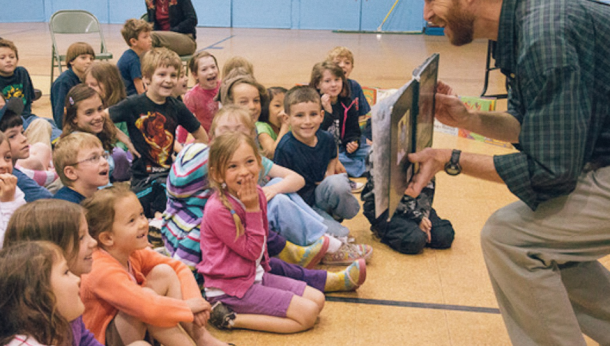
The Children’s Literacy Foundation, a nonprofit whose focus is getting kids reading, has given away plenty of books. Almost every child it works with goes home with up to 10 free books entirely of the child’s choosing.
But when Covid-19 hit Vermont in March, causing libraries to close and schools to turn to Zoom, the foundation realized that its target demographic — at-risk, low-income, and rural children — could use help more than ever. So CLiF decided to step up its game.
Communications manager Erika Nichols-Frazer said the foundation, which is based in Waterbury Center, usually has a pretty specific application process for organizations that work with kids who want to get books through CLiF. But in March, she said, things opened up completely.
“We said, let us know if we can help you. If you’re in Vermont or New Hampshire, serving kids, we’re happy to partner with you,” Nichols-Frazer said.
Right away, she said, the number of partner organizations began to shoot up.
In particular, Nichols-Frazer said, groups distributing food to kids and families reached out to CLiF. She said they wanted to include books in the thousands of meal packets that were being distributed across the state.
Since the pandemic began, CLiF has distributed about 40,000 books to kids in Vermont and New Hampshire — most to rural and low-income kids without easy access to reading materials during the pandemic. That’s thousands more than CLiF donates in a typical year.
Roughly 61% of low-income families have no children’s books at home, Nichols-Frazer said. These families are also likely to have less reliable internet access, and with schools and libraries closed, that can mean a total vacuum of reading for those kids.
“It’s more important than ever to make sure that all kids have access to high-quality reading material,” she said.
Typically, the nonprofit spends much of its time putting on events and storytimes where kids can learn from local authors and illustrators, and then take home books afterward. This summer, those events happened either outside or on Zoom.
The foundation also puts on an annual “Year of the Book” program, where 10 schools in Vermont and New Hampshire are each chosen to receive $25,000 worth of books, with the reading material picked by kids, teachers, school librarians and local public librarians.
To qualify as one of the 10, schools have to have at least 35% of students on free and reduced-price lunch and 30% of students underperforming on recent reading and writing assessments, but Nichols-Frazer said most schools actually come closer to 50% or higher. This year, she said, CLiF had to work with schools a little extra, to figure out how to get the books to kids when they weren’t coming to school.
CLiF also puts on a program for kids with incarcerated parents, where parents are able to read to their children, and Nichols-Frazer said the program has been adapted to work with Covid restraints.
As for “high-quality” literature, Nichols-Frazer said that means avoiding books based on movies or TV, sticker books, or books without much content. She said CLiF don’t censor any books, but does shy away from anything gimmicky, and tries to emphasize rich, complex stories that represent kids’ lives, and have characters who look like them — or, for rural kids who might be isolated, books that try to teach kids about people who look nothing like them.
Around 65% of Vermont third-graders test below proficient reading levels. And kids who aren’t reading proficiently by the end of third grade, Nichols-Frazer said, are four times more likely to drop out of school.
“We will continue to see those effects for a long time,” she said. “We know these low-income kids don’t have a lot of books in the home, and during the last several months, during Covid, when they’re home all the time, that’s going to have an effect for a long time to come.”
The key is not just getting books to kids, Nichols-Frazer said, but getting kids the books they actually want to read. She said research shows that, when a child is able to choose books to receive on their own, they’re far more likely to find something they love, and far more likely to actually read the books they take home.
“I hear all the time in our programming. Kids say ‘I can’t believe I get to keep it!’ or ‘I get to keep it forever?’ This is a big deal for a lot of them,” she said.
