

Federal prosecutors have reached a more than $8 billion settlement with Purdue Pharma that will also have the pharmaceutical giant admit to three criminal charges, including two stemming from a “kickback” scheme uncovered by federal authorities in Vermont.
Purdue, as part of the resolution, will plead guilty to conspiring with an electronic medical records company to influence physician prescribing of its drugs in a first-of-its-kind case revealed by the U.S. Attorney’s Office in Vermont.
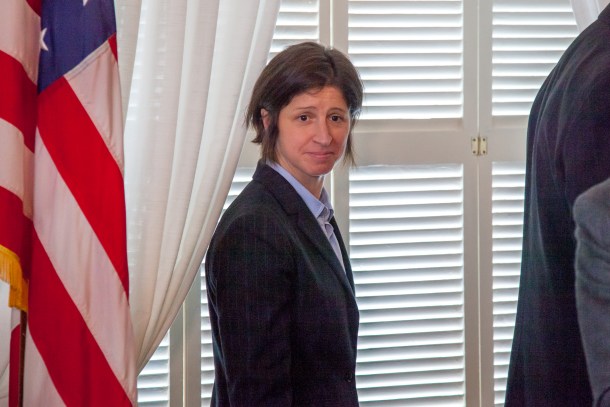
“The unlawful, dangerous scheme put profits over people by seeking to increase scripts for addictive drugs,” U.S. Attorney for Vermont Christina Nolan said Wednesday during a press conference held in Washington, D.C.
Those actions, Nolan added, came to light in 2016 at the height of the opioid addiction crisis in Vermont and across the country.
“People were suffering under opioid addictions that sometimes ended in death,” she said. “And so many of those addiction stories began with Oxycontin.”
Nolan took part in the press conference Wednesday along with other federal prosecutors revealing agreements with Purdue Pharma to resolve federal criminal and civil claims.
“Today’s announcement focuses on problems from wrongful activities in the prescription opioids realm,” Deputy Attorney General Jeffrey Rosen said at the press conference.
“The department will not relent to combat the opioid problem,” he added.
The agreement still needs approval through Purdue Pharma’s current bankruptcy proceeding, Rosen said, and would result in the company no longer existing in its current form.
“Purdue deeply regrets and accepts responsibility for the misconduct detailed by the Department of Justice in the agreed statement of facts,” Steve Miller, who joined Purdue’s board as chairman in July 2018, said in a statement issued later Wednesday.
While the agreement calls for the resolution of criminal charges against the company, no Purdue Pharma leaders, including members of the well-heeled Sackler family who have made billions from the sales of OxyContin, are facing any jail time as a result of it.
However, the agreement, prosecutors said Wednesday, does not prevent the future filing of any criminal actions against those company executives and that probe remains ongoing.
Specifically, according to the agreement with federal prosecutors, Purdue Pharma will plead guilty in federal court in New Jersey to three charges, including conspiracy to defraud the United States and to violate the Food, Drug, and Cosmetics Act.
In addition, prosecutors say, the company will admit to two counts of conspiracy to violate the federal anti-kickback statute.
As part of the resolution, the company agreed to the largest penalty ever brought in a criminal case against a pharmaceutical manufacturer. The company will be fined $3.544 billion, plus face an additional $2 billion in criminal forfeiture.
Also, Purdue Pharma has agreed to a settlement of $2.8 million to resolve civil liability under the False Claims Act.
Rosen said members of the Sackler family have agreed to pay a $225 million settlement to resolve federal civil liabilities. In a statement, the Sackler family denied all wrongdoing.
As part of the kickback investigation headed by Vermont’s U.S. Attorney’s Office, between April 2016 and December 2016 the company made payments to Practice Fusion, Inc., an electronic health records company.
Those payments, according to prosecutors, were made in exchange for “referring, recommending, and arranging” for the ordering of Purdue’s products, including OxyContin.
Purdue and Practice Fusion, prosecutors say, “conspired” to create an alert system in medical software to boost prescriptions for its drugs.
The alerts that were presented to physicians as impartial clinical alerts, according to prosecutors, “when in reality they were merely part of a clandestine unlawful marketing scheme.”
Earlier this year, Nolan reached a $145 million settlement with the San Francisco-based Practice Fusion to resolve claims against the company stemming from the kickback scheme investigation.
In an interview after the press conference, Nolan credited Vermont Assistant U.S. Attorneys Owen Foster and Michael Drescher for their work on the case, starting in August 2018 and involving more than 10 million pages of documents.
“I can’t go into all of our investigative techniques but they discovered this illegal kickback,” Nolan said. “The reason our office is involved is because we discovered this crime and investigated it, it’s only a piece of what you can see is a larger picture.”
Also, under the agreement announced Wednesday, Purdue Pharma will no longer operate in its present form and become a public benefit company overseen by a trust or similar entity with the Sacklers not involved in its operation.
The intent of the trust, according to federal prosecutors, is to provide the prescription drugs in “a manner as safe as possible.”
The aim of the new entity, prosecutors add, will be to donate or provide at deep discounts, the “life-saving overdose rescue drugs and medically assisted treatment medications to communities, and the proceeds of the trust will be directed toward State and local opioid abatement programs.”
The state of Vermont is involved in its own litigation against Purdue Pharma and the Sackler family. It’s unclear what, if any, effect the agreements announced Wednesday in the federal cases will have on the state cases.
Vermont Attorney General TJ Donovan said in a statement late Wednesday afternoon that the state is pressing ahead and “we are not taking our foot off the gas” in the push to recover funds through its legal actions against Purdue Pharma and the Sacklers.
“This Settlement Agreement,” Donovan said “does not sufficiently hold the Sacklers and Purdue accountable for the opioid crisis that they created – a crisis that has had a devastating effect on Vermonters, their families, and our communities.”.
The Associated Press reported that 25 state attorneys general sent a letter last week to Attorney General William Barr expressing great concern with the agreement, specifically the part dealing with Purdue Pharma and the government roles in its operations under the deal.
Donovan was among the mostly Democratic attorneys general signing onto that letter.
“We ask you to work with us to keep the OxyContin business in the private sector, secure money to abate the crisis, and hold the perpetrators accountable,” the letter to Barr stated.
Members of the Sackler family who served on Purdue’s board of directors said in a statement they acted ethically and lawfully.
“As members of the board, we adopted rigorous policies requiring Purdue to be in full compliance with the law. The board relied on repeated and consistent assurances from Purdue’s management team that the company was meeting all legal requirements, as shown in hundreds of pages of compliance reports that will become part of the public record,” the statement said.
“We reached today’s agreement in order to facilitate a global resolution that directs substantial funding to communities in need, rather than to years of legal proceedings. This proposed resolution includes relinquishing our ownership of Purdue and has been valued at $10-$12 billion — more than double all Purdue profits the Sackler family retained since the introduction of OxyContin,” the statement said.
“We have deep compassion for people who suffer from opioid addiction and abuse and hope the proposal will be implemented as swiftly as possible to help address their critical needs,” the Sackler family said.
This story has been updated with comments from Nolan, Donovan and the Sackler family.
