

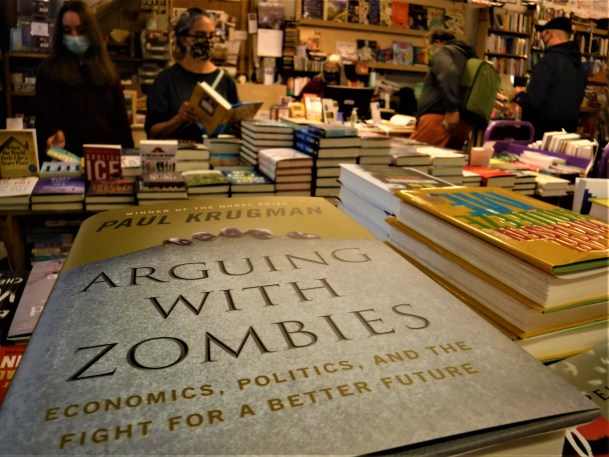
BRATTLEBORO — Ask authors at the annual fall Brattleboro Literary Festival what they’re reading and each usually points to a work by one of their prize-winning peers.
This year was different.
“I’m reading people’s eyes,” said Major Jackson, a University of Vermont professor and Harvard Review poetry editor, citing the plethora of pandemic masks hiding all other facial expressions.
Nobel economist and New York Times columnist Paul Krugman is trying to keep up with the headlines.
“These days we’re living on Covid time,” Krugman said. “Things that normally take a year, take a week.”
Journalist Jennifer Haupt is focusing on the new coronavirus anthology she just edited, “Alone Together.”
“I have to say I did not know what I was doing,” Haupt said. “I just knew the contract for my novel had been canceled and I needed community.”
That’s the same reason Literary Festival organizers — undeterred by this year’s postponement of the Burlington Book Festival and Woodstock’s Bookstock — plugged into technology during the weekend to share online presentations by 50 prominent novelists, poets and nonfiction writers.
“I wish I could be in Brattleboro in person to enjoy the fall,” said Dr. Ezekiel Emanuel, an MSNBC contributor and World Health Organization special adviser who spoke via Zoom and Facebook Live about his new book, “Which Country Has the World’s Best Health Care?”
The three-day event featured plenty of comment about the pandemic and upcoming presidential election, with several speakers targeting Donald Trump.
“The immediate question now is can people be corrupt in office, can they violate law, can they violate human rights and pay no political price?” said Krugman, author of the current bestseller “Arguing with Zombies: Economics, Politics and the Fight for a Better Future.”
“Even if you think that we should not have expanded health care and you don’t want to see taxes on the rich go up,” Krugman continued, “you need to ask yourself is it OK for the kinds of people who are running the country to stay in power?”
Steve Almond, co-host with “Wild” author Cheryl Strayed of The New York Times podcast “Dear Sugars,” elaborated while sharing his book “Bad Stories: What The Hell Just Happened To Our Country.”
“We have to find a way to activate our empathy and humanity so that we don’t get caught in a cycle of cynical reactive counter-aggression,” Almond said. “If we allow the pressure of the real to crush out of us our capacity to imagine and try to cast into words the experience of people other than ourselves, then we essentially have lost our most powerful form of resistance.”
Almond stressed he wasn’t advocating that society absolve criminal conduct but instead to bridge the growing gap of political polarization.
“I’m honestly very hopeful that, following the atrocities of this administration, if we are willing to work and stay active and stay involved and stay hopeful, we will author a better story — not a perfect story, but out of this mess will come a real sense of collective moral improvement,” he said.
Brattleboro boasts a long association with books. Royall Tyler, author of the first American comedy, 1787’s “The Contrast,” lived his last years and is buried in town. Rudyard Kipling penned “The Jungle Book” in the 1890s in his local home, now a landmark. A century later, the first U.S. edition of Harry Potter rolled out of the nearby Book Press.
Since its start in 2002, the festival has aimed to highlight such history and — as seen in videos available on the event’s Facebook page — offer a current read on the times.
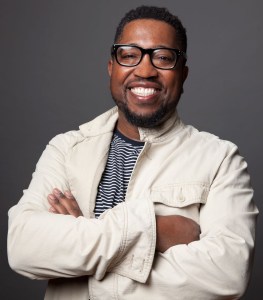
Mary Morris, author of the 1988 feminist classic “Nothing to Declare: Memoirs of a Woman Traveling Alone,” recalled injuring herself ice skating 20 years later. She didn’t know being sidelined for months would give her time not only to plan a trip to India but also to write the resulting book “All the Way to the Tigers” — now debuting as the rest of the world seeks ways to deal with its own confinement.
“I like to think of myself as the Tiger Queen,” joked Morris, playing off the pandemic popularity of the Netflix docuseries “Tiger King.”
Vermont author and adventurer Sam Brakeley spoke about his 8,000 miles of regional backpacking, ski and canoe travels.
“You don’t need to go somewhere exotic to have adventure,” the Upper Valley resident said. “There’s just as much to discover and just as much potential in the landscape and people around you.”
Take Brakeley’s most recent book, “Skiing with Henry Knox: A Personal Journey Along Vermont’s Catamount Trail.”
“This was in the middle of winter, so I had a lot of time where it was dark out and I was in my tent in the middle of the woods in the middle of the snow,” he said. “There’s not much else you can do during those times besides think — and write.”
In turn, fellow Vermonter Jackson shared his contribution to the anthology “Alone Together: Love, Grief and Comfort During the Time of Covid-19” — a poem titled “Eleutheria” that reads in part:
This is a country with a single dream —
all the counties and all the town meetings and all
the demonstrations amount to a sole creation.
Last night I pictured our shadows liberated from human forms.
How do we know the color of freedom?
“There are folks who are suffering right now in ways that may be unimaginable,” Jackson said. “I’m wanting to provide even a speck worth of hope and solace. I think we need these points of connection to get us through to a post-pandemic world.”
