

Jon Margolis is a political columnist for VTDigger.
One of the great things about political campaigns is that valuable lessons can be drawn from trivial incidents.
One such incident occurred the other day during a Vermont Public Radio debate between U.S. Rep. Peter Welch, a Democrat, and his Republican challenger, Miriam Berry, when Welch was asked if he favored replacing the Electoral College with a straight popular election of the president.
“I do,” Welch said. “Under a democracy the majority should rule.” As it is, he said, “things are upside down, and I do support direct popular election of the president.”
Miriam Berry disagreed. “We are not a democracy,” she said. “We are a constitutional republic.” Furthermore, she said, the Electoral College was created “to give the smaller states a voice,” so it benefits Vermont.
A few lessons here, some involving the Electoral College, some dealing with the old (and silly) argument over whether the U.S. is a democracy or a republic. In the interest of clarity, let’s hold off on that one (spoiler alert: it’s both; they’re the same thing) and concentrate on the Electoral College.
A dumb idea from the start.
But Peter Welch and his political allies should be wary about what would happen if it were replaced. This could be a classic case of beware of getting what you wish for.
Even some of the guys who created the Electoral College doubted that it would work. George Mason, a Virginia delegate to the Constitutional Convention, predicted that “19 times in 20” no candidate would get an Electoral College majority, meaning the House of Representatives would choose the president.
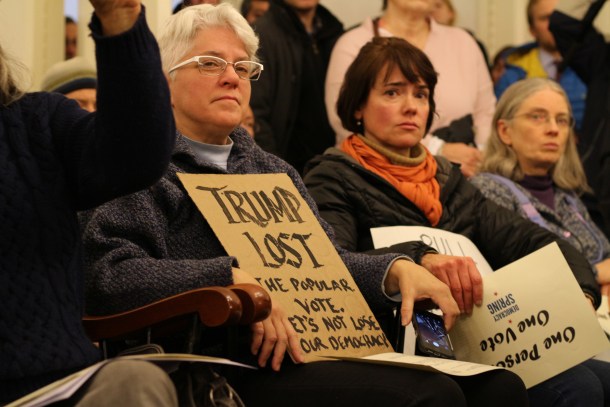
It wasn’t that bad. But it wasn’t very good, either. The Electoral College system messed up (and so had to be changed) in the elections of 1796 and 1800. It failed in the election of 1824. It was the foundation for stealing the election of 1876. In 1888, 2000 and 2016, the candidate who got the most votes did not get elected.
The Electoral College may be venerable. It is not particularly successful.
Nor was it created either as an alternative to direct popular election or “to give the smaller states a voice.” It was created as an alternative to having Congress or the states choose the president. And the Founders decided against direct election less because they distrusted the people than because (as George Mason said) in that pre-telephone, pre-telegraph era, “the extent of the country renders it impossible that the people can have the requisite capacity to judge (among) the candidates.”
The Founders hoped that the Electoral College would be “composed of the most enlightened and respectable citizens,” as John Jay put it (Federalist No. 64), who would actually ponder the strengths and weaknesses of the candidates before voting.
Smart guys, the Founders. But not perfect. They did not foresee the rise of political parties, which transformed electors from independent actors to mindless automatons following the dictates of their party. The Electoral College now serves no legitimate purpose and certainly provides no benefit to Vermont, which is ignored by presidential candidates because they know its three electoral votes will go to the Democratic candidate.

But Vermont (and other) Democrats like Peter Welch might pause before proposing a system in which whoever gets the most popular votes wins. Their side of the political-ideological spectrum is more fragmented by specific-issue constituencies (labor, environmentalists, immigration activists, etc.) as well as along the lines of ethnicity, gender and other “identities.”
So the mainstream center-left candidate likely to win the Democratic Party nomination could well face not just a Republican opponent, but energetic challenges from one or more of these factions. In that case, in a direct popular-vote election, a country that now has a center-left majority could end up electing a very conservative president.
Conservatives have their factions, too. But at least in recent years, they have been more disciplined than their liberal counterparts. Besides, the Republican Party is now far enough to the right to satisfy all but the most extreme conservatives.
The Electoral College could be replaced by a system that required a runoff if no candidate got a majority of the popular vote, either some time after the first election or as part of an “instant runoff” procedure.
What a mess that could be. Can you imagine two nationwide elections in the same month? And those instant runoffs can be confusing.
So, apparently, can the meaning of even the most common words. Otherwise, some folks would not spend time trying to make the case that there is a substantive difference between a republic and a democracy.
If the Founders called their creation a republic instead of a democracy, it was only because at the time “democracy” meant — at least to some of them — direct democracy, in which the entire electorate passes laws and makes policy.
For several reasons, they disapproved of that. So maybe they’d disapprove of Vermont Town Meeting, or of initiative and recall, which allows voters in some states to bypass their elected legislators and make laws on their own.
But the ultimate authority of the system established by the Constitution was the people. Only white, male people at the time. Still, the people as opposed to the clergy, the oligarchs, the plutocrats.
And yes, it was not direct democracy. It was representative democracy. But in plain English, the word “representative” in that phrase is just the adjective. The noun is democracy.
That’s the system. If we can keep it.
