


A month since officials declared the early days of Vermont’s college reopenings a success, Covid-19 rates have remained low on the state’s campuses.
Vermont colleges and universities had logged 51 cases of Covid-19 as of Oct. 6, according to a presentation at Gov. Phil Scott’s press conference on Tuesday — an increase of just 13 cases since Sept. 11. Colleges have a positive test rate of just 0.05% from 96,000 tests administered since students began returning to campuses the last week of August.
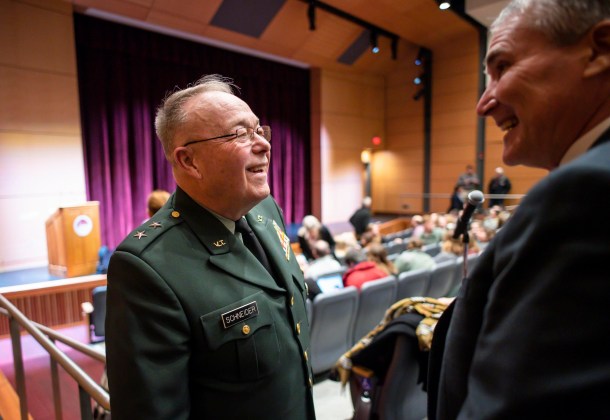
“The truth of the matter is, it’s safer to go to any college campus right now than anywhere in Vermont,” Richard Schneider, former Norwich University president and the head of Vermont’s college reopening team, told VTDigger last week.
The goal in August was to make Vermont “the safest place in the country for students to return to college,” Schneider said. So far, he sees the state on its way to accomplishing that goal, thanks to a strong testing, student health pledges and quick contact tracing of infected people on campuses.
Since reopening, the test positivity rate for colleges has remained even lower than Vermont’s rate as a whole. The state’s rate was 0.17% for September, according to Mike Pieciak, commissioner of the Department of Financial Regulation, who’s tracking the state’s numbers.
Vermont’s low rate of infection at colleges also sets it apart from other states.
Colleges in Maine and New Hampshire had test positivity rates slightly higher than Vermont’s through September, according to Pieciak — 0.07% and 0.13%, respectively.
Nationwide, The New York Times has tracked more than 130,000 cases of Covid-19 at colleges and universities. More than 35 colleges around the country had registered 1,000 or more cases as of Sept. 25.
Many colleges nationwide have not tested students consistently. According to an NPR report this week, more than two out of three colleges with in-person classes are testing only students who have symptoms, or who came into contact with another infected person.
That hasn’t been the case in Vermont, where state officials required all colleges to test students upon arrival and again seven days later. Colleges have also performed surveillance testing since then, though the number of tests each week varies by school and is not noted on every school’s public dashboard.

Schneider said arrival testing proved to be crucial. That requirement went beyond CDC guidance at the time, which did not call for schools to test each student upon arrival (the CDC recently revised its testing guidance for colleges).
“We decided that we couldn’t do [no arrival testing],” Schneider said. “It’s not guaranteeing you’re starting with an uninfected school.”
The reopening team, made up of college presidents, doctors and state officials, set out to quell campus outbreaks through a plan in three “phases”: getting students from home to campus without bringing the virus with them; practicing good behavior on campus that limits transmission; and quickly isolating and tracing cases as they appear.
It’s still too early to say whether “Phase 2” — limiting transmission as students go about life on residential campuses — can be called a success, Schneider said.
But if he had to give colleges letter grades on reopenings thus far, Schneider would give them an emphatic “A,” both on getting students to school safely and isolating cases as they arise.
The Department of Health’s contact tracers have proven critical in quickly identifying and isolating infected students, he said, and students appear to have largely bought into behavior pledges the state asked each college to adopt before reopening.
“We’re blessed to have our colleges in Vermont right now, where there’s such a low infection rate,” he said. “Plus, we’re drawing primarily from New England states with low infection rates.”
VTDigger found 50 cases on college campuses through Oct. 8. Disparities between state-reported data and VTDigger’s data may be due to slight differences in definitions of a case, and the varied ways colleges report case data to the public.
Besides posting case and testing numbers to public dashboards, colleges have been asked by the state to submit weekly data on how many students have broken campus Covid-19-related policies.
As of Oct. 1, the state had recorded 1,062 cases of students breaking Covid guidelines, including 44 students who were sent home for violating those guidelines, according to Ted Brady, deputy secretary of the Agency of Commerce and Community Development.
Twenty-seven of the 44 students removed from campuses are Middlebury College students sent home in late September.
In an email to VTDigger, UVM spokesperson Enrique Corredera said the university has taken a range of steps to discipline students that vary in severity. Those include letters of warning, notifying students’ parents or guardians they’ve broken rules, educational sanctions, fines, probation and suspension.
While some students have broken the rules, Schneider sees Vermont’s successful college reopenings as a microcosm of its statewide reopening plan: One that has relied on careful collaboration and paying attention to science at each turn.
“Some people said, ‘Well, you just got lucky,’” Schneider said. “No — it’s not luck, or there would have been more pockets of luck elsewhere. I think it was testing hard, the fact that [our students are] primarily from places with low infection rates, and that we’ve stayed on students’ behavior.”
Update: An earlier version of a map included in this story put UVM’s Covid-19 case count at 28, the number reported by Department of Financial Regulation Commissioner Mike Pieciak on Oct. 6. However, that figure included several cases tracked by the state from students who tested positive in their home states prior to arrival, or while living in Burlington over the summer. The map has been updated to show the total number of cases on UVM’s public dashboard as of Oct.7, which counts cases since reopening.
