


The advancement of a Rutland detective is being held up over credibility questions surrounding the takedown of a handcuffed prisoner in a holding cell at the police station more than two years ago.
Rutland County State’s Attorney Rose Kennedy said that a little over a month ago the city police department asked her to consider designating Detective Jimmy Plakas a “death scene investigator.”
By law, it’s the state’s attorney’s job to determine if a person can serve in that position, since that investigator often deals with the most serious of cases, including homicide.
“I need to think about when a detective takes the stand in a homicide, will the jury be distracted by something in their past that will take away from the homicide case?” she said.
Kennedy added of the crucial role death scene investigators play, “I really rely on them as my eyes and ears at the scene.”
Kennedy is holding off on giving that designation to Plakas. She is concerned about discrepancies in a sworn affidavit Plakas wrote in May 2018 stating that a prisoner thrown down by another officer in a holding cell did not have both hands cuffed when the video appears to show that they were.
That affidavit prompted Kennedy more than a year ago to write what is known as a “Brady,” or “Giglio,” letter related to the matter naming Plakas and the other officer involved. The letter, which gets its names from national cases, informs defense attorneys of possible credibility, or integrity, issues with an officer.
Even after recently talking to Plakas about the matter Kennedy still is not able to “reconcile” the differences between what she sees in the video and the sworn statement.
Rutland City Police Chief Brian Kilcullen questioned whether a Brady/Giglio letter was appropriate in this case where he said an officer is “mistaken” instead of being “intentionally deceitful.”
“I don’t think that should be disqualifying going forward in terms of a death scene investigator designation,” Kilcullen said.
He said he planned to continue seeking that designation for Plakas and hoped to talk to Kennedy about it soon.
“Certainly, our hope is that we can proceed,” the police chief said.
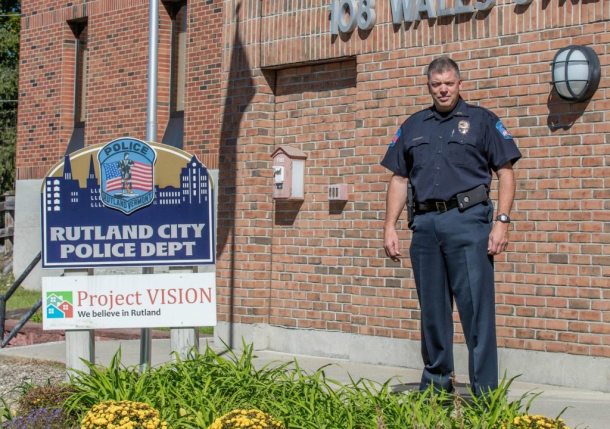
Plakas, reached Thursday, declined comment.
The question over whether Kennedy would designate Plakas a death scene investigator follows a decision she made this summer to strip another Rutland City Police detective of that role, also over credibility concerns.
In that earlier matter, Kennedy expressed concerns over the accuracies of a sworn statement by Detective Emilio Rosario, including one that she says will likely result in her dropping an attempted murder case.
Both incidents came to light following public records requests tied to officer misconduct.
In the Plakas case, Kennedy released several documents, as well as video taken from the holding cell where the takedown took place.
The video does not have audio. However, Kennedy also released a recording that does have audio picked up from the nearby processing room that did capture some of the exchanges, though they are hard to hear at times.
Rutland City Police also provided more than 100 pages of records, including a copy of its internal investigation.
In the Plakas matter, the May 2018 incident in question took place inside a holding cell of the city police station. That’s where a man reportedly not complying with officer demands and threatening officers was taken to the ground by an “arm bar” employed by Sgt. Adam Lucia.
Plakas, who was working alongside Lucia, wrote in a sworn affidavit that the man, 39-year-old Kevin Regimbald, did not have both hands cuffed at the time of the takedown. However, a later review of the videotape by Regimbald’s attorney and then by the prosecutor appeared to show him cuffed.
At worst, according to Kennedy, people could view the statements regarding the handcuffs in Plakas’ affidavit as trying to cover up for a supervisor’s possible inappropriate use of force.
Specifically, Plakas wrote in his affidavit, “Sergeant Lucia then took one of the handcuffs off the defendant in attempt [sic] to put his arm behind his back. The defendant pulled his arm back toward the front and began to attempt to fight Sergeant Lucia. Sergeant Lucia used an arm bar take down to get defendant back under control.”
Lucia has stated that Regimbald was still cuffed at the time he used the “arm bar” maneuver to take Regimbald to the ground.
Reports show Regimbald had a laceration to his head after he was thrown down. He was taken to Rutland Regional Medical Center for treatment.
According to court filings, Regimbald was arrested earlier that night on charges of making a false report to law enforcement and creating a false alarm.
A breath test, according to court records in that case, showed Regimbald had a blood-alcohol content nearly four times the 0.08 legal limit for driving, though there is no indication he was driving.
Regimbald eventually pleaded out in September 2018 to a charge of providing false information to law enforcement, while charges of false alarm as well as resisting arrest were dismissed. The resisting arrest charge stemmed from the incident that occurred in the holding cell.
Shortly after pleading out in the case, Regimbald died a month later in October 2018 due to an unrelated health issue.

Kennedy said her office became aware of the discrepancy between the holding cell video and Plakas’ sworn statement in late August or early September 2018, before the plea agreement, and that led to the dismissal of the resisting arrest charge.
She said she asked Kilcullen, the city police chief, to look into the incident in September 2018.
Kilcullen determined the use of force in the case was deemed appropriate, writing in an email to Kennedy in February 2019 that no disciplinary action was taken against either officer.
“The determination was that the response to Regimbald’s resistance was appropriate, but that the resistance should have been anticipated,” the police chief wrote.
“As such,” the police chief added, “Officers should have reconsidered moving the handcuffs from front to back until such time as Regimbald was compliant.”
The internal investigation by the city department regarding Plakas’ affidavit, according to an email from Kilcullen to Kennedy, also revealed no misconduct on Plakas’ behalf or on the part of Lucia, who as a supervisor, notarized Plakas’ affidavit.
Rutland City Police Commander David LaChance, who conducted that internal investigation, wrote in his report that he did not believe the “alleged inconsistencies” were an attempt to “deliberately distort” the details of what took place.
“Ofc Plakas advised at the time he wrote his affidavit he had not viewed the video recording and when he wrote his affidavit he was under the impression that a handcuff had come off one of Regimbald’s hands,” LaChance wrote in his report.
If the two officers had conspired to cover up what took place, LaChance added, their two versions of events would have matched up much more.
“I believe Ofc. Plakas was involved in a high stress encounter and as a result, his recollection of events contained inconsistencies,” LaChance stated.
As for Lucia, who as a supervisor notarized Plakas’ affidavit without properly reading it and noting the discrepancy regarding the handcuffs, Kilcullen wrote in a letter to Kennedy that he did not find misconduct.
“However, we have determined Sgt. Lucia failed to thoroughly review the affidavit before attaching his signature,” the police chief wrote. “We will be addressing with Sgt. Lucia this performance issue related to the review of the affidavit.”
Also, according to city records, Lucia was given a warning letter that would stay in his employee file for three years.
Kennedy had also forwarded the matter to Washington County State’s Attorney Rory Thibault for review since her office had a conflict due to a relationship between a deputy state’s attorney and Plakas.
Thibault recently provided the results of his review to Kennedy, stating in an 11-page document that he was not recommending the filing of any criminal charges.

At the time of the takedown by Lucia, according to Thibault, Plakas did not appear to be in a position to see what Lucia did, or did not do, to Regimbald’s cuffs.
Thibault wrote he considered whether Kennedy should decline to prosecute cases from the detective. However, he wrote, he didn’t believe that action would be justified “in light of the ambiguities of the situation, and the lack of evidence to demonstrate that Officer Plakas had an intent to deceive or otherwise falsify a matter.”
But, Thibault wrote, defense counsel, at a minimum, should be notified of the issue whenever Plakas is expected to testify about his use of force, or the use of force by others.
“These recommendations,” he added, “are not intended to excuse the`error made, or to minimize the potential harm of Officer Plakas’ inclusion of inaccurate information within his affidavit – quite the contrary – his misapprehension of whether Mr. Regimbald was handcuffed is significant.”
He added, “Public confidence in his reliability in future situations involving the use of force may be compromised, as this error may be construed as an effort to construct a more favorable justification for the use of force in the situation.”
Kennedy acknowledged that other prosecutors could view the credibility issue with Plakas differently, but ultimately it is a matter a jury could be asked to weigh and in a homicide case the stakes are exceedingly high.
According to Kennedy, the whole situation reveals shortcomings with the current process for handling matters involving officer credibility issues. She said an independent entity, rather than a county prosecutor’s office, would be in a better position to conduct those reviews.
She said county prosecutors lack investigators to do the time-consuming necessary probes and often have relationships with law enforcement within their jurisdiction, raising questions of impartiality. Internal investigations are also conducted by departments employing the officers in question.
