

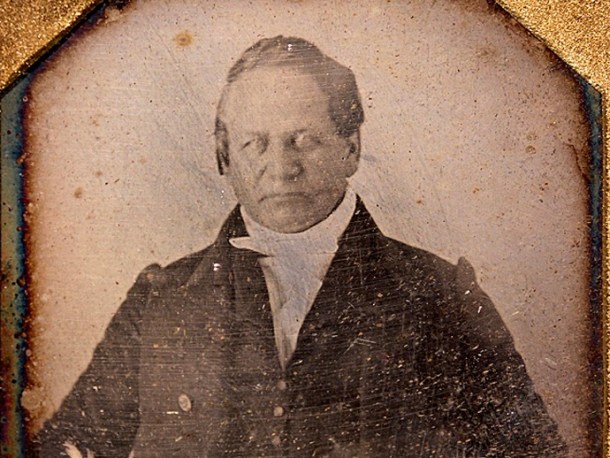
Joining the ranks of former governors and military figures on the walls of the Statehouse, a portrait of Alexander Twilight, the first African American lawmaker in the United States, will be hung in the state capitol by 2022.
The portrait’s commissioning was announced last week, on Twilight’s 225th birthday, which the Vermont Legislature designated earlier this year as “Alexander Twilight Day.”
“This goes beyond one portrait,” said David Schutz, Vermont state curator. “This is talking about the tenure of the building, and how to tell the stories of all Vermonters to ensure all Vermonters feel connected to their Statehouse, which is a very important change.”
Alexander Twilight was born in 1795 in Corinth, Vermont. In 1823, he graduated from Middlebury College, likely the first African American college graduate in the country. Later, he moved to Brownington, where he was principal of the Orleans County Grammar School. In 1836, he was elected to the Vermont House of Representatives, the first Black lawmaker in the nation — and the only one to serve before the Civil War.
Although the declaration of Alexander Twilight Day was spurred in part by the conversations this year about race and racism, Schutz said Twilight’s portrait has been in the works “a lot longer than that.”
Schutz said that, in the Statehouse’s entire collection of portraits — which was assembled over 180 years — he could point to “pretty much any portrait” and know it would be of a governor or a military figure, most of whom were white men.
Getting an outside group to commission a portrait like this, he said, is “a brand new phenomenon” for the building.
“The Statehouse is not a traditional museum where the storytelling is simple, like in a gallery,” Schutz said. “It’s a state capitol building, so 40 years ago, it was difficult to convey to people that the Statehouse was even a museum, and that’s why 35 years ago, my office was created.”
Schutz’s office worked with the private, nonprofit Friends of the Vermont Statehouse to get the Alexander Twilight project off the ground, starting with a gift of $30,000 that the Friends received from the National Life Group of Vermont.
“The Friends were planning to run a small capital campaign during the pandemic,” he said. “It was going to be challenging to raise money, but happily, they don’t have to.”
Instead, he said, one trustee of the Friends was talking to her husband — who has a “position of authority” at National Life Group — about the portrait, and soon, National Life offered to pay for the entire portrait, Schutz said.
Schutz said portraits in the Statehouse are “almost never” paid for by taxpayers. He said when a governor’s term ends, his or her portrait is traditionally paid for by their own friends and family.
But that way of doing things has left a lot of groups off the walls of the building. So, for the past two years, a task force has been considering ways to bring marginalized people into the artwork of the Statehouse.
Schutz said that began by recognizing Abenaki people in Vermont, followed by a major exhibition on women in the Vermont Statehouse this year to mark the 100-year anniversary of ratification of the 19th Amendment, which gave women the right to vote.
“It’s part of the interpretive plan for the building that we’re working on now, where we identify themes and storytelling that is appropriate for the building, including stories of people who have been left out,” Schutz said. “The Alexander Twilight portrait evolved from the conversations.”
But since this work is new to Schutz and the Friends of the Vermont Statehouse, he said a lot remains to be figured out in terms of what happens next. He said that’s why it will be a little while before the portrait actually goes up.
“Quite frankly, I expected much of the next year to be spent raising the money,” Schutz said. “Now we’re in the happy position of being able to talk about how we’re going to go about the actually commissioning process instead.”
Schutz said it takes easily a year for a “really good work of art” to be developed, but luckily there are one or two photographs of Twilight that can guide the portrait.
“A lot of people back then, of course, never left an image behind. Photography was in its infancy,” Schutz said. “The fact there actually is an image the portrait can be based upon is wonderful.”
One major decision will involve where in the building the portrait should go. He said knowing that will help determine many other aspects of the portrait.
“Since we’re commissioning this, we’re not just accepting something. We can make this the way it needs to be,” he said.
The Statehouse is currently closed due to Covid-19, and is not expected to reopen until 2021 at the earliest.
