

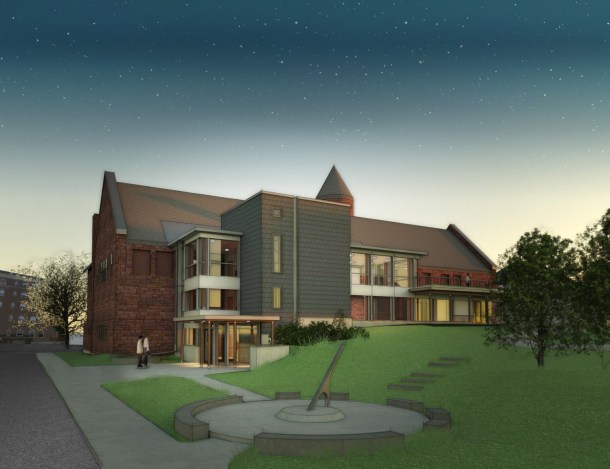
ST. JOHNSBURY — The Fairbanks Museum and Planetarium plans to boost accessibility, unveil hands-on exhibits and create the state’s first mass-timber building with an addition costing more than $2 million, the first expansion since 1895.
The 6,000-square-foot, three-story upgrade will be built at the back of the historic St. Johnsbury museum, executive director Adam Kane said, and workers could break ground as soon as next spring.
The addition alone will cost between $2.25 million and $2.5 million, he said. The museum hopes a $2 million federal grant will cover most of that cost.
“This is just another example of economic development taking place in downtown St. Johnsbury,” assistant town manager Joe Kasprzak said. “We certainly applaud the efforts of the Fairbanks Museum to continue to evolve and grow their footprint here in our very important downtown historical district.”
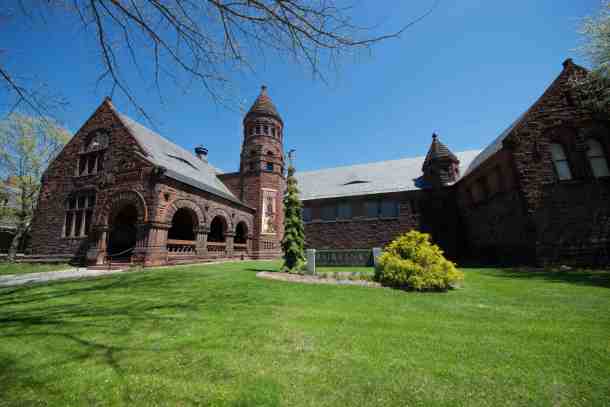
Museum leaders have been considering an expansion to the red sandstone and limestone building in the Richardsonian style for a few years, Kane said. The original goal was to improve access to the museum’s second-floor balcony — which guests can reach only via narrow spiral staircases — and to its basement.
“We wanted to make sure anybody who is not able to traverse stairs (and) wants to visit, that they can see the museum,” Kane said.
The addition will have an elevator that stops on all three floors of the building. It will open up at the southern end of the balcony, where a Tyrannosaurus rex skull looms on the wall.
Inside the addition, the museum plans to open interactive meteorology and astronomy exhibits, funded by a $250,000 award from the national Institute of Museum and Library Services.
The Fairbanks is mostly a “cabinet of curiosities museum,” Kane said, where people are encouraged to look, not touch. But visitors expect modern science museums to offer more hands-on activities.
Kane said the exhibits could involve guests learning to observe and forecast weather — just like the museum’s meteorologists who broadcast daily on Vermont Public Radio.
The addition might also house Community College of Vermont facilities, the director said. Kane said the college and museum have tentatively agreed to move the school’s St. Johnsbury operations to the future space.
An unusual building
When construction begins, workers will employ a wood building material that’s been on the rise recently in the U.S.: mass timber.
The building material involves “large structural panels, posts and beams glued under pressure or nailed together in layers, with the wood’s grain stacked perpendicular for extra strength,” according to Yale Environment 360, a magazine published by the university’s environmental school.
Advocates say mass timber can produce less waste and fewer emissions than typical construction, and U.S. Sen. Patrick Leahy, D-Vt., singled the wood product out last January when discussing forestry grants.
According to a 2017 New England Forestry Foundation report, construction and industry players consider mass timber the most promising option for getting into new construction markets.
The Fairbanks addition will be the first building in Vermont made entirely of mass timber, Kane said.
“It has potential to have a pretty significant economic impact on Vermont’s forestry industry,” he said.
The museum received a $350,000 grant from the Northern Border Regional Commission in August to support the mass-timber aspect of the project.
That money will also help the museum hold seminars and programs for builders, architects, engineers and more to encourage the use of mass timber, Kane said. Vermont Integrated Architecture of Middlebury designed the addition.
A boost for the softwood industry
Kasprzak, the St. Johnsbury official, said Vermont has been looking for ways to boost the wood industry, and mass-timber projects like the Fairbanks addition could do that.
“It’s really an interesting concept,” he said of mass timber, “and it’s a way to help the softwood industry in New England that’s been struggling so much.”
Kane said he expects to hear about the $2 million federal grant in the coming weeks. If the museum’s application is approved, work can begin next spring, he said. If not, museum leaders plan to push the timeline back a year.
The significance of the expansion isn’t lost on him.
“You want it to be of the same quality and interest and dynamism of what is there now,” he said. “That leads you to build something that is not just functional, but is also beautiful and can stand the test of time — like the existing museum has.”
