

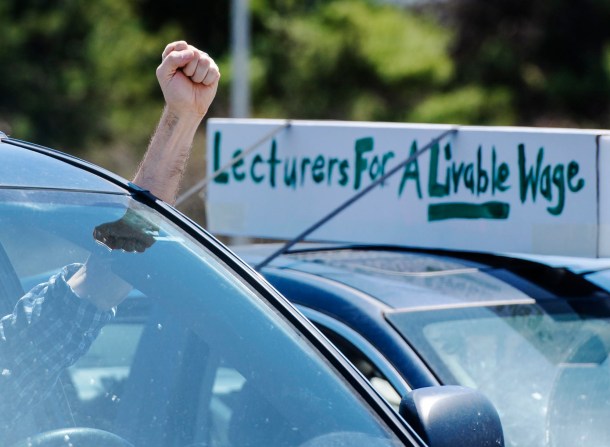
In May, the University of Vermont started preparing for the worst as the impacts of Covid-19 were emerging for higher education. Among the cuts: Course loads and pay were cut by 25% for about 70 lecturers.
United Academics, the union that represents UVM faculty, announced Tuesday that 63 of those lecturers have been restored to full-time course loads and pay. The news comes as enrollment losses seem to be less severe than the university expected.
However, the university is still facing budget shortfalls in the millions of dollars.
Enrique Corredera, a UVM spokesperson, said the fall/spring undergraduate enrollment is projected to be 9,939 students. Last year, the university enrolled 10,394 undergraduates, 455 more than it has now.
Corredera said it’s impossible to know whether the drop was entirely Covid-related. It amounts to a projected 4.3% reduction in undergraduate enrollment. Projected net revenue from tuition in this academic year is expected to be $23.3 million below the prior year.
Still, these enrollment losses are better than expected. UVM President Suresh Garimella sent an email to the college community in May, warning that colleges across the country could lose 20% of their students due to Covid-19.
But Garimella’s budget predictions were almost spot on. He said if the university experienced “even a half of the enrollment decrease predicted by current national surveys, we will suffer a $26 million loss of revenue, or over 7% of our general fund budget.”
Corredera said the university approved its $370.3 million general fund budget for fiscal year 2021 Friday, which includes a $21.4 million shortfall.
“We have accounted for all but $9.4 million of the shortfall,” Corredera wrote in an email, “which will come from academic units through budget adjustments and use of one-time reserve funds.”
UVM also projects losing another $8 million to $9 million in revenue that won’t be collected from room charges, parking and other sources. Corredera said the university will still need to find other ways to make up the shortfalls.
UVM received a total of $33.4 million in federal and state funds to cover Covid-19 expenses or incurred costs, all of which has been allocated, Corredera said. He said UVM projects it may face at least $10 million more in Covid-19-related expenses for this fiscal year.
Despite these hits, Corredera wrote, “the state of the university’s finances is sound, and we remain optimistic about the future. We will continue to pursue strategies and take decisive steps to ensure this remains the case.”
A win for lecturers
“Your lecturers, first of all, are the non-tenure-track faculty. And so they have the least job security in terms of faculty, and they also are paid the least,” said Julie Roberts, a linguistics professor and president of the faculty union.
“So, to take them from a full-time job to a 0.75 job is significant,” she said.
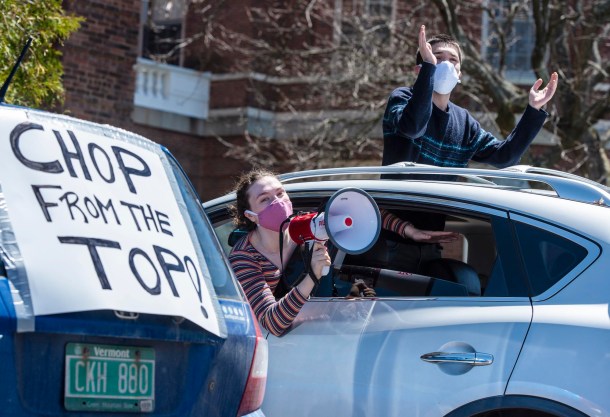
The UVM community responded with protests and critiques of the cuts, including a push to have the university “chop from the top” — meaning high-earning administrators should face deeper pay cuts than the lowest-earning faculty. Lecturers make an average of $65,411 a year at UVM. (Senior administrators also took pay cuts — Garimella, who earns upward of $600,000 a year, gave up a month’s salary.)
Roberts argued that cuts in lecturers’ workloads, and thus their salaries, was a pre-emptive move by the university to prepare for the worst of Covid’s effects. The union argued that UVM had no justification to reduce lecturers’ pay. It filed grievances both internally with UVM and with the Vermont Labor Relations Board, requesting that the lecturers’ hours be restored.
Through these efforts, and bargaining proposals, the union said it was able to win back full-time pay and teaching status for 63 of 68 affected faculty members.
“The only reason I’m not shocked that they were able to restore (the cuts) is because they really didn’t know that they didn’t need them in the first place,” Roberts said. “It was a just-in-case move … because our enrollment hasn’t really gone down very much.”
Corredera said the university “takes issue” with the union’s characterization. He said the university’s action was dictated by the demand for particular courses.
“Based on demand projections in different academic disciplines, the university informed some — but not all — lecturers on May 1 that their appointments would be a 0.75 teaching load for the current academic year,” he wrote.
Corredera said lecturers continued to receive their usual benefits if their course loads were reduced.
