


GREENSBORO — Liz Hatch was surrounded by junk.
She stood in a circular hilltop clearing in the Greensboro woods Friday afternoon, speaking as a six-man crew maneuvered around a mass of scrap tires, cardboard and piled fill materials.
“All this stuff, a lot of it is just garbage,” the Massachusetts native said.
That garbage is the material she’s using building a home.
Hatch and the work crew have been building an earthship, a type of house made from recycled materials that aims to retain a constant temperature, with less need for traditional heating and cooling.
The design originated in the Southwest in the late 20th century, and it’s a “relatively new building concept in Vermont,” said Elle O’Casey, communications director at the state Agency of Natural Resources.
Until recently Hatch, a software developer, had been trying to live sustainably in her 19th-century Massachusetts home, at one point converting to geothermal energy.
“I have wanted to minimize my footprint,” she said.
But she wanted to go even further: off the grid. The earthship concept, pioneered by architect Michael Reynolds, seemed ideal.
With its small pockets of people, the Northeast Kingdom appealed to Hatch as a good location, and last June she bought 11.5 acres off Bayley Hazen Road in Greensboro.
She enlisted the help of Regenerative Retrofits — a building group led by Johnson resident Brenden McBrier — and since the summer the crew has been working three days a week on the planned 800-square-foot home.
The key idea behind earthships is to use abundant materials that would otherwise be discarded — namely scrap tires. In building earthships, tires are used like bricks; Hatch’s project calls for about 700 of them, and the walls of the home will eventually reach 13 tires high.
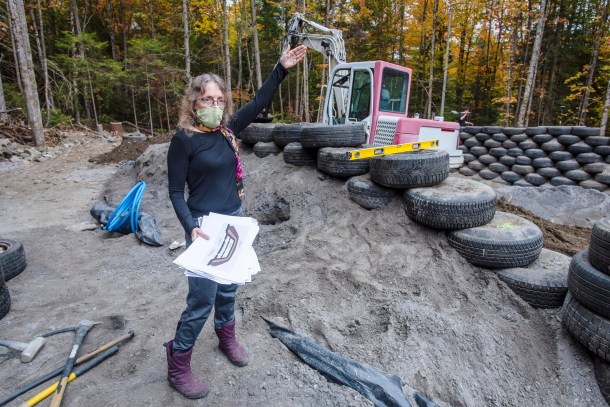
As they have for about the last month, workers on Friday packed trashed cardboard into the bottom of each tire, filled the space with dirt, then swung sledgehammers and shovels to compact the filling. The structure’s horseshoe-shaped rubber skeleton had reached nine tires high as of that afternoon.
Eventually, the layer of tires will be covered with thermal wrapping, Hatch said. Inside, between exterior windows and glass interior walls, will be a greenhouse. The combined setup will act to capture heat from sunlight so it can be released into the building when the sun is away — a concept called passive solar heating.
The design turns the house itself into “a battery, basically,” Hatch said, allowing the inside temperature to moderate over time.
“The thing about this for a house is, it doesn’t freeze,” Hatch said. “This house will have an average temperature of somewhere in the 60s.”
She believes the design will help her avoid the common trials of houses in New England winters: frozen pipes and exorbitant heating costs. She cited examples of earthships in Canada as evidence that the design could work in Vermont’s frigid climate, though she’ll need some supplemental, traditional heating at times.
She sold her old home to fund construction of the new building, which she said will cost about $40,000 to complete — well under the cost of a similarly sized traditional house.
James “Buzz” Surwilo, an environmental analyst with the state’s solid waste program, said earthship buildings could be one way to address tire recycling in Vermont, a longstanding problem.
“Tire recycling is just a challenge,” Surwilo said.
Vermont banned tires in landfills in 1992, and because there is no in-state processor, about 700,000 scrap tires each year are sent to Maine, New York and Massachusetts, he said.
Most scrap tires are chopped up and burned for fuel, he said, when they could be used in a more eco-friendly way.
“We’re supportive of the legitimate, beneficial use of scrap tires,” Surwilo said.
That includes projects like the earthship in Greensboro, which he signed off on. Through an agreement with the state, Hatch has been visiting tire shops and garages around the area and collecting old tires turned in by customers.
Surwilo said plenty of people pitch ideas to the state ideas about reusing tires, but those plans are pipe dreams. Workers end up having to clean up projects where tires are essentially trashed, rather than reused, he said.
Surwilo, who visited Hatch’s worksite Friday, said he’d seen one other earthship in Vermont, a project in Huntington.
“We’ll see,” he said. “Maybe it’ll be an upcoming trend.”
McBrier, head of the construction crew, has been working on earthships for about 10 years. “The idea that homeowners can do it themselves” appealed to him, he said, as did the community-minded spirit of the building style.
The builder said he had worked on earthship buildings in the Southwest, before he came to Vermont, and the Greensboro site is the first he’s tackled here.
But he said two other people have already booked projects with him for next year, in Johnson and in Richford.
For Hatch, the crew plans to seal up the building for the winter, then resume construction next spring.
McBrier hopes more building companies will take on earthship projects in the future.
“You’re using a product that would be burned or buried,” McBrier said during a break. “You’re giving value to a wasted object.”
